
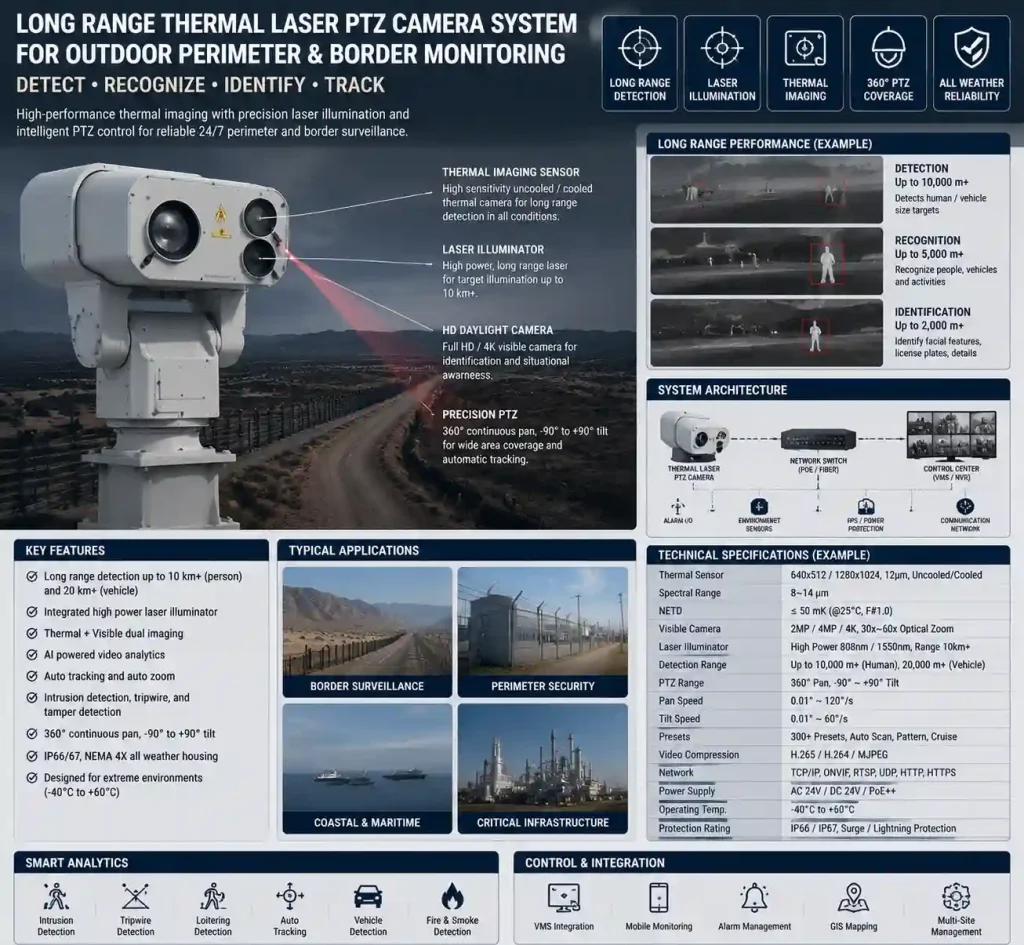
Selecting a long-range PTZ camera starts with the outdoor task. A police vehicle scanning a road corridor, a substation watching open equipment areas, and a forest lookout searching for heat patterns each need a different evidence record. For projects at 150 m or more, the camera specification should connect target distance, thermal search, visible verification, pan and tilt coverage, weather exposure, power, communications, and the control-centre workflow.
The phrase “manufacturer of long range thermal laser PTZ camera” also needs careful handling during procurement. Thermal imaging, visible zoom, and PTZ control can be verified from a model page. Laser wavelength, illumination distance, eye-safety class, beam control, and thermal-linkage functions require model-level confirmation.
What Should A Manufacturer of Long Range Thermal Laser PTZ Camera Provide?
A long-range PTZ camera should give an operator a repeatable view of distant outdoor targets and a clear action path when a target appears. The selection begins with the smallest target, the line of sight, and the decision the operator must make.
Define The Target, Distance, And Decision
Record target type, approximate size, 150 m-plus distance, terrain, mounting height, and slant distance. Define the required decision: detection, recognition, tracking, or visible verification. Lens focal length, atmosphere, target contrast, and acceptance testing determine usable detail.
Assign Thermal Search, Visible Verification, And Laser Roles
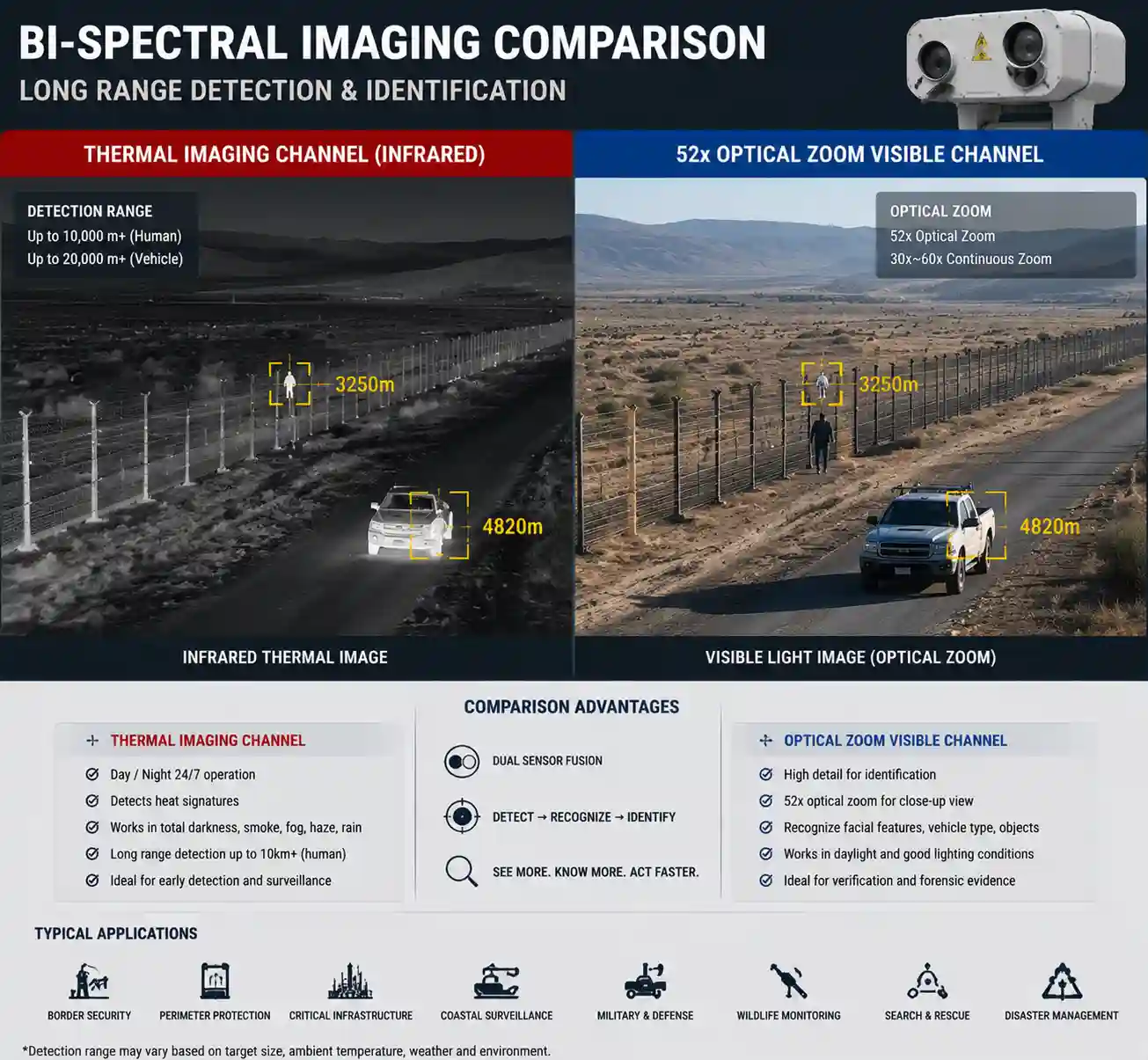
Thermal imaging forms an image from heat patterns and gives the operator a search channel in darkness and changing illumination. A visible channel adds scene detail for verification when light and atmosphere support it.
Laser functions belong in a separate requirements block. Ask the manufacturer to state wavelength, illumination distance, eye-safety class, stabilization, control interface, and PTZ linkage.
Which Imaging Configuration Fits The Site?
Use the project condition to choose the imaging role, then request test evidence that matches the target and distance.
| Project condition | Preferred channel or feature | Evidence to request |
|---|---|---|
| Dark open terrain at 150 m or more | Thermal channel with a lens matched to target size | Detector format, response band, lens range, test target and atmosphere |
| Daylight verification along a road or power route | Visible channel with optical zoom | Sensor format, focal length, optical zoom, field of view and sample footage |
| Mobile observation from a police vehicle | PTZ presets, tracking paths, vehicle power and vibration provisions | Mounting details, DC input range, shock provisions and control test |
| Project specification includes laser illumination | Optional laser module defined separately | Wavelength, safety class, range, beam control and integration documents |
Thermal Channel For Darkness, Smoke, And Heat Contrast
Thermal selection depends on detector resolution, pixel size, response band, lens focal length, target size, background, and atmosphere. Fog, rain, smoke, humidity, terrain and line of sight affect the detector image. A DRI value should come from a model-specific test with stated conditions. The thermal camera DRI range guide supports planning; the project still needs a matching test record.
Visible Channel For Scene Detail And Verification
Visible-light performance comes from the sensor, focal length, optical zoom, digital zoom, field of view, and available light. Optical zoom changes the lens view; digital zoom enlarges recorded pixels. For a road corridor or substation perimeter, request sample footage at the intended distance and mounting height and compare it with the acceptance target.
The WL-TX30-HD-RCX has a 1/2.8-inch CMOS sensor, 1920 x 1080 output, a 6.1-317 mm visible lens, 52x optical zoom, and 16x digital zoom.
Laser Requirements That Need Confirmation
Add wavelength, eye-safety documentation, illumination distance, beam control, stabilization, trigger logic, and maintenance access to the quotation request. Keep these fields separate from the thermal detector and visible lens.
How Do PTZ Mechanics Affect Long-Range Coverage?
Pan, Tilt, Presets, And Tracking Paths
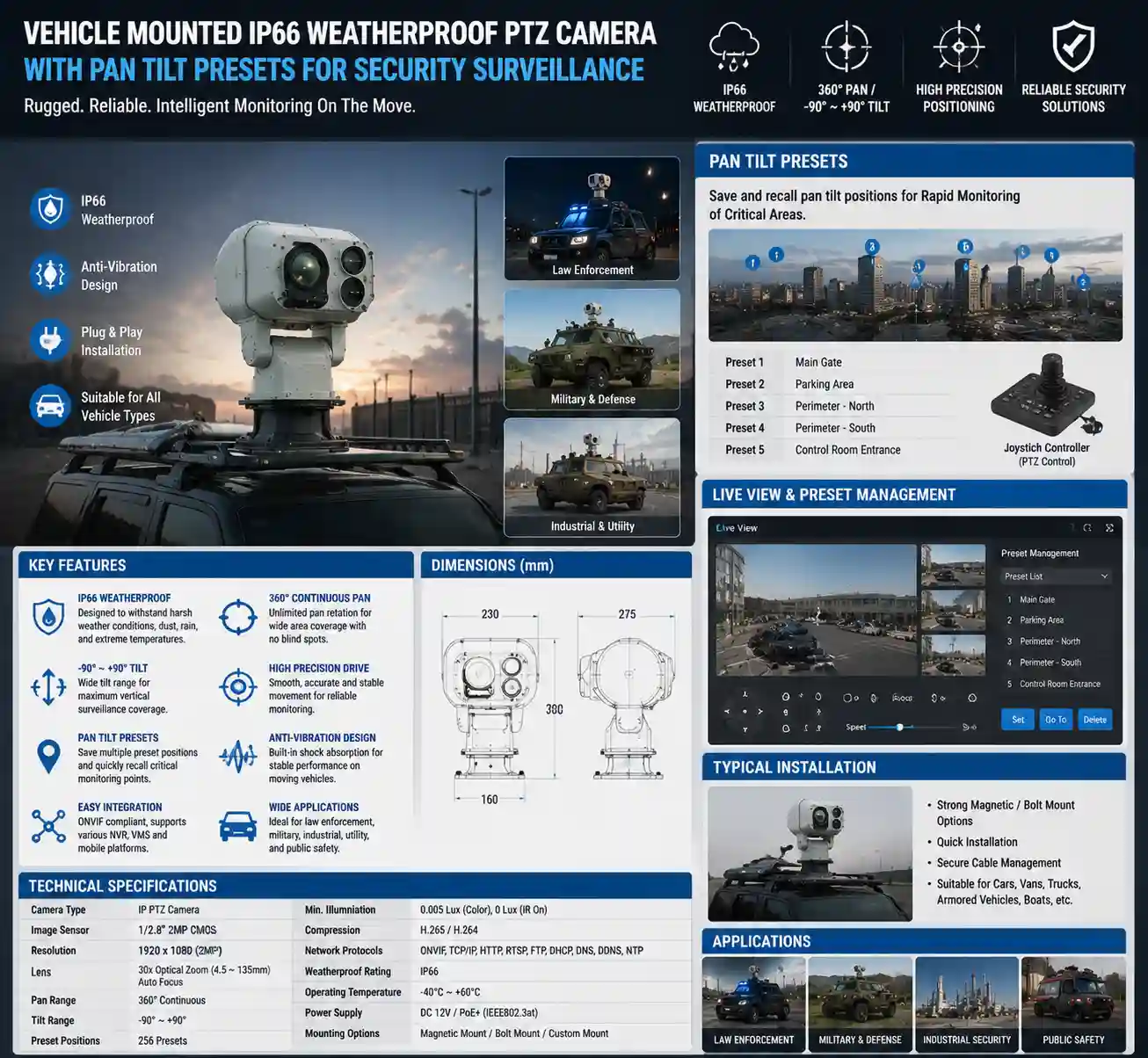
Pan and tilt move between sectors. Presets set repeatable views, tracking paths define recurring scans, and absolute positioning calls a known view. Confirm angular limits, speed, preset count, tracking paths, and control protocol in model documentation.
The WL-TX30-HD-RCX provides 360-degree endless pan, +90 to -90 degree tilt, 256 presets, and eight tracking paths. These control features do not establish target identification at a stated distance.
Mounting On Police Vehicles, Roads, And High Points
Vehicle mounting adds vibration, shock, changing power conditions, and moving network coverage. Fixed points add wind, rain, heat, cold, and service-access questions. Document the mounting surface, cable route, connector protection, and communications handover before selecting the housing or accessories.
The verified model supports wide-range DC12V vehicle input and optional vehicle shock absorbers. Request mounting drawings and power limits for the platform.
Which Outdoor Specifications Should You Verify?
Outdoor specifications describe operating conditions and project interfaces.
| Specification | Why it matters at 150 m-plus | Model-level confirmation |
|---|---|---|
| Enclosure and temperature | Exposed sites face rain, dust, heat and cold | IP rating, operating temperature and environmental test scope |
| Window and maintenance | Condensation, frost and water film affect the optical path | Heated glass, wiper, defrosting, defogging and service procedure |
| Video and control | Control rooms need compatible streams and commands | H.265/H.264/MJPEG, ONVIF profiles, RS485 and control software |
| Power and mounting | Remote points and vehicles have different supply conditions | Input range, connector, mounting load and accessory requirements |
Enclosure, Temperature, Wiper, And Defogging
The WL-TX30-HD-RCX is specified with IP66 protection, an operating range of -35 to +55 degrees C, a wiper, heated glass, defrosting, and defogging. These features address enclosure and window conditions. Site review covers wind, salt, dust, lightning protection, drainage, and service access.
Video, Network, Control, And Storage
The example model supports H.265, H.264, and MJPEG, plus ONVIF Profiles S/G and RS485. The system designer still needs bandwidth, retention, delay, permissions, and control-centre calculations from the actual stream settings and topology. Request a protocol test before acceptance.
How Do You Match The Camera To An Outdoor Application?
Power Facilities, Substations, And Oilfields
Map equipment zones, access routes, and the longest sightline. Specify mounting height, target distance, weather, power, network path, and alarm handoff. Tie any temperature threshold to an approved model and test method.
Roads, Police Vehicles, Borders, Forests, And Remote Areas
Road and border projects need sector coverage, presets, tracking rules, and communications planning. Police vehicles add vibration and DC power constraints. Forest lookout points need a clear view and response chain. The thermal PTZ camera for forest-fire prevention page supports planning; confirm alarm, temperature, and distance claims against the selected model.
What Is A Practical PTZ Camera Selection Workflow?
Use this sequence for a quotation or technical review:
1. Define the smallest target and the operator decision. 2. Survey the 150 m-plus line of sight, terrain, mounting height, and weather exposure. 3. Assign thermal, visible, and laser requirements. 4. Match lenses, field of view, PTZ coverage, presets, and tracking paths to the sectors. 5. Confirm power, communications, control, storage, and maintenance access. 6. Request model specifications, sample footage, test conditions, and site acceptance.
Conclusion: Request A Configuration That Matches The Site
The right PTZ camera is the model whose sensor, lens, movement, enclosure, interfaces, and power match the outdoor task at 150 m or more. A supplier review needs target, distance, terrain, mounting, movement, power, communications, laser, integration, and acceptance details.
Shuoxin’s WL-TX30-HD-RCX combines a 640 x 512 uncooled vanadium oxide thermal detector, 30-150 mm thermal lens, 1080p visible channel with 52x optical zoom, 360-degree pan, 256 presets, eight tracking paths, IP66 protection, and vehicle DC12V input. Review the bi-spectral long-range thermal imaging PTZ camera data. Send site and acceptance details through the long-range PTZ project requirements contact path for model and laser-module confirmation.
FAQ
Q1: What is the most important specification for a long-range PTZ camera?
A: The most important specification is the combination of target size, distance, lens, detector, and operator decision. A project at 150 m or more should define acceptance testing before selecting zoom or resolution.
Q2: Does every thermal PTZ camera include a laser illuminator?
A: Every model does not include the same laser function. Ask the manufacturer to confirm whether a laser module is present and to provide its wavelength, eye-safety class, illumination distance, beam control, and integration documents.
Q3: How far should a PTZ camera monitor for an outdoor project?
A: This article uses 150 m or more as the project boundary. Usable detail depends on target size, lens, detector, line of sight, weather, terrain, and test conditions, so a single distance number cannot establish performance for every site.
Q4: When should you choose a bi-spectral thermal and visible PTZ camera?
A: Choose a bi-spectral configuration when the operator needs thermal search and visible-light verification in one PTZ workflow. The WL-TX30-HD-RCX example provides a 640 x 512 thermal channel and 1920 x 1080 visible channel with 52x optical zoom; confirm model and test footage for the site.
Q5: Which details should you send to a manufacturer before requesting a quote?
A: Send target type and size, distance, terrain, mounting position, vehicle platform, power, communications, protocols, storage, environmental conditions, laser requirements, quantity, and acceptance criteria. These details let the manufacturer return a project-linked model configuration and quotation basis.