
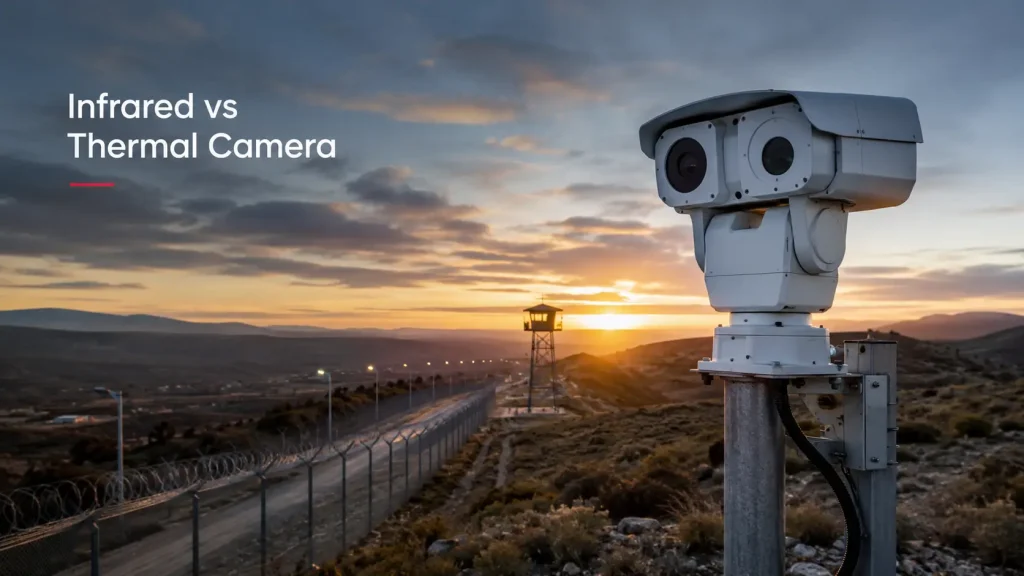
For outdoor monitoring at 150 m or more, an infrared camera and a thermal camera start from different signals. An infrared camera projects near-infrared illumination and records reflected light with a CMOS sensor. A thermal camera maps heat radiation into an image. A thermal PTZ camera adds pan, tilt, optical zoom, presets, and tracking.
Start with the task. A road patrol, substation, border sector, or forest lookout may need thermal search, visible-light verification, or both channels. Target size, lens, weather, mounting, power, and communications set the specification.
Infrared Camera And Thermal Camera: How Do They Form Images?
Both technologies sit in the infrared family. Each builds the image from a different energy path, so image detail and illumination planning change.
How An Infrared Camera Uses Active Near-IR Illumination
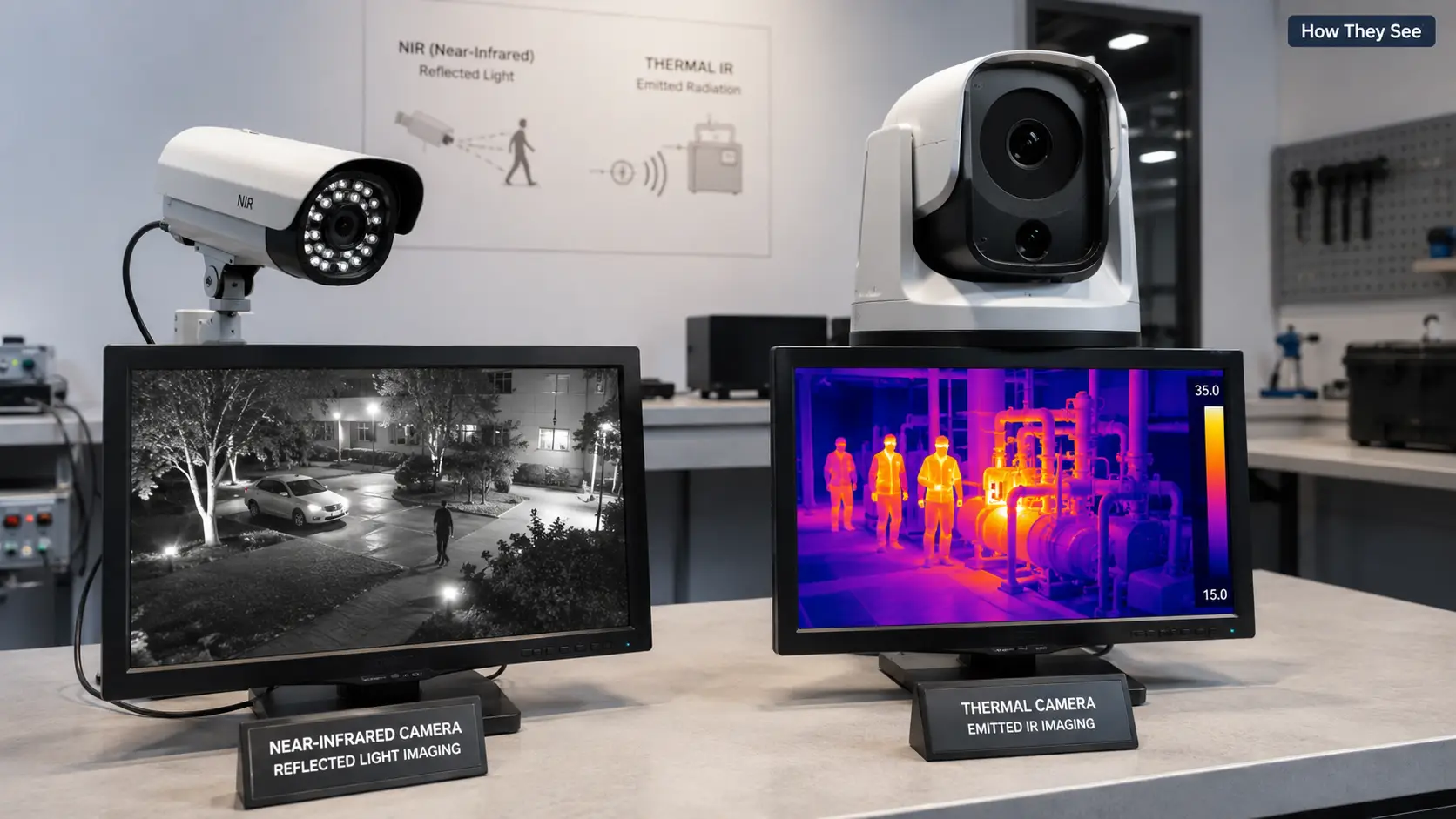
In security systems, an infrared camera uses an IR illuminator to send near-infrared light toward a target. The target reflects that light into the lens, and a CMOS or CCD sensor converts the signal into video. At night, that footage often appears in monochrome because the sensor records reflected illumination.
An IR-CUT assembly manages the day/night transition. In daylight, the cut filter blocks infrared energy so the visible channel can reproduce colour. In low light, the filter moves away and the sensor receives more near-IR energy. Useful coverage depends on illuminator output, beam coverage, target reflectivity, lens angle, atmosphere, and line of sight.
How A Thermal Camera Senses Heat Patterns
A thermal camera receives infrared radiation emitted by objects above absolute zero. Its detector measures energy differences and converts them into a heat-pattern image. The process is passive, so the camera forms an image in darkness with no active light beam.
Thermal contrast comes from the target and background. A vehicle engine, person, or hot spot may stand out against cooler ground. Sun-heated ground, rain, humidity, fog, target size, lens, and viewing angle can change the image. Thermal video supports search; visible video adds context.
What Is The Difference Between Infrared And Thermal Imaging?
| Selection question | Infrared camera | Thermal camera |
| Energy path | Active near-IR illumination reflected from the target | Passive heat radiation emitted by the target and background |
| Main image information | Surface texture, edges, and visible-scene detail under the illuminator | Heat contrast and temperature-pattern differences |
| Complete darkness | Requires usable illuminator coverage and line of sight | Forms an image without visible light or an active illuminator |
| Long-range planning | Beam reach, optical zoom, reflectivity, and glare control | Detector resolution, thermal lens, target size, contrast, and atmosphere |
| Typical PTZ role | Visible or near-IR detail and verification | Search, cueing, and tracking of heat-contrast targets |
Image Detail And Identification
Near-IR video records reflected scene structure such as road markings and equipment outlines when the illuminator and lens deliver enough pixels. Thermal video shows heat distribution and can guide an operator toward a person, vehicle, or warm area.
Detection asks whether an object is present. Recognition classifies a target type. Identification requires a more specific visual judgment. For a 150 m-plus project, define the smallest target and decision at the farthest slant distance, then request matching footage or a thermal camera DRI range review.
Range, Line Of Sight, And Weather
Here, 150 m defines the project boundary. Useful range depends on target size, focal length, detector resolution, heat contrast, atmosphere, terrain, mounting, and DRI level. A long thermal lens places more pixels on a distant target while narrowing the field of vie
Light fog or smoke may reduce visible detail while leaving some thermal contrast. Dense fog, heavy rain, and high humidity weaken transmission. A useful site test uses the smallest target and the weather the operator expects.
When Should You Use A Thermal PTZ Camera For Outdoor Monitoring?
Power Facilities, Substations, And Oilfields
Power assets and oilfield routes combine open terrain, long sightlines, and changing illumination. Thermal sensing can search a sector while visible zoom inspects structures and vehicle movement. Put the basics into the project file: camera position, target distance, communications path, power, and control workflow.
Roads, Police Vehicles, Borders, And Remote Areas
Road and border monitoring requires repeatable coverage of long routes. PTZ presets return to defined sectors, while tracking paths and remote pan/tilt control support alarm response. Vehicle installations bring vibration, DC power, and communications checks into the review.
Forest-Fire Prevention And Early Warning
A thermal PTZ camera for forest-fire prevention uses thermal contrast to scan outdoor areas in darkness. A warm patch can prompt visible inspection. Smoke, terrain, humidity, and background temperature affect the image. Temperature range, alarm threshold, and accuracy require the selected model’s official specification and test method.
Which Specifications Should You Compare Before Choosing?
Thermal And Visible Channels
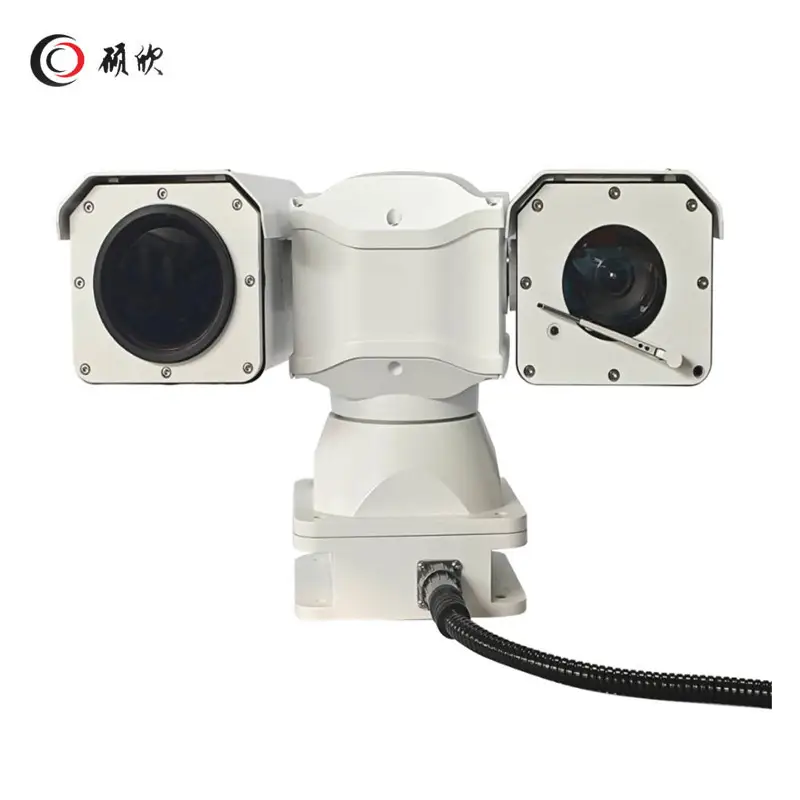
For configuration, Shuoxin’s bi-spectral long-range thermal imaging PTZ camera provides a model reference. WL-TX30-HD-RCX uses a 640 x 512 uncooled vanadium oxide detector with an 8-14 um response band, 12 um pixel size, and a 30-150 mm thermal lens. Its visible channel uses a 1/2.8-inch progressive-scan CMOS sensor with 1920 x 1080 effective pixels, a 6.1-317 mm focal length, 52x optical zoom, and 16x digital zoom.
Those figures belong to that model. Ask the supplier to map both lenses, target dimensions, and required decision to the site plan.
PTZ, Control, Network, And Storage
WL-TX30-HD-RCX supports 360-degree endless pan, +90 to -90 degree tilt, 256 preset positions, eight tracking paths, and absolute positioning. It supports RS485 control, ONVIF Profiles S and G, and H.265, H.264, and MJPEG video compression. Match these interfaces with the control centre, recorder, bandwidth, storage, alarm inputs, and cybersecurity review.
Enclosure, Power, And Site Conditions
The official model page lists IP66 protection, an operating temperature range of -35 to +55 degrees C, a wiper, heated glass, and defrosting and defogging functions. It also lists wide-range vehicle DC12V input and optional vehicle shock absorbers. Confirm mounting, vibration, power, network coverage, and installation requirements.
How Do You Select The Right Camera For A 150 m-Plus Project?
- Define the smallest target and the decision: detection, recognition, or identification. 2. Map the sightline, terrain, mounting point, maximum slant distance, and sectors that require PTZ coverage. 3. Assign thermal sensing and visible-light verification roles for each operating condition. 4. Match detector resolution, thermal focal length, visible optical zoom, field of view, presets, and tracking to the task. 5. Confirm enclosure, temperature, wiper, defogging, power, communications, control protocols, bandwidth, and storage. 6. Request model-level specifications, original test footage, and a site trial that represents the target, weather, and acceptance criteria.
Conclusion: Match The Sensor To The Outdoor Task
An infrared camera records reflected near-IR light and supplies scene detail when illumination reaches the target. A thermal camera senses heat contrast and supports passive search in darkness. A thermal PTZ camera adds pan, tilt, zoom, presets, tracking, and remote integration. The decision depends on the target, distance, line of sight, weather, and required action.
Shuoxin’s WL-TX30-HD-RCX example combines a 640 x 512 thermal channel, a 1920 x 1080 visible channel, long focal-length options, 360-degree pan, IP66 protection, and vehicle power and shock-absorption options. For a configuration review, submit the site layout, target type and size, distance, mounting and vibration conditions, power and communications availability, control-system interfaces, and acceptance test goals through the long-range PTZ project requirements channel.
FAQ
Q1: Is a thermal camera an infrared camera?
A: A thermal camera is an infrared-sensing device that forms images from emitted heat radiation. In security usage, infrared camera often describes a near-IR camera using active illumination and a CMOS or CCD sensor. The terms describe different imaging methods.
Q2: Which is better for long-range outdoor monitoring, an infrared camera or a thermal camera?
A: Thermal sensing suits passive search in darkness and heat-contrast scenes. Near-IR imaging suits reflected detail when an illuminator covers the target. At 150 m or more, define the target, weather, sightline, and DRI level before selecting a channel.
Q3: Does a thermal PTZ camera need an infrared illuminator?
A: Thermal imaging forms an image from heat radiation and operates without an active light source. A bi-spectral unit may include a visible camera whose night operation uses its own low-light or near-IR design. Confirm the exact channel configuration on the official model specification.
Q4: How far can an infrared or thermal camera monitor at 150 m or more?
A: Both technologies can be planned for outdoor observation at 150 m or more when the lens, target, line of sight, atmosphere, mounting, and system design support the task. A useful range statement requires a target, DRI level, lens, weather condition, and test method. Ask for those conditions with the model proposal.
Q5: Can one bi-spectral thermal PTZ camera provide thermal detection and visible-light verification?
A: A bi-spectral PTZ design can place thermal and visible channels on one remotely controlled platform. WL-TX30-HD-RCX lists a thermal detector, a 1920 x 1080 visible channel, presets, tracking paths, and ONVIF/RS485 integration. Confirm recording, control, and acceptance requirements for the configuration.