
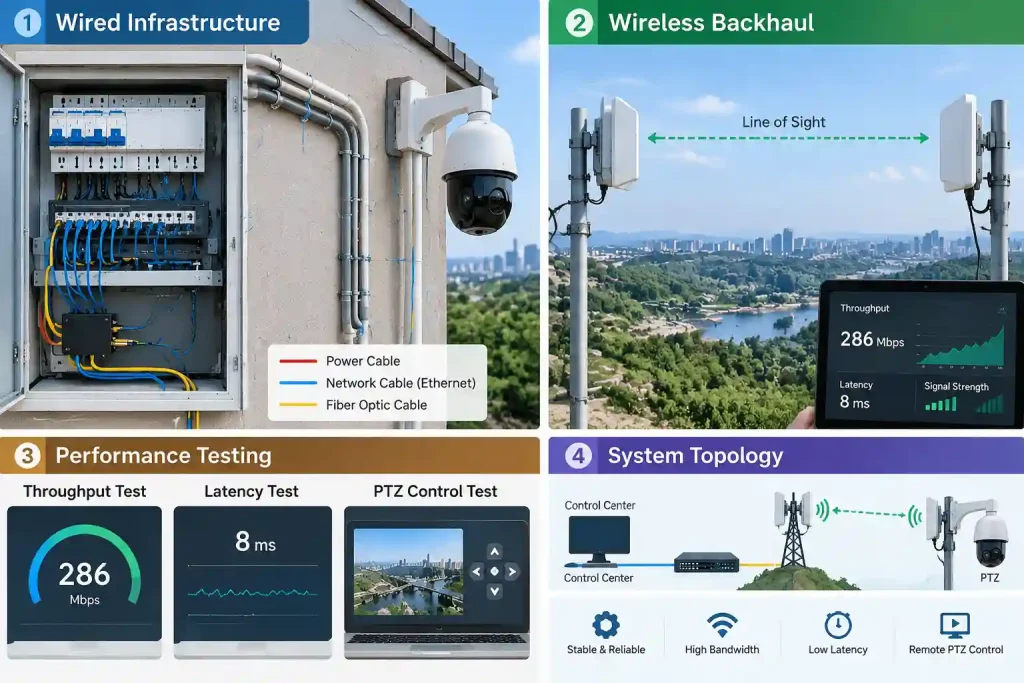
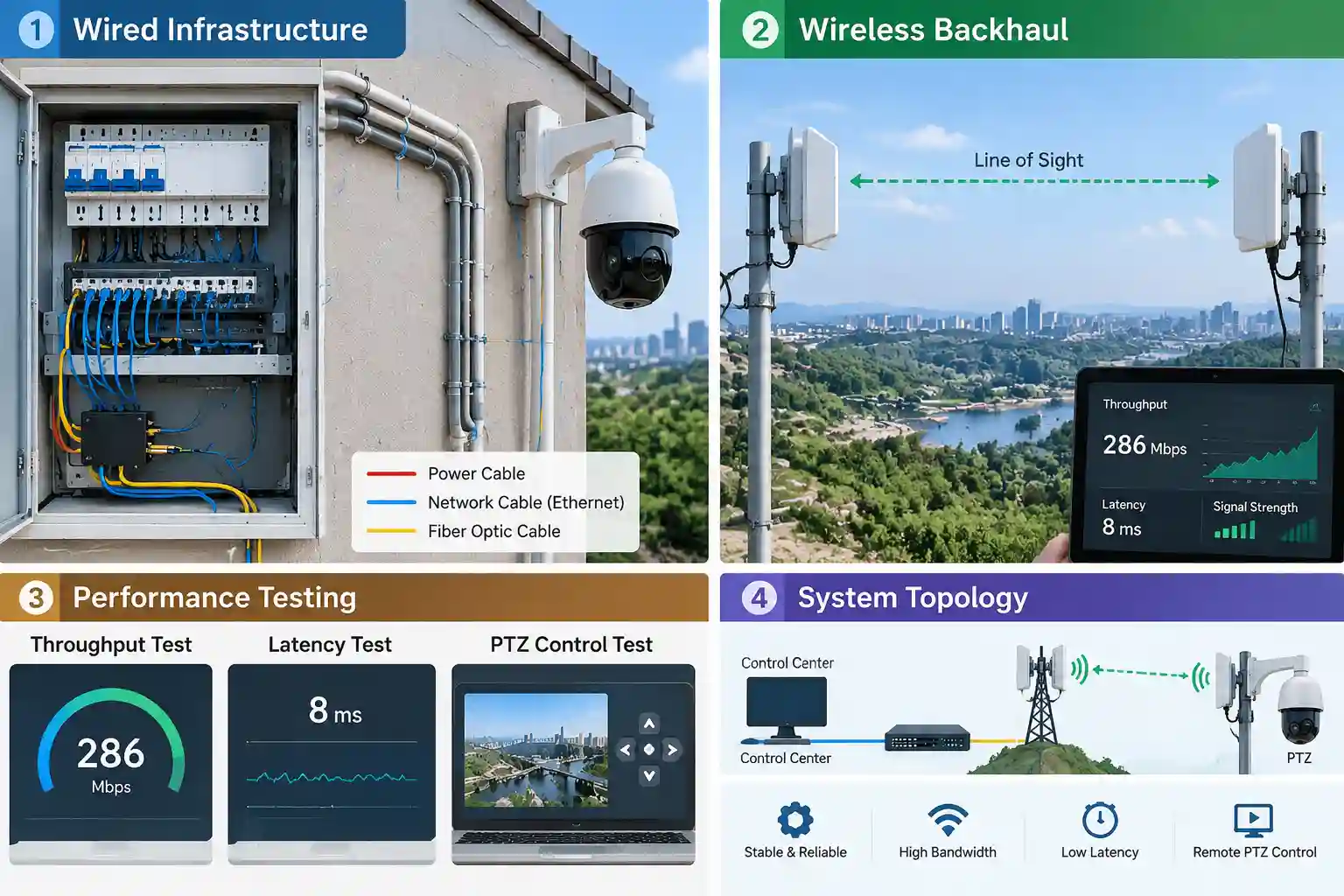
A wired vs wireless long-range PTZ camera decision starts with the site. A fixed observation point with an accessible cable route can use a wired backhaul. A remote or mobile point can use a wireless backhaul when measured coverage supports video, control, and recording requirements. For camera security at 150 m or more, the selected connection must carry the required stream and PTZ commands under the site’s operating conditions.
Record the mounting position, communication path, power, operator task, and acceptance test before comparing equipment.
What Do Wired and Wireless Mean for a Long-Range PTZ Camera?
The terms describe how video and control data travel between the camera and the monitoring platform. Power remains a separate design item for both architectures.
Wired PTZ Camera Architecture
A wired architecture uses a documented physical data path, which may include network cable, fiber, transmission equipment, protected terminations, and a recorder or video platform. The route needs a drawing, protection plan, electrical review, and service points.
Wireless PTZ Camera Architecture
A wireless architecture sends data through a radio or cellular backhaul. The design needs measured coverage, antenna placement, terrain checks, capacity, authentication, encryption, reconnect behavior, and local power.
| Decision factor | Wired project condition | Wireless project condition |
| Physical route | Cable path and protected terminations are documented | Antenna position and coverage path are documented |
| Network evidence | Link capacity is tested through the installed path | Signal, throughput, latency, and packet behavior are measured onsite |
| Power | Camera and transmission equipment have defined supplies | Camera, radio, and any local recorder have defined supplies |
| Maintenance | Service points and cable access are recorded | Antenna, subscriber equipment, and service status are accessible |
When Does a Wired vs Wireless Long-Range PTZ Camera Decision Favor Cabling?
A wired PTZ camera fits a fixed site with available infrastructure and a maintainable cable route. Power facilities, substations, oilfields, and permanent road observation points may have suitable network paths. The site survey must confirm that route.
Cable Route, Power, and Site Access
Map the route from the mounting point to the network handoff. Record poles, conduits, cabinets, exposed sections, terminations, power, and service access. Project documents should identify each powered device and its environmental protection.
Ask for the complete route drawing before approving the architecture.
Bandwidth, Latency, and Recording
Calculate capacity from the streams, codecs, frame settings, recording schedule, and retention plan. Test live movement, presets, focus, zoom, and playback because PTZ commands share the link. Shuoxin’s reference model lists H.265, H.264, and MJPEG; confirm the codec with the recorder and platform.
When Can a Wireless PTZ Camera Fit a Remote Outdoor Site?
A wireless PTZ camera can fit a site with a measurable radio or cellular path and local power. Relevant settings include border sectors, forest observation points, temporary road monitoring, and mobile public-safety units. Each site needs a survey.
Backhaul Coverage and Line of Sight
Measure coverage at the planned camera height and antenna position. Record upload throughput, latency, packet behavior, and connection stability with the site’s terrain, vegetation, structures, weather, and movement. Installed-site measurements support acceptance.
For radio links, document both endpoints and mounting hardware. For cellular links, document the service technology, signal evidence, data responsibility, and coverage. Define the recording process for a connection interruption.
Power, Security, and Fallback Behavior
List power needs for the camera, transmission device, window functions, and local recorder. Define authentication, credentials, encryption, link monitoring, reconnect behavior, and access ownership in the commissioning record.
Set an operational rule for link alarms, local recording, and transfer after reconnection. Test that sequence before approval.
How Does Connectivity Affect PTZ Control and Video Quality?
Video and PTZ commands share the data path. Run the required streams while an operator pans, tilts, zooms, recalls presets, and reviews recorded video.
Pan, Tilt, Zoom, Presets, and Tracking Paths
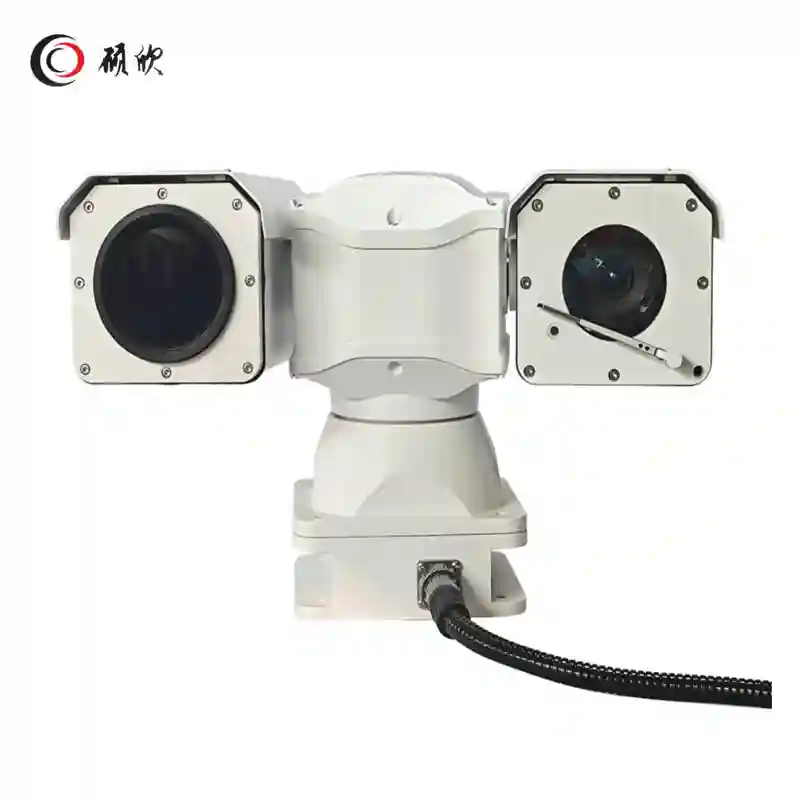
The Shuoxin WL-TX30-HD-RCX lists 360-degree endless pan, a +90 to -90 degree tilt range, 256 presets, and eight tracking paths. Map these functions to recurring road directions, substation sectors, border areas, or forest observation points. Then test the functions across the planned wired or wireless link. The bi-spectral long-range thermal imaging PTZ camera page provides the verified reference configuration.
Thermal Search and Visible Verification
The model combines a 640 x 512 uncooled vanadium oxide thermal detector and a 1920 x 1080 visible channel. Its thermal lens is 30-150 mm, while the visible channel lists a 6.1-317 mm lens and 52x optical zoom. Dual-channel operation gives the network designer multiple streams to include in the capacity and recording plan. The thermal camera DRI range guide explains detection, recognition, and identification terms for project acceptance discussions.
Which Outdoor Conditions Should You Compare?
Review the connection, enclosure, optical window, power, mounting hardware, and maintenance plan as one field installation.
Weather, Enclosure, and Optical Window
The WL-TX30-HD-RCX lists IP66 protection and an operating range of -35 to +55 degrees C. It also lists a wiper, heated glass, and defrosting/defogging. Compare these model-specific figures with the local temperature, precipitation, dust, and optical-window maintenance requirements. Include representative environmental conditions in the site test.
Vehicle Power and Remote Communications
For vehicle configurations, the model lists wide-range DC12V input and optional vehicle shock absorbers. A police-vehicle project also needs a route-based communication assessment because the backhaul conditions change as the vehicle moves. Test the video stream, PTZ controls, reconnect behavior, and recording process across the intended operating area.
How Does the Choice Change by Outdoor Application?
Power Facilities, Substations, and Oilfields
Permanent sites can compare existing fiber or network infrastructure with a surveyed wireless backhaul. Record cable access, equipment cabinets, power, control-room interfaces, and observation sectors. The selected path should carry the required visible and thermal streams during the acceptance test.
Roads, Police Vehicles, Borders, and Remote Areas
Roadside and border projects need route or sector coverage, terrain evidence, mounting access, and a maintenance plan. Police vehicles add vibration, mobile power, and changing network conditions. A hybrid design may use a local wired connection between the camera and vehicle equipment, then a wireless backhaul to the control platform. The project documents should describe each segment separately.
Forest-Fire Prevention
Forest observation points may sit on high or remote terrain. Survey the backhaul, power, weather, sector coverage, and maintenance access together. The guide to thermal PTZ cameras for forest-fire prevention provides application context.
Use This Wired vs. Wireless PTZ Camera Selection Checklist
- Define the 150 m-plus target, observation sector, and operator decision.
- Map the mounting position, sightline, terrain, weather, and service access.
- Document the cable route or collect wireless coverage measurements.
- Confirm power, video streams, codecs, latency, PTZ control, and recording.
- Set authentication, encryption, link monitoring, reconnect, and fallback requirements.
- Run the required views and PTZ functions through the installed connection.
Conclusion: Match the Connection to the Outdoor PTZ Camera Task
A wired connection suits a fixed site with a documented physical path. A wireless connection suits a remote or mobile site whose measured backhaul and local power support the required workflow. Hybrid architectures can assign wired and wireless links to different system segments. Site evidence determines the final choice.
Changzhou Shuoxin Electronic Technology Co., Ltd. supplies the WL-TX30-HD-RCX reference configuration with documented thermal and visible channels, PTZ presets, outdoor hardware, vehicle options, codecs, ONVIF Profiles S/G, and RS485. The official specification does not state a built-in wireless network type, so the project team must confirm compatible transmission equipment. Use the contact page to submit outdoor PTZ camera requirements including the target, mounting plan, power source, cable route or coverage survey, platform, streams, and acceptance tasks.
FAQ
Q1: Are wired or wireless cameras better for long-range outdoor PTZ monitoring?
A: Wired connections fit sites with a protected physical route, while wireless connections fit sites with measured radio or cellular coverage and local power. Compare both against the same video, PTZ control, recording, and acceptance requirements.
Q2: Does a wireless PTZ camera need a separate backhaul connection?
A: A wireless PTZ design needs a defined radio or cellular backhaul between the field equipment and the monitoring network. It also needs power for the camera and communication equipment. Document both paths separately.
Q3: How do latency and packet loss affect PTZ control?
A: The installed link carries both video and PTZ commands. Test live movement, zoom, focus, presets, and recorded playback while the required streams are active, then record whether operator tasks meet the acceptance criteria.
Q4: What wired and wireless details should an outdoor camera security project specify?
A: Specify the target, distance, mounting point, cable route or coverage measurements, power, streams, codecs, platform, recording, access controls, reconnect behavior, and acceptance tasks. Include terrain, weather, and maintenance access for every outdoor point.
Q5: Can the Shuoxin WL-TX30-HD-RCX use any wireless network?
A: The verified specification lists ONVIF Profiles S/G, RS485, and H.265/H.264/MJPEG. It does not identify a built-in wireless technology. Confirm the proposed transmission equipment, interfaces, bandwidth, power, and platform compatibility with Shuoxin and the system integrator.