
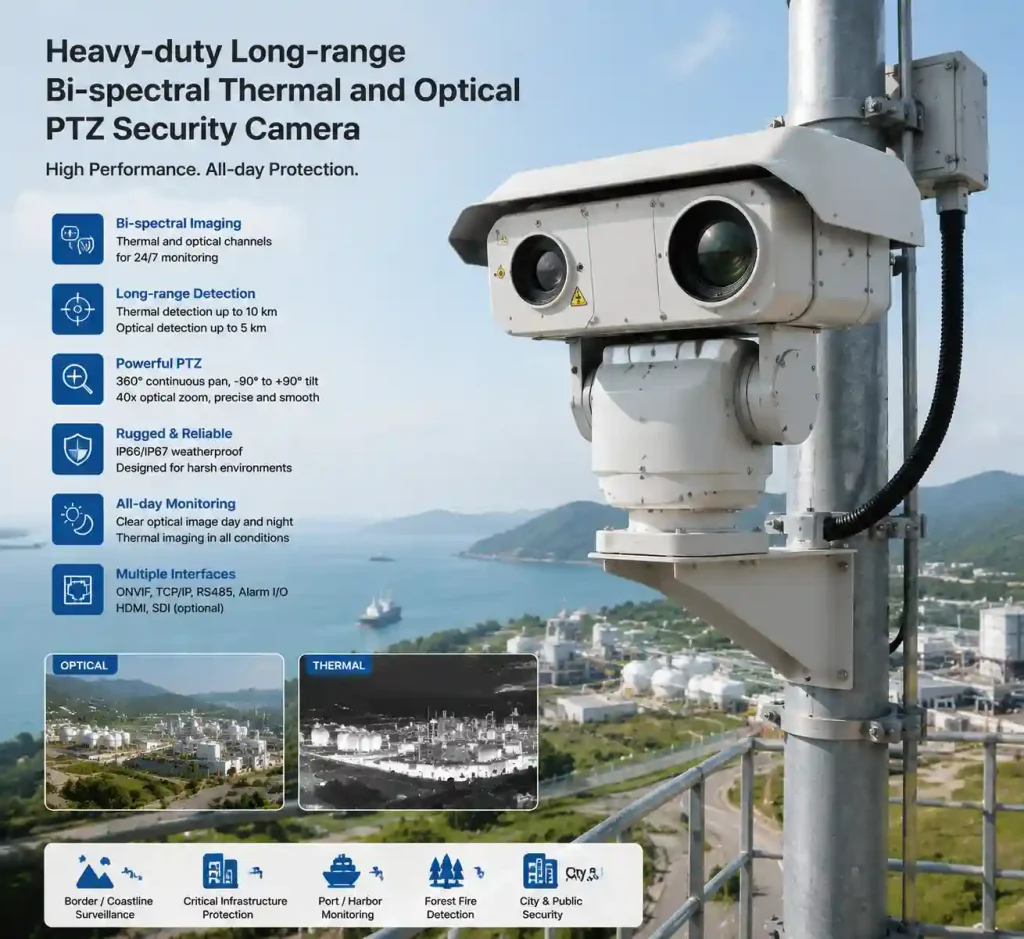
For a small organization operating a remote outdoor asset, a security-system budget is a project total that includes the PTZ camera and its supporting systems. A PTZ camera installation at 150 m or more can include thermal or visible imaging, long focal-length optics, a mount, weather protection, power conversion, communications, recording, commissioning, and maintenance access.
The right spend follows the target and acceptance test. This guide shows which line items to define before requesting a quotation.
What Does A PTZ Camera Security Budget Include?
A practical budget separates one-time equipment and commissioning from recurring operating inputs. That structure lets you compare supplier offers with the same scope.
Camera, Thermal, Visible, And Optical Zoom Costs
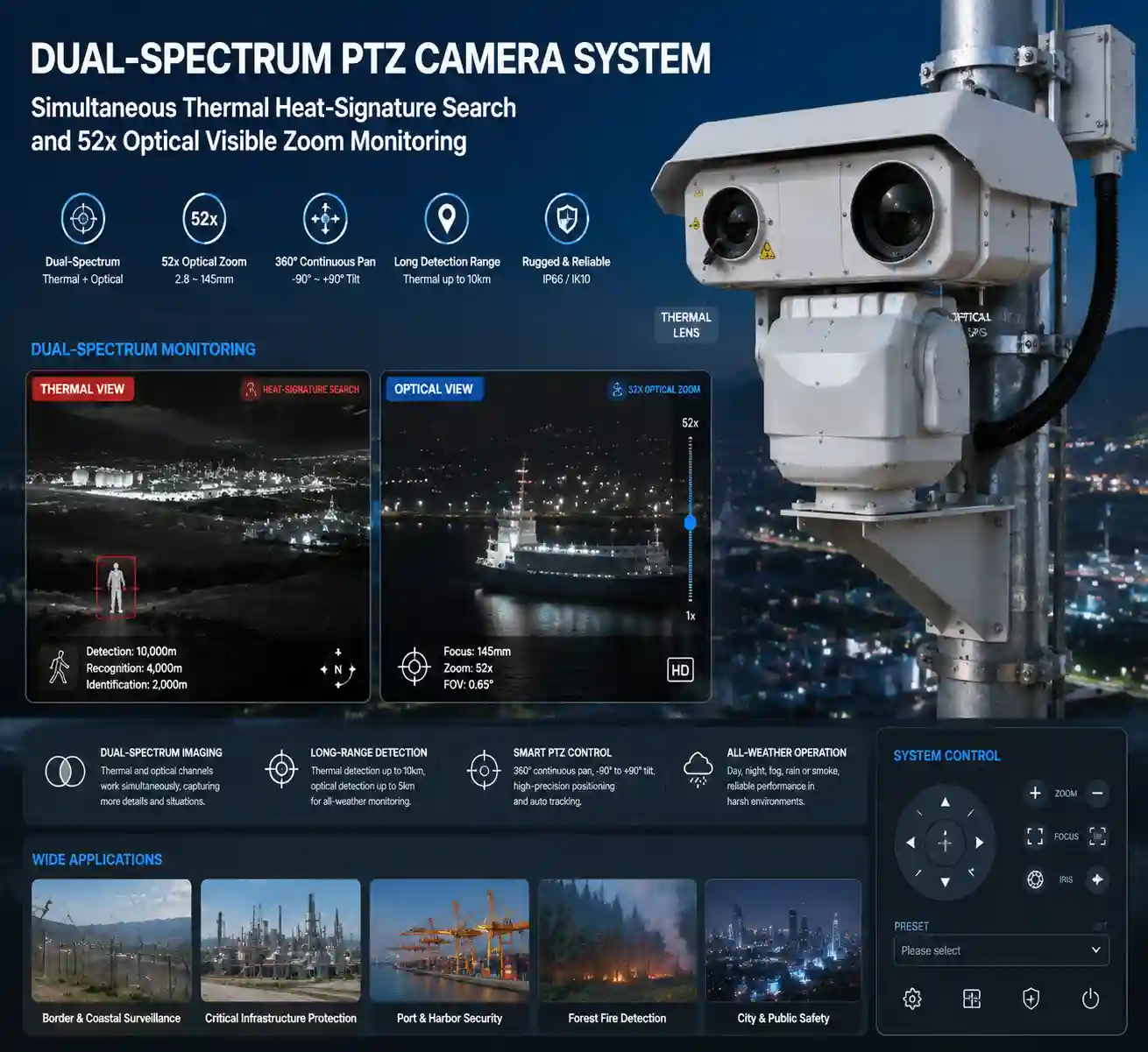
The camera line depends on the task. A visible-light PTZ may suit a well-lit road view. A thermal PTZ can support heat-pattern search in darkness and changing illumination. A bi-spectral model combines thermal search with visible verification and adds two imaging channels with their control requirements.
The verified Shuoxin WL-TX30-HD-RCX example uses a 640 x 512 uncooled vanadium oxide thermal detector, an 8-14 um response band, a 12 um pixel size, and a 30-150 mm thermal lens. Its visible channel uses a 1/2.8-inch CMOS sensor, 1920 x 1080 output, a 6.1-317 mm lens, 52x optical zoom, and 16x digital zoom. The official page provides no universal price list.
Ask the supplier to separate the camera, channels, lens configuration, optional laser module, and accessories. Confirm laser wavelength, illumination distance, eye-safety class, and control linkage at model level.
Mounting, Housing, Power, And Communications
Mounting costs follow the observation point. A vehicle platform may need a reinforced mount, shock provisions, cable protection, and a wide-range DC supply. A high point at a substation, border sector, or forest lookout may need a structural review, weather routing, grounding, and service access.
The WL-TX30-HD-RCX is specified with IP66 protection, a -35 to +55 degrees C operating range, heated glass, a wiper, defrosting, and defogging. It also supports wide-range DC12V vehicle input and optional vehicle shock absorbers. Request each mount, power component, cable run, network link, and installation activity as a separate quotation line.
Communications may include Ethernet, fiber, radio, or cellular backhaul. Provide the control-point distance, available network, bandwidth plan, and maintenance route.
Recording, Control, Commissioning, And Maintenance
Recording costs depend on streams, codec, retention, resolution, frame rate, and storage location. The example model supports H.265, H.264, MJPEG, ONVIF Profiles S/G, and RS485. Confirm the video-management system, PTZ commands, permissions, time synchronization, and export format before purchasing storage.
Commissioning should cover alignment, preset programming, tracking paths, control-room testing, sample footage, and acceptance documentation. Maintenance planning should record access equipment, cleaning, window care, firmware handling, spares, and remote-site travel.
How Does Distance Change The PTZ Camera Budget?
Why 150 m-Plus Projects Need A Site-Based Quote
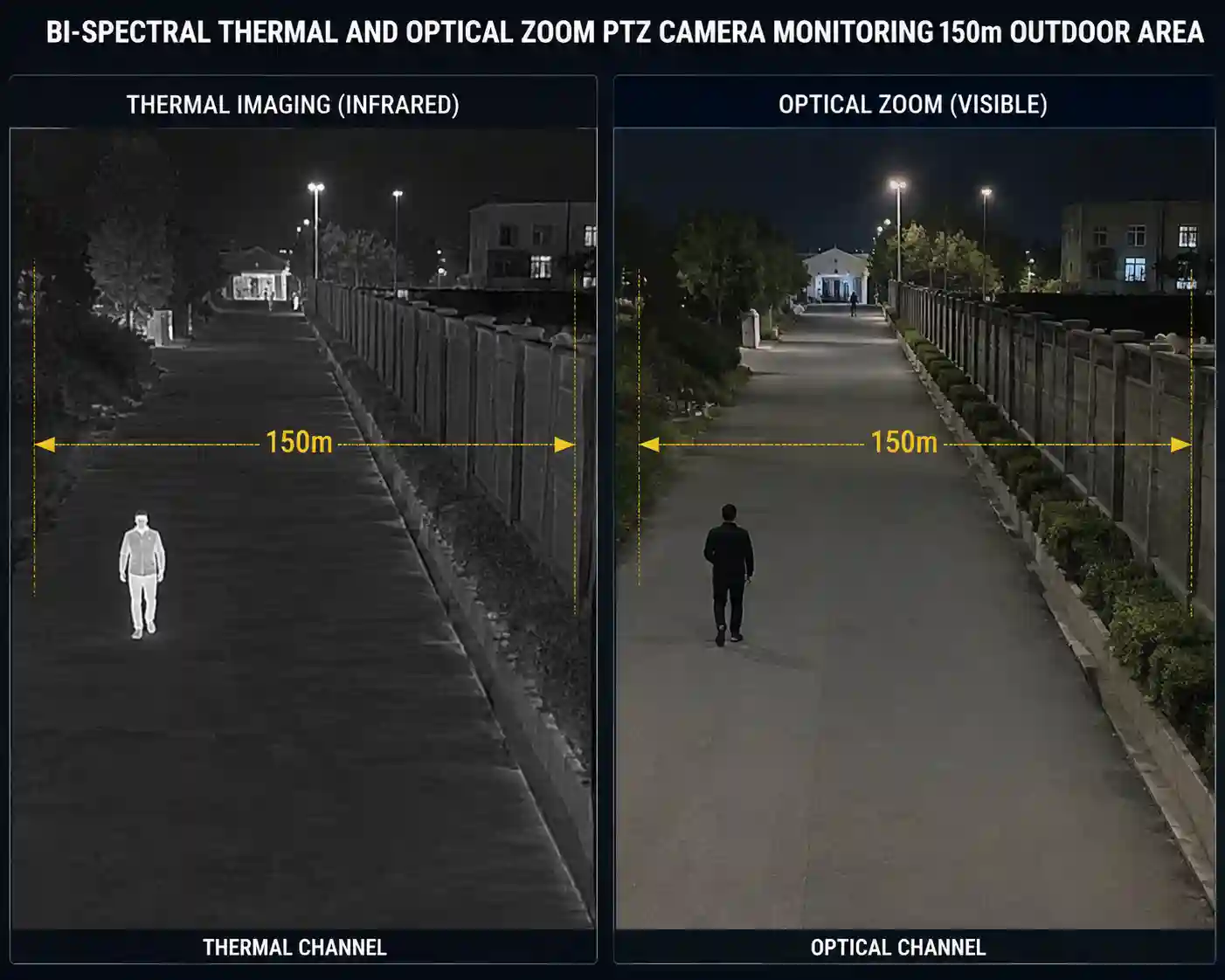
At 150 m or more, target size, line of sight, terrain, mounting height, weather, lens, and operator task shape the image. Ask for a model-specific test target, conditions, sample footage, and acceptance method.
The thermal camera DRI range guide can support range planning. Use the selected model and project conditions for the final decision.
Thermal Search And Visible Verification
Thermal and visible channels serve different decisions. Thermal imaging can direct attention toward a heat-pattern change across a dark road, power route, or forest sector. Visible zoom can help an operator examine scene detail when light and atmosphere support it.
Budget each channel against a defined task. A visible-only configuration, a thermal-only configuration, and a bi-spectral configuration carry different equipment, storage, testing, and training requirements. The bi-spectral long-range thermal imaging PTZ camera page provides the verified model example for this comparison.
What Should You Budget For Each Outdoor Application?
Power Facilities, Substations, And Oilfields
Map equipment areas, access routes, cable approaches, and the longest sightline. Include the mount, weather protection, power continuity, network path, recording retention, alarm handoff, and maintenance access. Thermal search and visible verification should each have a stated operator decision.
For an oilfield or energy route, ask how technicians reach the observation point, how equipment is isolated during service, and which environmental documents the project requires.
Roads, Police Vehicles, Borders, And Remote Areas
Road and border projects need sector coverage, repeatable presets, tracking rules, and communications planning. Police vehicles add vibration, shock, vehicle DC input, and changing network coverage. Remote areas add travel time, weather exposure, and link-availability checks.
The WL-TX30-HD-RCX provides 360-degree endless pan, +90 to -90 degree tilt, 256 presets, and eight tracking paths. Include these control functions in the acceptance plan: call a preset, run a tracking path, transfer control, record the result, and document the response.
Forest-Fire Prevention
Forest-fire lookout points need a clear view across terrain and a defined response chain. Thermal search can support observation of heat patterns, while smoke, weather, distance, and vegetation affect interpretation. Include the lookout mount, power, communications, recording retention, and alarm workflow in the budget.
The thermal PTZ camera for forest-fire prevention page supports application planning. Confirm every alarm threshold, temperature value, and distance claim against the selected model and test method.
How Can A Small Organization Control Total Ownership Cost?
Use a quotation table that ties every amount to a decision and an evidence item.
| Budget item | Question to answer | Quotation evidence |
|---|---|---|
| Camera and optics | What target and image task must the system support at 150 m or more? | Model, detector, lens, visible channel, test footage |
| Mounting and environment | Where will the PTZ camera operate and how will it be serviced? | Mount drawing, IP rating, temperature range, accessories |
| Power and communications | How will the camera receive power and reach the control point? | Input range, cable route, network design, commissioning scope |
| Recording and control | How long will video remain available and who controls PTZ functions? | Codec, retention calculation, ONVIF/RS485 test, export method |
| Maintenance and acceptance | How will the project verify operation after installation? | Test plan, training, service schedule, spare and access plan |
Specify The Acceptance Test Before Buying
Define the target, distance, image task, weather condition, PTZ movement, recording period, control functions, and integration test before comparing offers. Each supplier should quote the same acceptance scope.
Separate Required Features From Optional Modules
Mark thermal imaging, visible zoom, laser, tracking, vehicle accessories, storage, and service as required or optional. A laser module needs its own technical schedule. A tracking option needs a stated workflow and test. Storage needs a retention calculation. This separation keeps the budget linked to decisions.
What Should You Send To A PTZ Camera Manufacturer?
Send the application, site layout, target type and size, target distance, terrain, mounting position, quantity, power source, communications path, recording retention, control protocols, environmental conditions, laser requirements, acceptance criteria, delivery region, and required technical documents.
This list gives the manufacturer enough information to return a model-level configuration, quotation scope, and confirmation list.
Conclusion: Set The Budget Around The Outdoor Task
The appropriate PTZ camera budget covers the observation task at 150 m or more, then accounts for optics, mounting, environment, power, communications, recording, commissioning, acceptance, and maintenance. A single camera figure cannot represent those project conditions.
Shuoxin’s verified WL-TX30-HD-RCX example combines a 640 x 512 thermal channel, a 30-150 mm thermal lens, a 1080p visible channel with 52x optical zoom, 360-degree endless pan, 256 presets, eight tracking paths, IP66 protection, and vehicle DC12V input. Send the site layout, target distance, mounting, power, communications, quantity, and acceptance criteria through the long-range PTZ project requirements contact path. The resulting review can identify the required model configuration and the commercial items that need a project-specific quotation.
FAQ
Q1: What is the typical cost of a PTZ camera system for a small business?
A: A universal price does not describe a 150 m-plus outdoor PTZ project. The budget depends on the camera channels, lens, mount, power, communications, recording, commissioning, and maintenance scope. Request a project-specific quotation with each line item identified.
Q2: Does a long-range thermal PTZ camera cost more than a standard camera?
A: Thermal imaging, long focal-length optics, dual-spectrum channels, environmental accessories, and testing add budget items. The final amount depends on the selected model and site conditions, so compare the same target, distance, and acceptance scope.
Q3: Which costs are often missed in a PTZ camera budget?
A: Mounting, power conversion, network backhaul, storage retention, commissioning, control-room testing, training, remote-site access, and maintenance are common budget lines. Put each item in the request for quotation.
Q4: Can one PTZ camera cover a 150 m-plus outdoor area?
A: One PTZ camera can cover a defined sector when its lens, detector, pan and tilt coverage, mounting point, and acceptance test match the site. Terrain, weather, target size, and line of sight determine the practical result.
Q5: What information should you provide before requesting a PTZ camera quote?
A: Provide the application, target type and size, distance, terrain, mounting, quantity, power, communications, retention, protocols, environment, laser requirements, delivery region, documents, and acceptance criteria. These inputs support a model-level configuration and quotation scope.