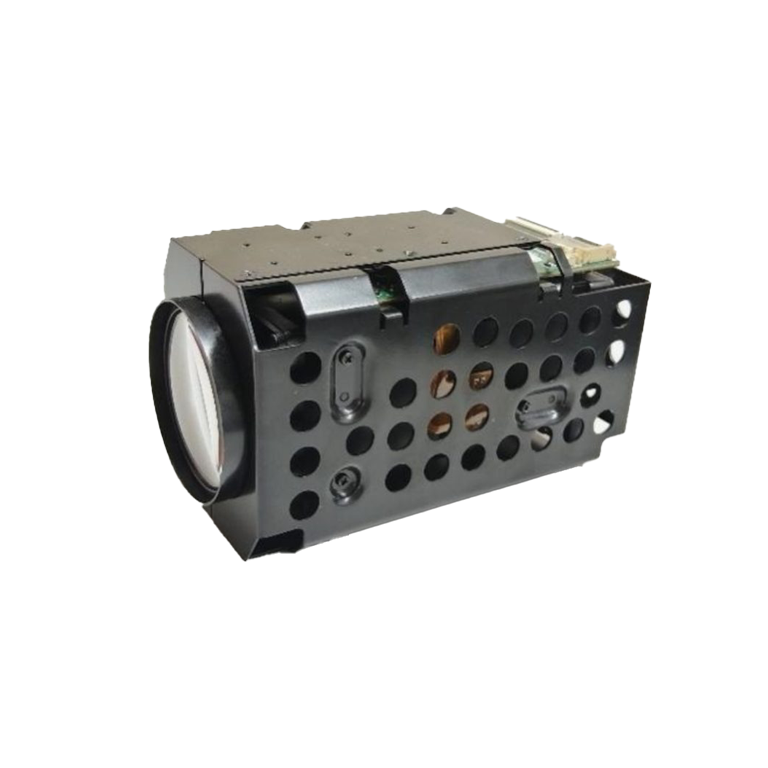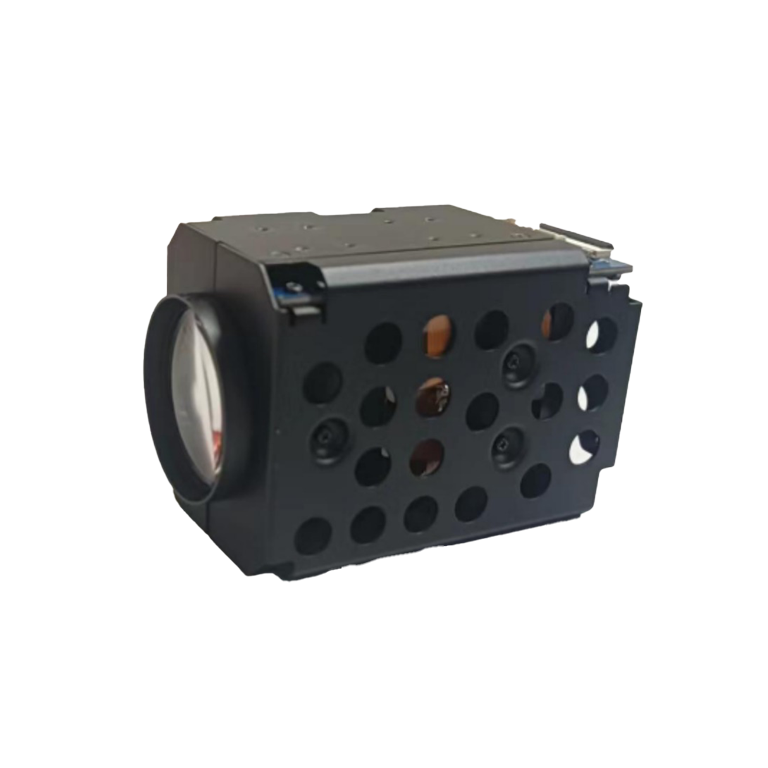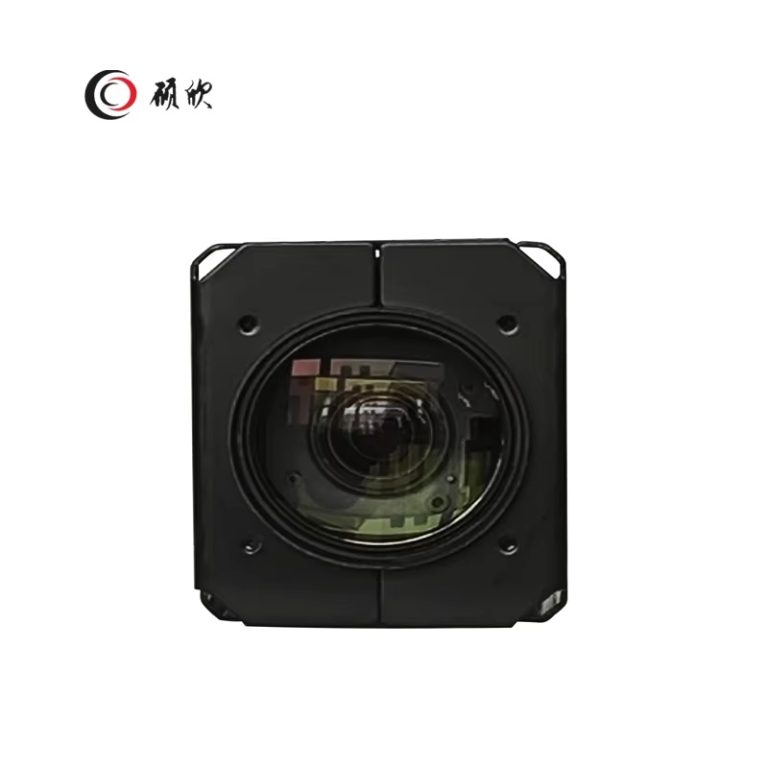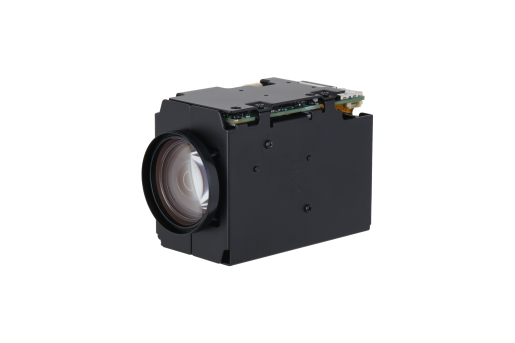
JM-G4032B is a 4 MP IP zoom module with a 4.8–154 mm lens and 32× optical zoom. The table lists up to 2560 × 1440 output, H.265/H.264/MJPEG choices, ONVIF Profile S/G/T, GB/T28181, audio and alarm I/O, RS485/RS232, microSD storage up to 512 GB, DC 12 V power and a 98.46 × 51.3 × 67 mm body.
JM-G4032B is a module; the host supplies enclosure and mounting. Start with 4 MP/32× frame-rate task.
Define 4 MP/32× frame-rate task before encoding or storage choices.
The stated use is integration into camera assemblies for projects such as petrochemical and electrical monitoring. That scope does not establish compatibility with a particular housing, recorder, VMS or PTZ assembly.
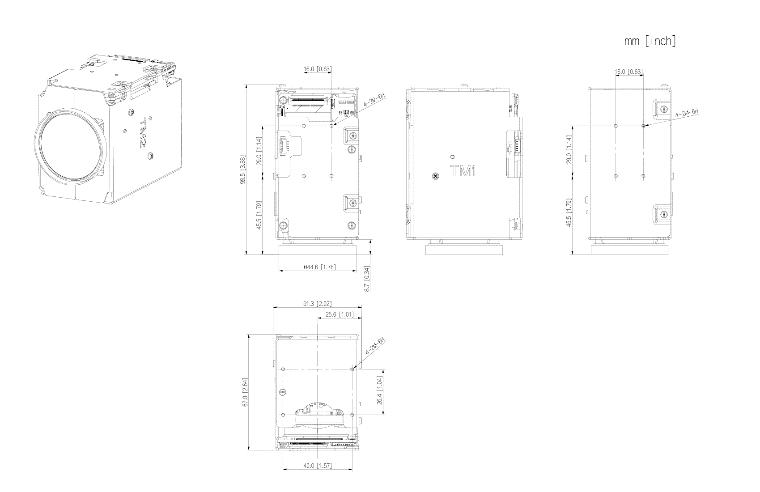
Place 98.46 × 51.3 × 67 mm plus cables on the host drawing with lens and cable clearance.
Show JM-G4032B DC 12 V, network, serial and I/O on the integration schematic, and distinguish mandatory signals from unused options.
Reserve the module’s power within the host calculation. Enclosure sealing and internal temperature control are responsibilities of the host design.
Send the 4 MP/32× frame-rate task, the 98.46 × 51.3 × 67 mm envelope plus cables, and the required DC 12 V, network, serial and I/O connections. Specify the presets and commands needed by the host.
| Telecamera | |
| Sensore di immagine | 1/2,8″ CMOS |
| Pixel | 4mp |
| Risoluzione massima | 2560×1440 |
| Otturatore elettronico | 1/1s~1/30000s |
| Illuminazione minima | Color:0.005lux/F1.6;B/W:0.0005lux/F1.6 |
| Controllo della luce di riempimento | Priorità d'ingrandimento/Manuale/SmartIR/Off |
| Len | |
| Lunghezza focale dell'obiettivo | 4,8 mm~154 mm |
| Apertura dell'obiettivo | F1.6~F4.0 |
| Campo visivo | pan:55.8°~2.3°;tilt:31.9°~1.3°;diagonal:63.7°~2.7° |
| Zoom ottico | 32x |
| Modalità di messa a fuoco | Automatico/semi-automatico/manuale |
| Distanza ravvicinata | 0,1m-1,5m |
| Velocità di zoom | 3.5s |
| ptz | |
| Punto preimpostato | JM-SD1: 80 presets; Pelco D/P: 255 |
| Controllo automatico della velocità di crociera | 8 linee, ciascuna delle quali può aggiungere 32 punti preimpostati |
| Pattugliamento automatico | 5 |
| Scansione automatica delle linee | 5 |
| Spegnimento della memoria | supporto |
| Azioni inattive | Punto di preselezione; pattugliamento; crociera; scansione lineare |
| Protocollo PTZ | JM-SD1Pelco-P/D (riconoscimento automatico) |
| Attività programmate | Punto di preselezione; pattugliamento; crociera; scansione lineare |
| Punto di congelamento video preimpostato | supporto |
| Posizionamento 3D | supporto |
| Funzione di visibilità | supporto |
| video | |
| Standard di compressione video | Smart H.265;H.265;Smart H.264;H.264;H.264B;H.264H;MJPEG |
| Bitrate predefinito con risoluzione predefinita | 6144kbps, 4M (2560 × 1440) |
| Frequenza dei fotogrammi video | Flusso principale a 50Hz (2560×1440@25fps), flusso principale (2304×1296@25fps), flusso principale (1920×1080@25fps), flusso principale (1280×960@25fps), flusso principale (1280×720@25fps), flusso ausiliario 1 (704×576@25fps), flusso ausiliario 1 (352×288@25fps), flusso ausiliario 1 (640×480@25fps), flusso ausiliario 2 (1280×720@25fps) flusso principale a 60Hz (2560×1440@30fps), flusso principale (2304×1296@30fps), flusso principale (1920×1080@30fps), flusso principale (1280×960@30fps), flusso principale (1280×720@30fps), flusso ausiliario 1 (704×480@30fps), flusso ausiliario 1 (352×240@30fps), flusso ausiliario 1 (640×480@30fps), flusso ausiliario 2 (1280×720@30fps) |
| Controllo del flusso | Bitrate variabile/bitrate fisso |
| Giorno / notte | ICR commutazione automatica/elettronica da colore a nero |
| Compensazione della retroilluminazione | supporto |
| Ampia gamma dinamica | supporto |
| Forte soppressione della luce | supporto |
| Bilanciamento del bianco | Automatico/interno/esterno/tracciamento/manuale/lampada al sodio/luce naturale/luce di strada |
| Controllo del guadagno | Automatico/Manuale |
| Riduzione del rumore | Riduzione del rumore 2D/Riduzione del rumore 3D |
| Regione di interesse ROI | supporto |
| Stabilizzazione dell'immagine | Stabilizzazione elettronica dell'immagine |
| Funzione di disappannamento | Penetrazione elettronica della nebbia |
| Zoom digitale | 16x |
| Maschera per la privacy | Fino a 24 aree poligonali, con un massimo di 8 aree contemporaneamente sullo stesso schermo; supporta più colori tra cui scegliere |
| Rapporto segnale/rumore | ≥55db |
| Audio | |
| Standard di compressione audio | PCM;G.711A;G.711MU;G.726;AAC;MPEG2-Layer2;G.722.1 |
| rete | |
| Interfaccia di rete | 1 (porta di rete a filo nudo, supporta dati di rete 10M/100M) |
| Protocollo di rete | HTTP;HTTPS;TCP/IP;IPv4;RTSP;UDP;SMTP;NTP;DHCP;DNS;DDNS;IPv6;802.1x;SSL;QoS;FTP;UPnP;ICMP;SNMP;SNMPv1/v2c/v3(MIB-2);IGMP;ARP;RTCP;RTP;PPPoE;Filtro IP;RTMP;Bonjour;TCP;SMB;NFS |
| Standard di accesso | GB/T28181;ONVIF(Profilo S e Profilo G e Profilo T);CGI;SDK |
| Anteprima del numero massimo di utenti | 20 |
| Funzione di archiviazione | FTP;Micro SD(Supporto massimo 512G);NAS |
| Browser | Supporto IE: IE7 e versioni successive Supporto Google: 42 e inferiori Supporto Firefox: 52 e inferiore Supporto Apple: nessuna restrizione di versione |
| Piattaforma di attracco | Smart PSS;configtool |
| Funzione | |
| SVC | Dominio del tempo |
| Focus regionale | supporto |
| Sovrapposizione di informazioni OSD | Canale; ora; punto preimpostato; temperatura; coordinate PTZ; zoom; direzione nord vero; traccia di pattugliamento; posizione geografica; immagine |
| Modalità provvisoria | Nome utente e password autorizzati; binding dell'indirizzo MAC; crittografia HTTPS; IEEE802.1x; controllo degli accessi alla rete |
| Gestione degli utenti | 32 bit |
| Interfaccia | |
| Interfaccia di uscita analogica | 1 canale (uscita CVBS) |
| Interfaccia RS-485 | 1 (velocità di trasmissione: 1200bps~9600bps) |
| Ingresso audio | 1 |
| Uscita audio | 1 |
| Uscita audio | SOSTEGNO |
| Ingresso allarme | 1,Ingresso interruttore(0~5V CC) |
| Uscita allarme | 1 |
| Collegamento all'allarme | Cattura; punti preimpostati; crociera; tracce di pattugliamento; registrazione video; uscita interruttore di allarme; invio e-mail |
| Eventi di allarme | Rilevamento della dinamica video/occlusione; rilevamento della disconnessione di rete; rilevamento dei conflitti IP; rilevamento dello stato della scheda di memoria; rilevamento dello spazio di memoria |
| Energia | |
| Alimentazione | DC12V/1A±10% |
| ambiente | |
| Temperatura operativa | -40℃~+70℃ |
| Umidità di esercizio | ≤95% |
| struttura | |
| Dimensioni del prodotto | 98.46mm×51.3mm×67mm(L×W×H) |
| Dimensioni della confezione | 145mm×145mm×109mm(L×W×H) |
| N.W. | 0,320 kg |
| G.W. | 0,428 kg |
| Altri | |
| Tipo di interfaccia | Interfaccia BNC; interfaccia RJ45; interfaccia RS485; interfaccia RS232 |
| H.265 | supporto |
| Livello stella | Luce stellare |
Review JM-G4032B in the Camera Module category around the required 4 MP/32× frame-rate task. The comparison also needs the 98.46 × 51.3 × 67 mm envelope, cable clearance, DC 12 V and the exact host interface set.
Begin with 4 MP/32× frame-rate task.
Match JM-G4032B DC 12 V, network, serial and I/O connections to the host functions that will actually be used.
Show 98.46 × 51.3 × 67 mm plus cables, cables and clearances.
Keep any function not clearly defined by the retained table outside the order until it receives written confirmation.
Start with the required 4 MP image and frame-rate plan, then apply the 4.8–154 mm, 32× lens range. Encoding, streaming and storage selections should follow that workload. The module specification does not establish a finished camera housing or compatibility with an unnamed PTZ assembly.
The host drawing must contain the 98.46 × 51.3 × 67 mm body plus connector and cable space. Add the lens path and installation direction so the module can be assembled and serviced. Sealing and internal temperature management remain part of the surrounding product design.
Separate the DC 12 V supply from network, RS485/RS232, audio, alarm and other I/O on the schematic. Select only the signals the finished camera will use. The retained table also lists ONVIF Profile S/G/T, GB/T28181 and microSD up to 512 GB; each needs a defined role in the host architecture.
Freeze the design after the frame-rate requirement, optical envelope and electrical connections agree. Confirm connector access and the host power budget before making the carrier. Any claim about weather protection, recorder fit or PTZ compatibility must come from the completed system evidence, not the module page.
The integration record should also name the stream stored on microSD, if local storage is used, and distinguish it from network delivery. Keep unused alarm or audio lines off the released schematic.
Use Contattaci to send the 4 MP/32× frame-rate task, the drawing and required functions. Note any unresolved interface or control requirement separately.