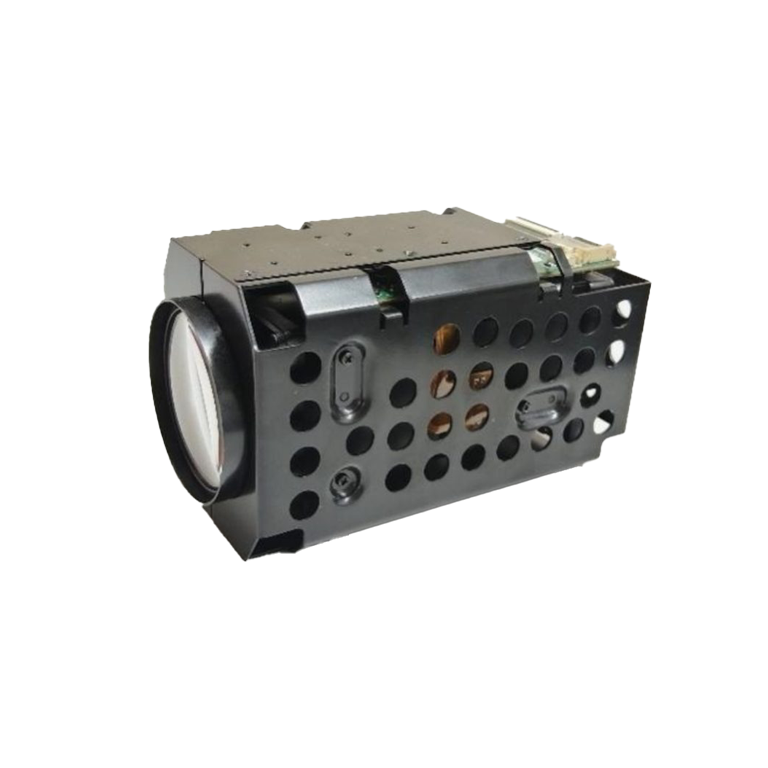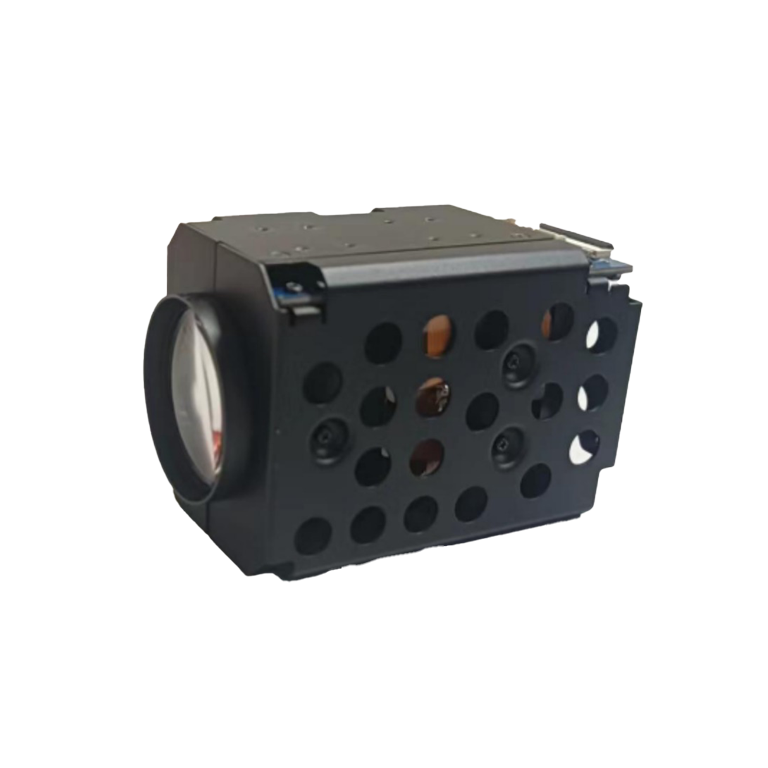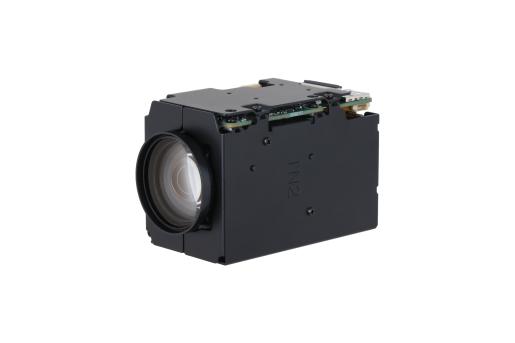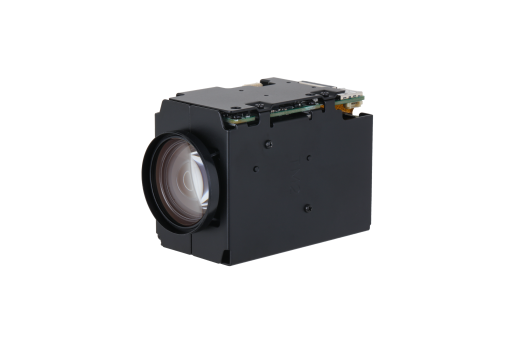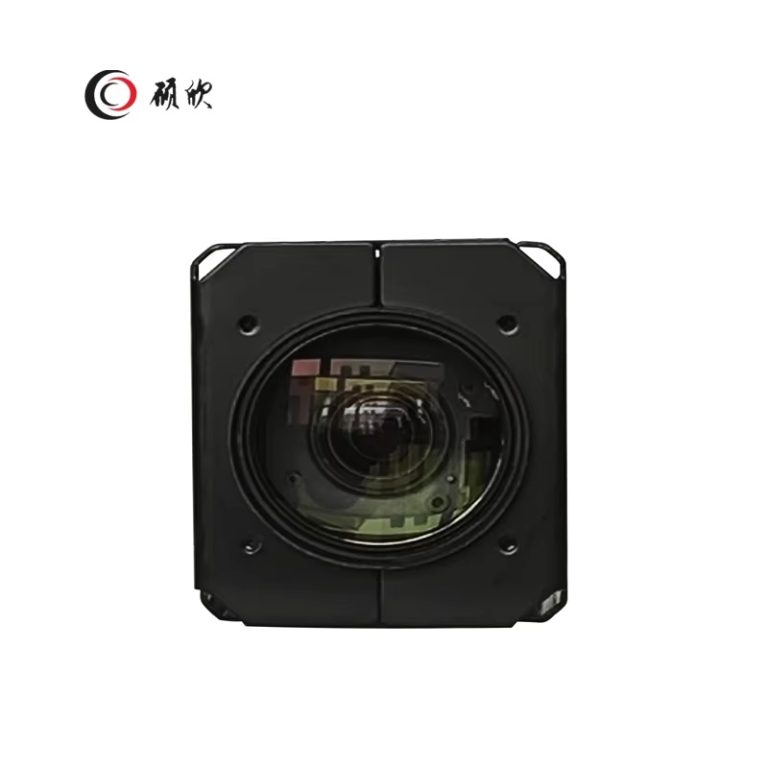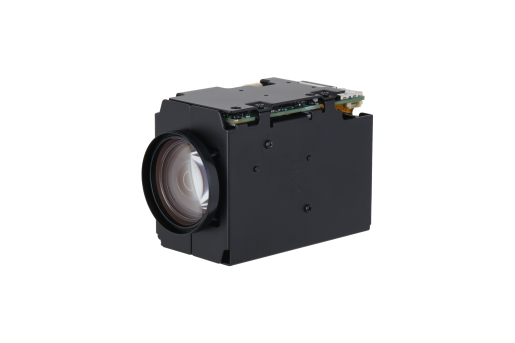
JM-G4032B is a 4 MP IP zoom module with a 4.8–154 mm lens and 32× optical zoom. The table lists up to 2560 × 1440 output, H.265/H.264/MJPEG choices, ONVIF Profile S/G/T, GB/T28181, audio and alarm I/O, RS485/RS232, microSD storage up to 512 GB, DC 12 V power and a 98.46 × 51.3 × 67 mm body.
JM-G4032B is a module; the host supplies enclosure and mounting. Start with 4 MP/32× frame-rate task.
Define 4 MP/32× frame-rate task before encoding or storage choices.
The stated use is integration into camera assemblies for projects such as petrochemical and electrical monitoring. That scope does not establish compatibility with a particular housing, recorder, VMS or PTZ assembly.
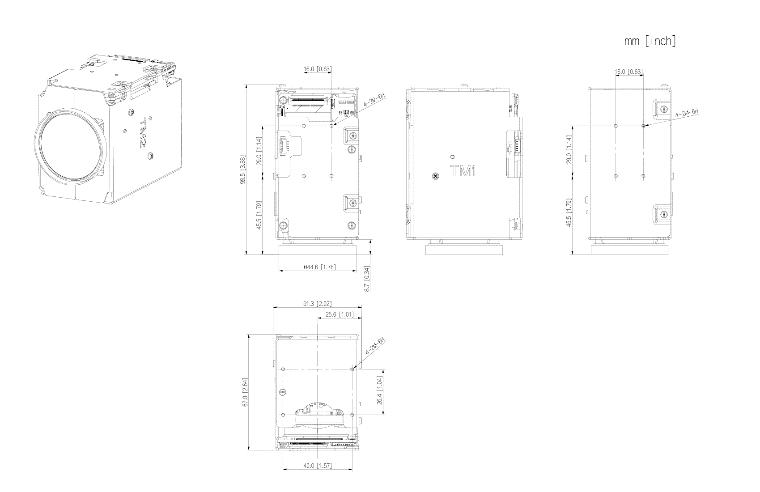
Place 98.46 × 51.3 × 67 mm plus cables on the host drawing with lens and cable clearance.
Show JM-G4032B DC 12 V, network, serial and I/O on the integration schematic, and distinguish mandatory signals from unused options.
Reserve the module’s power within the host calculation. Enclosure sealing and internal temperature control are responsibilities of the host design.
Send the 4 MP/32× frame-rate task, the 98.46 × 51.3 × 67 mm envelope plus cables, and the required DC 12 V, network, serial and I/O connections. Specify the presets and commands needed by the host.
| Caméra | |
| Capteur d'image | 1/2.8″ CMOS |
| Pixel | 4mp |
| Résolution maximale | 2560×1440 |
| Volet électronique | 1/1s~1/30000s |
| Éclairage minimal | Color:0.005lux/F1.6;B/W:0.0005lux/F1.6 |
| Contrôle de la lumière de remplissage | Priorité au grossissement/Manuel/SmartIR/Désactivé |
| Len | |
| Longueur focale de l'objectif | 4.8mm~154mm |
| Ouverture de l'objectif | F1.6~F4.0 |
| Champ de vision | pan:55.8°~2.3°;tilt:31.9°~1.3°;diagonal:63.7°~2.7° |
| Zoom optique | 32x |
| Mode de mise au point | Automatique/semi-automatique/manuel |
| Distance d'approche | 0,1m-1,5m |
| Zoom | 3.5s |
| ptz | |
| Point préréglé | JM-SD1: 80 presets; Pelco D/P: 255 |
| Régulateur de vitesse automatique | 8 lignes, chaque ligne peut ajouter 32 points de présélection |
| Patrouille automatique | 5 |
| Balayage automatique des lignes | 5 |
| Mise hors tension de la mémoire | soutien |
| Actions au ralenti | Point de présélection ; patrouille ; croisière ; balayage de ligne |
| Protocole PTZ | JM-SD1Pelco-P/D (reconnaissance automatique) |
| Tâches programmées | Point de présélection ; patrouille ; croisière ; balayage de ligne |
| Gel vidéo à un point prédéfini | soutien |
| Positionnement en 3D | soutien |
| Fonction de visibilité | soutien |
| vidéo | |
| Normes de compression vidéo | Smart H.265;H.265;Smart H.264;H.264;H.264B;H.264H;MJPEG |
| Débit binaire par défaut à la résolution par défaut | 6144kbps, 4M (2560 × 1440) |
| Fréquence d'images vidéo | Flux principal 50Hz (2560×1440@25fps), flux principal (2304×1296@25fps), flux principal (1920×1080@25fps), flux principal (1280×960@25fps), flux principal (1280×720@25fps), flux auxiliaire 1 (704×576@25fps), flux auxiliaire 1 (352×288@25fps), flux auxiliaire 1 (640×480@25fps), flux auxiliaire 2 (1280×720@25fps) flux principal 60Hz (2560×1440@30fps), flux principal (2304×1296@30fps), flux principal (1920×1080@30fps), flux principal (1280×960@30fps), flux principal (1280×720@30fps), flux auxiliaire 1 (704×480@30fps), flux auxiliaire 1 (352×240@30fps), flux auxiliaire 1 (640×480@30fps), flux auxiliaire 2 (1280×720@30fps) |
| Contrôle des cours d'eau | Débit variable/débit fixe |
| Jour / nuit | ICR commutation automatique/électronique couleur vers noir |
| Compensation du rétroéclairage | soutien |
| Gamme dynamique étendue | soutien |
| Forte suppression de la lumière | soutien |
| Balance des blancs | Automatique/Indoor/Outdoor/Tracking/Manual/Sodium Lamp/Natural Light/Street Light |
| Contrôle du gain | Automatique/Manuel |
| Réduction du bruit | Réduction du bruit en 2D/Réduction du bruit en 3D |
| Région d'intérêt ROI | soutien |
| Stabilisation de l'image | Stabilisation électronique de l'image |
| Fonction de désembuage | Pénétration électronique du brouillard |
| Zoom numérique | 16x |
| Masque de confidentialité | Jusqu'à 24 zones polygonales, avec jusqu'à 8 zones sur le même écran en même temps ; possibilité de choisir parmi plusieurs couleurs |
| Rapport signal/bruit | ≥55 dB |
| Audio | |
| Normes de compression audio | PCM;G.711A;G.711MU;G.726;AAC;MPEG2-Layer2;G.722.1 |
| réseau | |
| Interface réseau | 1 (port réseau à fil nu, supporte les données réseau 10M/100M) |
| Protocole de réseau | HTTP;HTTPS;TCP/IP;IPv4;RTSP;UDP;SMTP;NTP;DHCP;DNS;DDNS;IPv6;802.1x;SSL;QoS;FTP;UPnP;ICMP;SNMP;SNMPv1/v2c/v3(MIB-2);IGMP;ARP;RTCP;RTP;PPPoE;Filtre IP;RTMP;Bonjour;TCP;SMB;NFS |
| Normes d'accès | GB/T28181;ONVIF(Profile S & Profile G & Profile T);CGI;SDK |
| Prévisualisation du nombre maximum d'utilisateurs | 20 |
| Fonction de stockage | FTP;Micro SD(Maximum support 512G);NAS |
| Navigateur | Prise en charge de IE : IE7 et supérieur Prise en charge de Google : 42 et moins Support Firefox : 52 et moins Support Apple : aucune restriction de version |
| Plate-forme d'amarrage | Smart PSS;configtool |
| Fonction | |
| SVC | Domaine temporel |
| Focus régional | soutien |
| Superposition des informations de l'OSD | Canal ; heure ; point de présélection ; température ; coordonnées PTZ ; zoom ; direction nord vrai ; piste de patrouille ; emplacement géographique ; image |
| Mode sans échec | Nom d'utilisateur et mot de passe autorisés ; liaison d'adresse MAC ; cryptage HTTPS ; IEEE802.1x ; contrôle d'accès au réseau |
| Gestion des utilisateurs | 32 bits |
| Interface | |
| Interface de sortie analogique | 1 canal (sortie CVBS) |
| Interface RS-485 | 1(Taux de débit en bauds:1200bps~9600bps) |
| Entrée audio | 1 |
| Sortie audio | 1 |
| Sortie audio | SOUTIEN |
| Entrée d'alarme | 1,Switch input(0~5V DC) |
| Sortie d'alarme | 1 |
| Liaison d'alarme | Capture ; points prédéfinis ; croisière ; pistes de patrouille ; enregistrement vidéo ; sortie de commutateur d'alarme ; envoi d'un courrier électronique |
| Événements d'alarme | Détection vidéo dynamique/occlusion ; détection de déconnexion réseau ; détection de conflit IP ; détection de l'état de la carte mémoire ; détection de l'espace de stockage |
| Pouvoir | |
| Alimentation électrique | DC12V/1A±10% |
| l'environnement | |
| Température de fonctionnement | -40℃~+70℃ |
| Humidité de fonctionnement | ≤95% |
| structure | |
| Taille du produit | 98.46mm×51.3mm×67mm(L×W×H) |
| Taille de l'emballage | 145mm×145mm×109mm(L×W×H) |
| N.W. | 0,320 kg |
| G.W. | 0,428 kg |
| Autres | |
| Type d'interface | Interface BNC ; interface RJ45 ; interface RS485 ; interface RS232 |
| H.265 | soutien |
| Niveau étoile | Lumière des étoiles |
Review JM-G4032B in the Camera Module category around the required 4 MP/32× frame-rate task. The comparison also needs the 98.46 × 51.3 × 67 mm envelope, cable clearance, DC 12 V and the exact host interface set.
Begin with 4 MP/32× frame-rate task.
Match JM-G4032B DC 12 V, network, serial and I/O connections to the host functions that will actually be used.
Show 98.46 × 51.3 × 67 mm plus cables, cables and clearances.
Keep any function not clearly defined by the retained table outside the order until it receives written confirmation.
Start with the required 4 MP image and frame-rate plan, then apply the 4.8–154 mm, 32× lens range. Encoding, streaming and storage selections should follow that workload. The module specification does not establish a finished camera housing or compatibility with an unnamed PTZ assembly.
The host drawing must contain the 98.46 × 51.3 × 67 mm body plus connector and cable space. Add the lens path and installation direction so the module can be assembled and serviced. Sealing and internal temperature management remain part of the surrounding product design.
Separate the DC 12 V supply from network, RS485/RS232, audio, alarm and other I/O on the schematic. Select only the signals the finished camera will use. The retained table also lists ONVIF Profile S/G/T, GB/T28181 and microSD up to 512 GB; each needs a defined role in the host architecture.
Freeze the design after the frame-rate requirement, optical envelope and electrical connections agree. Confirm connector access and the host power budget before making the carrier. Any claim about weather protection, recorder fit or PTZ compatibility must come from the completed system evidence, not the module page.
The integration record should also name the stream stored on microSD, if local storage is used, and distinguish it from network delivery. Keep unused alarm or audio lines off the released schematic.
Use Contactez-nous to send the 4 MP/32× frame-rate task, the drawing and required functions. Note any unresolved interface or control requirement separately.