
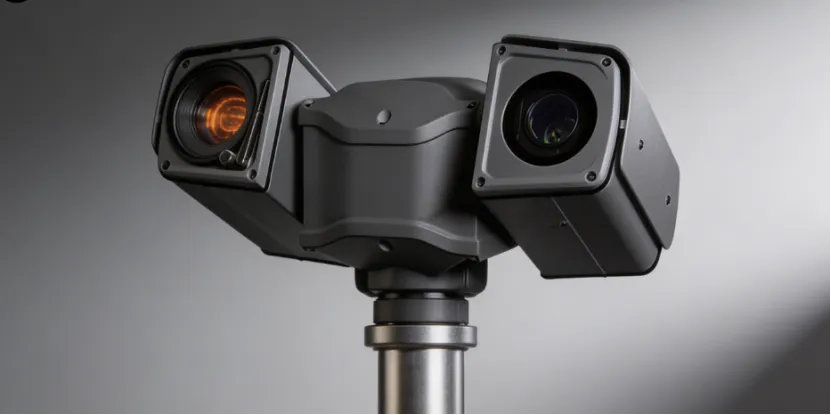
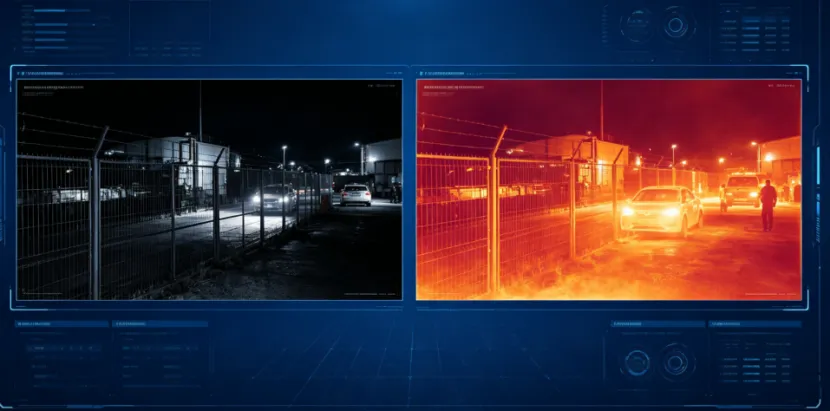
A bi-spectral thermal imaging PTZ camera is built for one simple reason: security teams do not just need to see an area, they need to know what is happening there. In real work, that can mean a person moving near a border fence at midnight, a vehicle stopping near a petrochemical site, or smoke blocking a fire command scene.
A normal camera may miss the target. A single thermal camera may find heat but lack clear visual detail. A visible and thermal camera solves both problems in one system.
For buyers comparing CCTV, thermal, and PTZ systems, the key question is not “Which camera has more specs?” It is “Can this camera help you detect, confirm, and respond faster?” That is where a bi-spectral thermal imaging PTZ camera becomes useful.
What Does Bi-Spectral Mean?
Bi-spectral means the camera uses two imaging channels. One channel captures visible-light video, and the other detects heat. This creates a more complete view of the scene, especially when light, weather, or distance makes monitoring difficult.
Visible-Light Imaging
The visible camera gives you the details people expect from a CCTV image. You can check object shape, clothing, vehicle type, road conditions, and scene changes.
Shuoxin’s WL-TW10-HD-RCX uses a 1/2.8” Progressive Scan CMOS sensor with 1920×1080 resolution, so it can provide 2MP HD video for day and night monitoring. Its minimum illumination reaches 0.0005 Lux in color mode and 0.0001 Lux in black-and-white mode, which matters when lighting is weak but not totally dark.
Thermal Imaging
Thermal imaging works differently. It detects heat signatures instead of relying on visible light. The thermal module in this thermal imaging security camera uses an uncooled vanadium oxide detector, 640×512 resolution, 8–14 μm response band, and sensitivity below 35mK. In plain words, it can catch small temperature differences, which is useful for spotting people, vehicles, animals, or overheated equipment in darkness, fog, smoke, or rain.
How Does a Thermal PTZ Camera Work?
To answer how does a thermal PTZ camera work, look at three parts: thermal detection, visible confirmation, and PTZ movement. Each part does a different job, and together they make the system far more practical than a fixed camera.
Detection, Confirmation, and Tracking
First, the thermal sensor detects heat. Then the visible camera helps you confirm what the target is. After that, the PTZ system lets you pan, tilt, and zoom to follow the event. A thermal PTZ camera is not passive. You can move it to inspect a road, a fence line, a port entrance, or a rescue area.
Shuoxin’s model supports 360° endless rotation, +90° to -90° tilt, 100°/s pan preset speed, 60°/s tilt preset speed, 256 preset positions, and 8 tracking paths. That is useful when an operator has to switch from a wide patrol view to a specific target fast.
Why Is a Dual-Sensor PTZ Camera Better for All-Weather Security?
A dual-sensor PTZ camera reduces a common field problem: one sensor rarely works best in every condition. Daytime, nighttime, glare, fog, smoke, and long distance all challenge cameras in different ways. A bi-spectral camera gives you more room to work.
Better Results Than a Single Sensor
When comparing thermal camera vs visible camera for security, the visible camera gives detail, while the thermal camera gives detection. A bi-spectrum camera combines them, so you do not have to choose one strength and lose the other.
For wide-area protection, a long-range thermal PTZ camera also needs zoom. This model uses 33x optical zoom and 16x digital zoom, with a 6.1–317mm focal length and a 57° to 1.7° horizontal field of view. You can scan broadly, then zoom in on a distant target without turning the whole site into a blind spot.
Where Can You Use This Camera?
The best use cases are places where a missed target can become expensive or dangerous. These are not small office lobby jobs. Think roads, borders, airports, coastal areas, power lines, substations, and emergency vehicles.
Perimeter, Vehicle, and Emergency Scenes
A perimeter security thermal camera helps you detect movement before someone reaches a restricted zone. A thermal PTZ camera for border surveillance can watch large outdoor areas day and night.
A vehicle-mounted thermal PTZ camera fits police mobile law enforcement, road patrol, urban management, special vehicle inspection, fire emergency command, and ambulance vehicle monitoring. Shuoxin’s product page also lists mobile inspection border, airport, coastal defense, petrochemical and natural gas sites, shipboard monitoring, aquaculture monitoring, and substation use.
For a thermal PTZ camera for emergency command, small details matter. Heated glass, defrost and defogging functions, wiper support, IP66 housing, and a -35°C to +55°C working temperature range help the device stay useful when weather gets ugly. That sounds boring until a rescue scene happens in cold rain at 3 a.m.
What Should You Check Before Buying?
A camera may look powerful on paper, but you should check whether it fits your site, platform, and response workflow. The best thermal PTZ camera for perimeter security is not always the one with the longest spec sheet. It is the one that works with your control room and your field conditions.
Key Buying Points
Check thermal resolution, visible-light resolution, optical zoom, PTZ speed, weather protection, power supply, and video platform support. An ONVIF thermal PTZ camera is easier to add to many VMS or NVR systems. This model supports ONVIF Profile S and Profile G, H.265, H.264, MJPEG, RS485, WEB control, and PELCO D/P protocol.
It also supports smart detection, including cross-border detection, area intrusion detection, entering and leaving area detection, hovering detection, personnel gathering detection, fast motion detection, parking detection, scene change detection, audio detection, false focus detection, and face detection.
Why Consider Shuoxin?
Shuoxin is a technology-based security monitoring manufacturer focused on intelligent surveillance equipment. Its product lines cover vehicle-mounted PTZ systems, thermal imaging night vision PTZ systems, infrared laser heavy-duty PTZ systems, marine monitoring, road monitoring, public security, border defense, forest fire prevention, urban management, transportation, environmental protection, and power applications.
The company states that it uses strict production management, complete testing equipment, and quality control systems, with products tested by relevant public security quality inspection bodies and certifications such as ISO9001, CE, RoHS, and FCC.
For buyers looking for a long range PTZ camera with thermal imaging, the WL-TW10-HD-RCX is a practical example. It combines visible detail, thermal detection, fast PTZ motion, 33x optical zoom, rugged housing, and system integration in one unit. You can view the related bi-spectral thermal imaging PTZ camera page for product details.
FAQ
Q1: What is a bi-spectral thermal imaging PTZ camera?
A: A bi-spectral thermal imaging PTZ camera combines a visible-light camera, a thermal imaging sensor, and pan-tilt-zoom movement. It helps you detect heat, confirm visual details, and track targets across wide areas.
Q2: Is a bi-spectral camera better than a normal CCTV camera?
A: For all-weather and night security, yes. A normal CCTV camera depends on light. A bi-spectral camera can use thermal imaging when light is poor and visible imaging when you need detail.
Q3: What is a dual sensor thermal camera for law enforcement vehicles?
A: A dual sensor thermal camera for law enforcement vehicles gives mobile teams both heat detection and visible video. It is useful for patrol, emergency response, road checks, and special vehicle inspection.
Q4: Why is optical zoom important in a long-range thermal PTZ camera?
A: Optical zoom helps you inspect distant targets with better detail than digital zoom alone. A 33x optical zoom camera can move from wide-area viewing to close inspection quickly.
Q5: What is an all-weather thermal imaging surveillance camera used for?
A: An all-weather thermal imaging surveillance camera is used for border security, perimeter protection, fire command, roads, airports, coastal defense, power sites, petrochemical sites, and vehicle-mounted monitoring.