
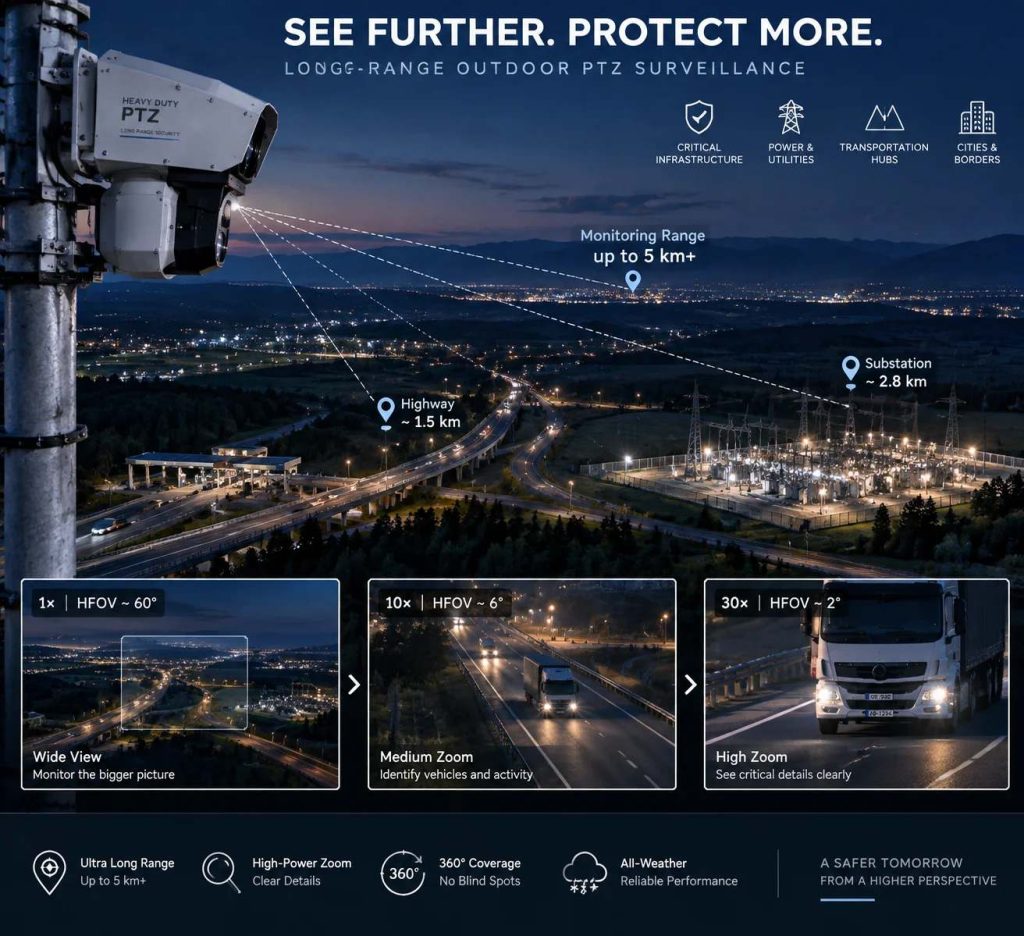
The range of PTZ camera systems has no universal distance. A camera may have a clear line of sight across several kilometres while the target still occupies too few pixels for an operator’s task. Usable range depends on target size, required detail, sensor resolution, lens focal length, atmosphere, light or thermal contrast, mounting geometry, compression, display, and test conditions. For outdoor projects at 150 m and beyond, define what the operator must detect, recognize, identify, or verify. Then select and test the camera system against that decision.
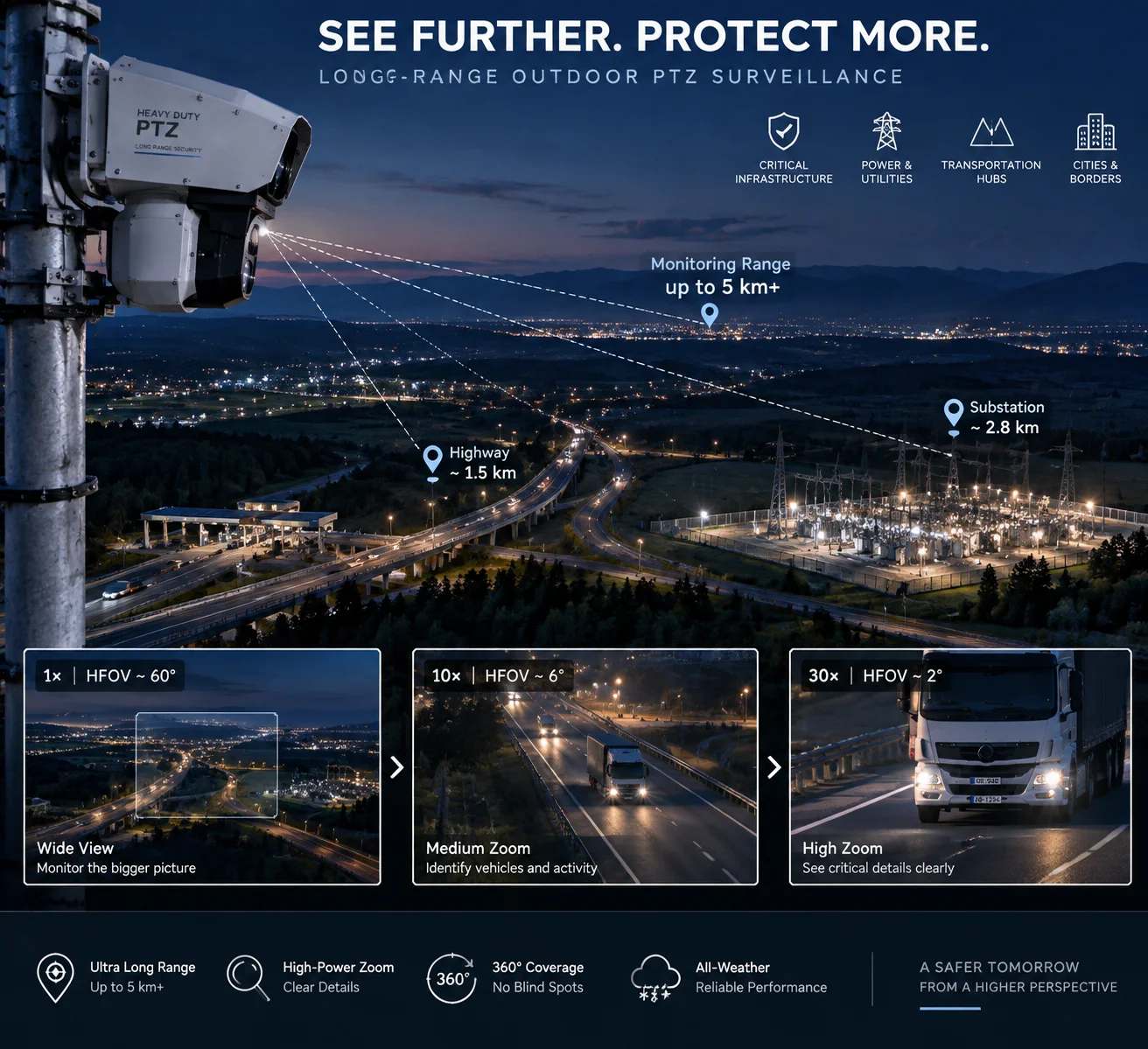
Is There a Standard Range of PTZ Camera Systems?
A quoted distance becomes useful when it includes a target, a task, and test conditions. Three separate concepts help project teams describe the requirement accurately.
| Distance concept | Meaning | Evidence required |
|---|---|---|
| Geometric line of sight | The camera has an unobstructed view toward the target area. | Site survey, mounting coordinates, terrain profile, and obstruction map |
| Image detail | The target occupies enough captured pixels for a stated observation task. | Target dimensions, field of view, sensor output, focus, and sample images |
| Operational range | An operator can complete a defined detection, recognition, identification, or verification task. | Acceptance criteria and footage recorded under representative conditions |
Geometric Line of Sight
Mounting height and terrain establish the physical view. Hills, road curves, transmission structures, and vegetation can interrupt it. Vehicle position continually changes a mobile system’s sightline. Record camera and target elevations, slant distance, and seasonal obstructions.
Image Detail on the Target
Target size in the frame governs usable detail. A narrow field of view places more pixels across a distant person, vehicle, insulator, or smoke source. Focus, motion, compression, transmission, and display size then affect the operator’s image.
Operational Detection, Recognition, and Verification
Detection confirms that an object or thermal event is present. Recognition assigns it to a useful class. Identification or verification requires finer detail tied to a project decision. The target dimensions and acceptance method should accompany every distance claim. A Руководство по диапазону DRI тепловизионных камер can help teams structure these task levels for thermal projects.
Which Optical Factors Determine PTZ Camera Range?
Sensor, Lens, and Field of View
Sensor format, resolution, focal length, and target geometry form one optical system. Longer focal lengths narrow the field of view and place more pixels across a target. They also reduce the search area and magnify vibration, focus error, and atmospheric disturbance. Select a lens from target width, required scene width, distance, and field-test results.
Optical Zoom and Digital Zoom
Optical zoom changes the scene captured by the sensor. Digital zoom enlarges pixels already captured, so it can support screen inspection while preserving the original level of scene detail. As a reference configuration, the Shuoxin WL-TX30-HD-RCX visible channel uses a 1/2.8-inch CMOS sensor, 1920 x 1080 output, a 6.1-317 mm lens, 52x optical zoom, and 16x digital zoom. These values describe the imaging chain; project range still depends on target and conditions.
How Do Thermal and Visible Channels Affect Range?
Thermal Search at Night and in Outdoor Conditions
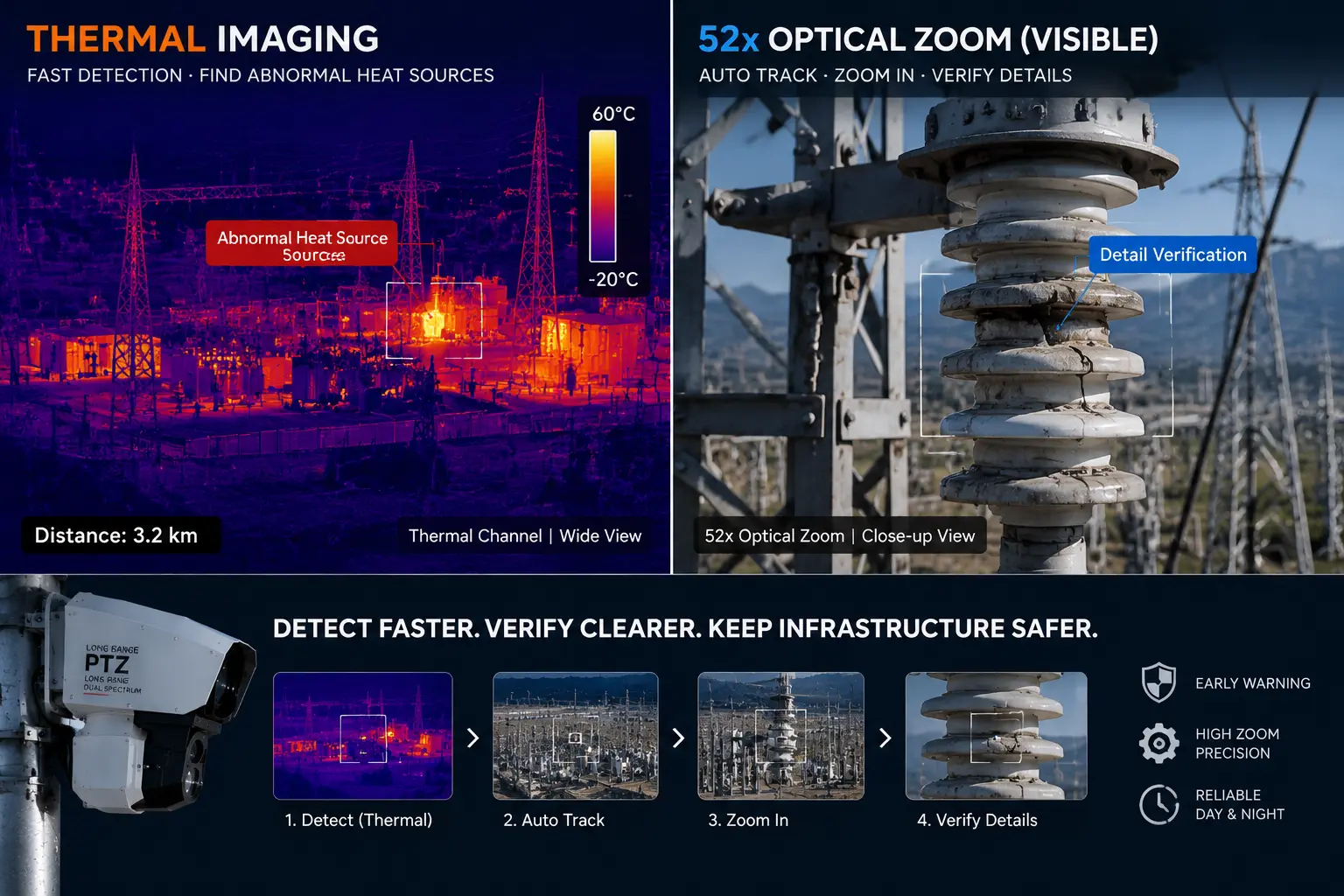
Thermal imaging maps temperature differences and supports search in darkness. The reference model uses a 640 x 512 uncooled vanadium oxide detector, an 8-14 um response band, 12 um pixels, and a 30-150 mm thermal lens. Target-background contrast, humidity, rain, haze, and lens setting govern detail.
Visible Verification and Scene Detail
The visible channel supplies colour, texture, markings, and environmental context when illumination and atmosphere support them. In a bi-spectral workflow, an operator can search with thermal imagery, steer the PTZ to the event, and examine the same sector with visible zoom. The official биспектральная тепловизионная PTZ-камера дальнего действия page lists the reference detector, lenses, visible output, zoom, PTZ movement, interfaces, and outdoor hardware.
Active Illumination and Low-Light Data Gaps
Any active illumination claim needs a matching model specification covering wavelength, beam angle, distance, safety classification, target reflectivity, and test environment. Low-light evidence should state exposure, frame rate, gain, illumination, and motion.
How Do PTZ Mechanics Change Coverage?
Pan, Tilt, Presets, and Tracking Paths
PTZ movement expands directional coverage. It does not define optical range. The WL-TX30-HD-RCX provides 360-degree endless pan, tilt from +90 to -90 degrees, 256 presets, and eight tracking paths. Presets can return the camera to substations, road sectors, boundary points, or forest observation zones. Patrol timing must leave enough observation time at each priority location.
Mounting Geometry and Sector Planning
Sector plans should show slant distance, target direction, blind areas, preset centres, and overlap. High magnification makes pole movement and vehicle vibration visible. Review mount stiffness, wind loading, service access, and stabilization. Test vehicle systems during idling and travel over representative roads.
Which Outdoor Conditions Reduce Usable Detail?
Atmosphere, Weather, and Optical Windows
Haze, rain, dust, heat shimmer, and moisture reduce long-path contrast or sharpness. Thermal contrast changes with weather and time. The reference model specifies IP66 protection, operation from -35 to +55 degrees C, a wiper, heated glass, and defrosting and defogging. Match window maintenance to local exposure.
Power, Network, Recording, and Display
Range verification covers the full video path. The reference model supports ONVIF Profiles S/G, RS485, H.265, H.264, MJPEG, wide-range DC12V vehicle input, and optional vehicle shock absorbers. Calculate bandwidth, latency, retention, power protection, decoding, and control response. Review acceptance footage through the intended recorder and display.
How Does Range Planning Change by Application?
Энергетические объекты, подстанции и нефтяные месторождения
Start with the smallest equipment feature or thermal event that drives action. Account for conductors, gantries, pipework, dust, vapour, and hot backgrounds along the longest sightline. Presets assign repeatable views; acceptance footage confirms the required operator decision.
Roads, Police Vehicles, Borders, and Remote Areas
Moving targets require suitable shutter, frame rate, focus, tracking speed, and control. Roads add curves, headlights, vibration, heat shimmer, and changing angles. Border and remote observation add terrain, long atmospheric paths, communications limits, and large sectors. Test police-vehicle systems while stationary and moving.
Предотвращение лесных пожаров
Lookout position, terrain, vegetation, weather, thermal contrast, and response procedure shape the required range. A practical workflow assigns thermal search sectors, visible verification views, alarm handoff, and field response. The guide to thermal PTZ cameras for forest-fire prevention explains how those functions support early outdoor observation.
Use This Long-Range PTZ Camera Acceptance Checklist
- Define the target dimensions and the exact operator decision: detection, recognition, identification, or verification.
- Measure every 150 m-plus sightline and map terrain, structures, vegetation, road curves, and seasonal obstructions.
- Select the detector, sensor, lens, optical zoom, focus method, and thermal-visible channel roles from target geometry.
- Map pan and tilt limits, presets, tracking paths, dwell times, mounting height, vibration, and service access.
- Confirm enclosure, window care, temperature, power, network, recording, display, control, and maintenance requirements.
- Test representative targets at the intended distance, mounting position, time, weather, system bitrate, recorder, and operator display.
Conclusion: Define Range Through the Required Outdoor Task
The range of PTZ camera systems is the distance at which the installed system supports a specified operator decision under stated conditions. Target size, optics, thermal or visible contrast, PTZ sector planning, mounting, atmosphere, transmission, and display all contribute to that result.
Changzhou Shuoxin Electronic Technology Co., Ltd. offers the WL-TX30-HD-RCX with documented thermal and visible channels, 360-degree PTZ movement, presets, tracking paths, IP66 protection, environmental controls, video codecs, interfaces, and vehicle options. Project teams can submit long-range PTZ camera requirements with target dimensions, sightlines, mounting data, environmental conditions, network design, and acceptance tasks for configuration review.
ЧАСТО ЗАДАВАЕМЫЕ ВОПРОСЫ
Q1: Как далеко может видеть камера PTZ?
A: Its usable distance depends on the target, required operator task, lens, sensor, atmosphere, mounting, image transport, and display. A field test provides evidence for a specific site and configuration.
Q2: What determines the range of PTZ camera systems?
A: The main inputs are target size, required detail, focal length, field of view, sensor resolution, focus, thermal or visible contrast, weather, sightline, vibration, compression, and viewing setup.
Q3: Does optical zoom increase PTZ camera range?
A: Optical zoom narrows the captured field of view and places more sensor pixels across a distant target. The final operational distance remains conditional on focus, atmosphere, target geometry, mounting stability, and acceptance criteria.
Q4: Can a thermal PTZ camera see farther at night?
A: Thermal imaging can locate temperature differences in darkness. Its usable range depends on target size, thermal contrast, detector and lens selection, humidity, rain, atmosphere, and the required detection or verification task.
В5: How should a 150 m-plus PTZ camera range be tested?
A: Install the proposed configuration at representative height, record defined targets at the intended distances and conditions, pass the video through the planned network and recorder, and have operators score each required task against written criteria.