
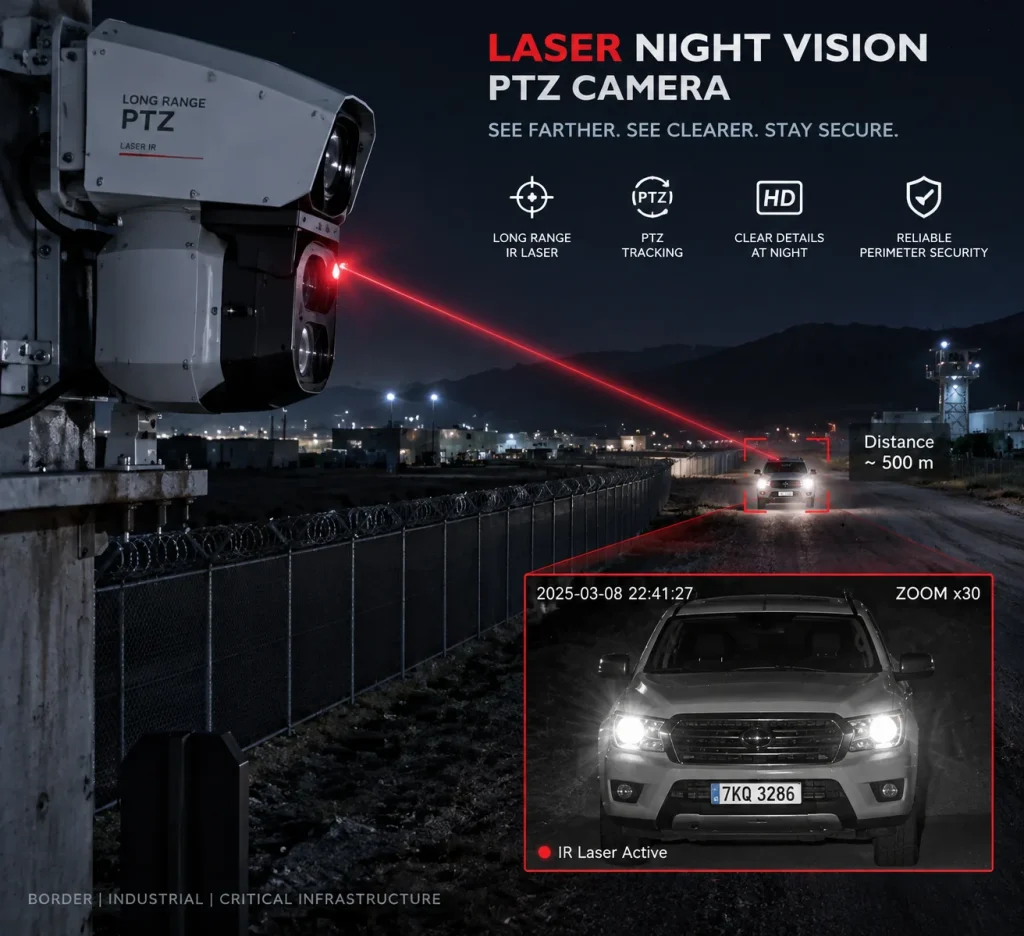
“IR camera” identifies equipment that uses infrared energy. “Night vision” describes the ability to produce a usable image after dark. A laser night vision PTZ camera combines active infrared illumination, visible-channel imaging, zoom optics, and pan-tilt control.
For outdoor monitoring at 150 m or more, identify the imaging method before comparing products.
What Is the Difference Between an IR Camera and a Night Vision Camera?
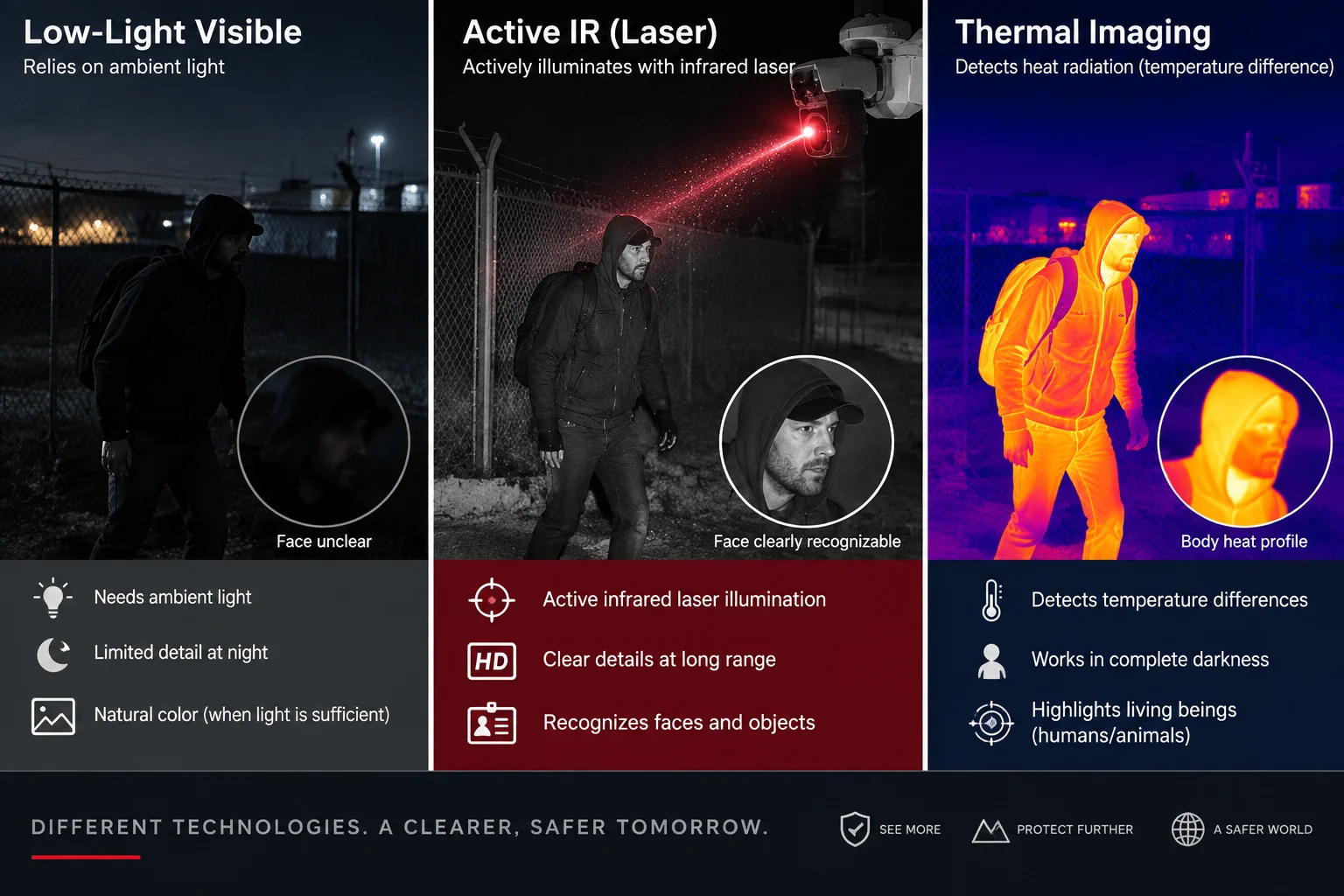
IR camera has two common meanings. An active near-infrared camera records energy reflected from an illuminated scene. A thermal camera detects infrared energy emitted by objects. Night vision can include either method or low-light visible imaging.
| Method | Energy used | Required scene input | Project evidence |
|---|---|---|---|
| Low-light visible | Available visible light | Defined ambient illumination | Night footage under stated light and motion |
| Active IR or laser | Reflected near-infrared illumination | Illuminator, target reflectance, and clear optical path | Beam coverage, camera response, and night test |
| Тепловая визуализация | Emitted infrared energy | Temperature contrast within the scene | Detector, lens, conditions, and acceptance footage |
Active Near-Infrared Imaging
An active system directs near-infrared energy toward a sector and records reflections from the target and background. Results depend on camera sensitivity, illumination field, target reflectance, atmosphere, focus, and lens. Include rain, haze, vegetation, and reflective surfaces in testing.
Align the illuminator field with the camera field of view. Record both fields at the intended zoom settings and check the complete frame for useful illumination.
Thermal Infrared Imaging
A thermal detector records emitted infrared energy and uses temperature differences to form the scene. It operates without an illuminator. Results depend on detector format, pixel size, lens, target dimensions, atmosphere, and contrast.
Thermal imaging supports search in darkness. A visible or active-IR channel can support verification. The Руководство по диапазону DRI тепловизионных камер explains detection, recognition, and identification terms; apply them with a stated target, lens, conditions, and test method.
Low-Light Visible Imaging
A low-light camera uses available visible light. Specify ambient illumination, lens aperture, exposure, frame rate, target motion, and required detail. Acceptance should include the darkest planned operating condition.
What Is a Laser Night Vision PTZ Camera?
A laser night vision PTZ camera combines a day/night imaging channel, laser illuminator, zoom lens, PTZ mechanism, controls, and video output. The laser lights a defined sector and the sensor records reflected energy. Thermal imaging is a separate channel.
Laser Illumination and Visible-Channel Imaging
The specification should state wavelength, illumination distance and test conditions, safety class, beam angle and control, synchronization, and documentation. These values define sensor pairing, optical-zoom linkage, mounting, and safety review.
Ask for night footage with lens position, target, weather, and distance. Test the operator’s actual decision, such as following a vehicle on a highway sector.
Pan, Tilt, Zoom, Presets, and Tracking
PTZ movement steers the view and illuminated sector when the laser is linked to the camera head. The WL-TX30-HD-RCX lists 360-degree endless pan, +90 to -90 degree tilt, 256 presets, and eight tracking paths. Its laser configuration remains unverified and requires separate specifications.
Map presets to roads, utility boundaries, borders, and remote points. Test movement, zoom, illumination alignment, preset recall, and recording as one sequence.
Which Imaging Method Fits a 150 m-Plus Outdoor Task?
Start with the operator’s decision. Thermal imaging supports temperature-contrast search. Active illumination supports reflected-light detail in a defined sector. Low-light imaging uses available visible light.
Thermal Search and Visible Verification
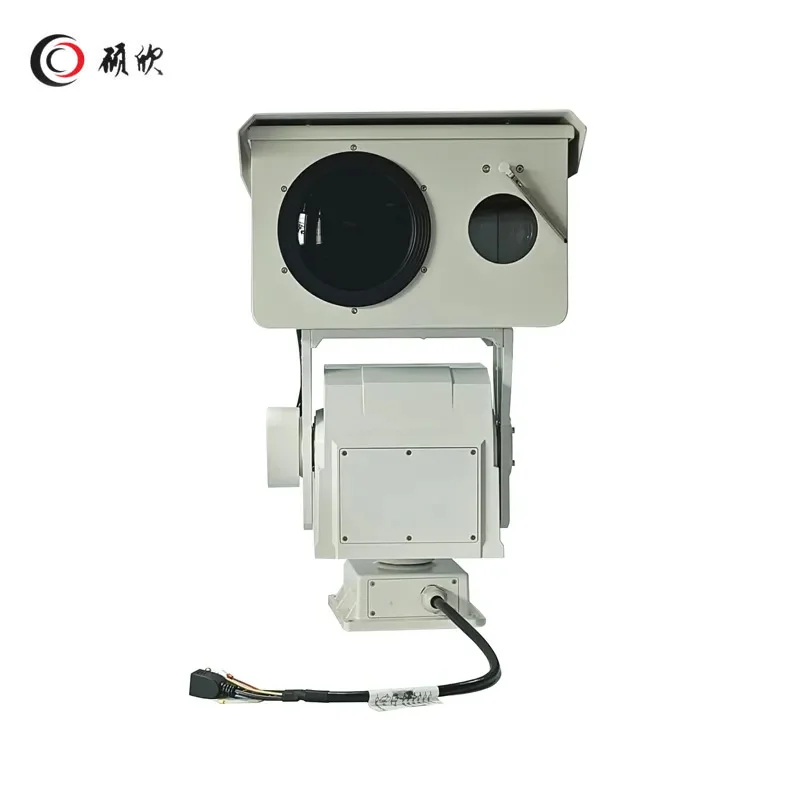
The Shuoxin WL-TX30-HD-RCX combines a 640 x 512 uncooled vanadium oxide detector with a 1920 x 1080 visible channel. Its thermal channel lists an 8-14 um response band, 12 um pixels, and a 30-150 mm lens. The visible channel lists a 1/2.8-inch CMOS sensor, 6.1-317 mm lens, 52x optical zoom, and 16x digital zoom. This биспектральная тепловизионная PTZ-камера дальнего действия is a thermal-visible reference. Laser data remains pending.
Active Illumination for Defined Night Sectors
Active illumination requires a documented target, distance, background, atmosphere, and mounting geometry. Test representative targets at the operator’s zoom positions because surfaces return different amounts of energy.
Combining Channels in an Operator Workflow
Write the sequence: search, slew, zoom, verify, record, and hand off. Assign a channel to each action. This defines the required imaging configuration, streams, and controls.
Which Laser and Outdoor Specifications Should You Confirm?
Separate laser data from camera and PTZ data in the RFQ. Require distinct evidence for illumination and image detail.
| Спецификация | Why it matters | Доказательства для запроса |
|---|---|---|
| Wavelength and camera response | Establishes sensor and illuminator pairing | Model datasheets for both components |
| Safety class and controls | Guides installation and access review | Classification and market documentation |
| Beam angle and control | Aligns illumination with optical field of view | Beam settings and linked-zoom description |
| Illumination distance | Defines the stated test boundary | Target, lens, atmosphere, and test footage |
Laser Wavelength, Safety Class, and Beam Control
Record wavelength, safety class, beam divergence, adjustment, zoom linkage, stabilization, and shutdown controls. Request applicable market documentation. Site design should state mounting height, accessible areas, and operating procedures. These items support approval.
Enclosure, Optical Window, and Weather
The WL-TX30-HD-RCX lists IP66, -35 to +55 degrees C operation, a wiper, heated glass, and defrosting/defogging. Compare these model facts with local temperature, precipitation, dust, wind, and access. Record atmospheric conditions during night tests.
Power, Network, Control, and Recording
The model lists ONVIF Profiles S/G, RS485, H.265/H.264/MJPEG, vehicle DC12V input, and optional shock absorbers. Calculate power for the camera, PTZ drive, heaters, laser, and transmission equipment. Calculate bandwidth and retention, then test control and playback.
How Does Selection Change by Outdoor Application?
Энергетические объекты, подстанции и нефтяные месторождения
Map equipment sectors, reflective surfaces, mounting, power, network paths, and operator response. Assign each decision to a channel and test the view at 150 m or more.
Roads, Police Vehicles, Borders, and Remote Areas
Roads and borders add moving targets, terrain, and variable atmosphere. Police vehicles add vibration, mobile power, and changing communications. Confirm beam control and safety requirements across the route.
Предотвращение лесных пожаров
Forest observation uses broad sectors, terrain, weather, and a defined alarm handoff. Thermal search and visible confirmation should have separate acceptance criteria. The guide to thermal PTZ cameras for forest-fire prevention provides related application context.
Use This Night Vision PTZ Selection Checklist
- Define the 150 m-plus target, sector, and operator decision.
- Assign thermal search, low-light visible imaging, active laser illumination, or a documented combination.
- Match detector, lens, optical zoom, illumination field, PTZ movement, presets, and tracking.
- Confirm laser wavelength, safety class, beam control, and market documentation at model level.
- Confirm enclosure, power, network, codecs, recording, and maintenance access.
- Run daytime, twilight, and night acceptance tests at the intended observation distance.
Conclusion: Specify the Night Imaging Method Before Selecting a Model
An IR label alone does not define the image-forming method. State whether the project needs emitted thermal infrared, reflected active infrared, low-light visible imaging, or a combined workflow. A laser night vision PTZ camera also needs model-level laser, optical, safety, control, and test evidence.
Changzhou Shuoxin Electronic Technology Co., Ltd. supplies the WL-TX30-HD-RCX thermal-visible reference configuration with documented detectors, lenses, PTZ functions, outdoor hardware, codecs, and interfaces. Its available record does not verify a laser module. Use the contact page to submit laser night vision PTZ requirements including target size, distance, ambient light, wavelength and safety needs, mounting, power, network, and acceptance tasks.
ЧАСТО ЗАДАВАЕМЫЕ ВОПРОСЫ
Q1: Is an IR camera the same as a night vision camera?
A: IR identifies the infrared energy used by the camera, while night vision describes operation after dark. An IR camera may use reflected near-infrared illumination or emitted thermal infrared energy. State the sensing method in the specification.
Q2: What does a laser night vision PTZ camera use to form an image?
A: A laser night vision PTZ camera directs infrared illumination toward a sector and records reflected energy with a compatible imaging sensor. Its PTZ mechanism steers the view, while zoom optics set the field of view.
Q3: Does a thermal PTZ camera need a laser illuminator?
A: A thermal detector forms an image from emitted infrared energy and scene temperature contrast. A laser illuminator serves a separate active-imaging channel when the project requires reflected-light detail.
Q4: Which laser specifications should a buyer confirm?
A: Confirm wavelength, illumination distance and test conditions, safety class, beam divergence, beam control, zoom linkage, stabilization, shutdown controls, power, and market documentation. Bind each value to the selected model.
В5: How should a long-range night vision camera be tested outdoors?
A: Test representative targets at the intended 150 m-plus distance during daytime, twilight, and the darkest planned night condition. Record weather, lens and zoom settings, illumination alignment, PTZ commands, streams, playback, and the operator’s acceptance decision.