
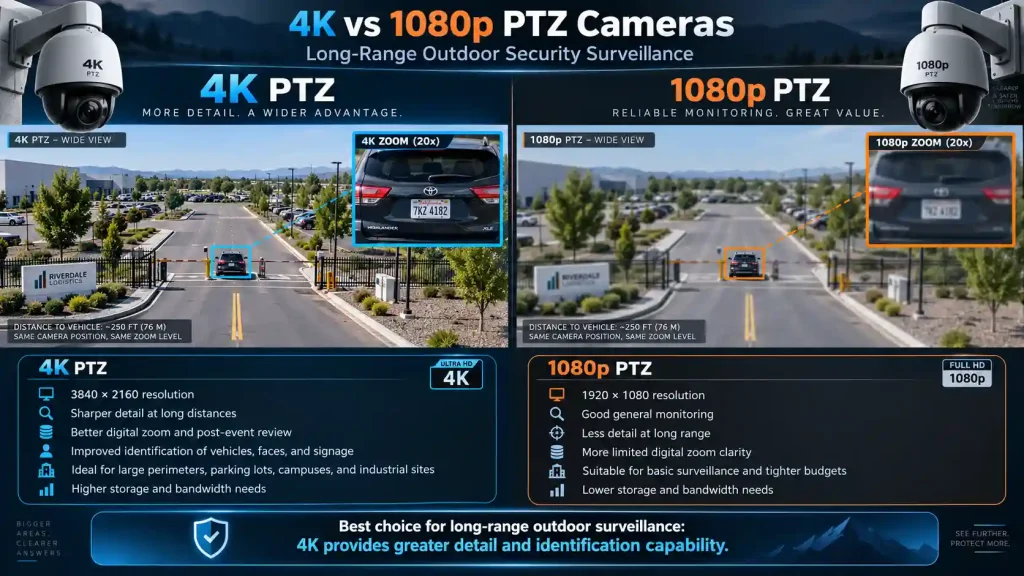
For camera security projects that observe targets from 150 m or more, 4K and 1080p are output choices inside a larger system. A PTZ camera with the correct lens, detector, pan-tilt coverage, network path, and acceptance view can support a defined operator decision. Resolution becomes useful when it matches the target geometry and the way a control room reviews video.
The comparison covers power facilities, roads, police vehicles, border sectors, forest-fire prevention, oilfields, and remote outdoor sites.
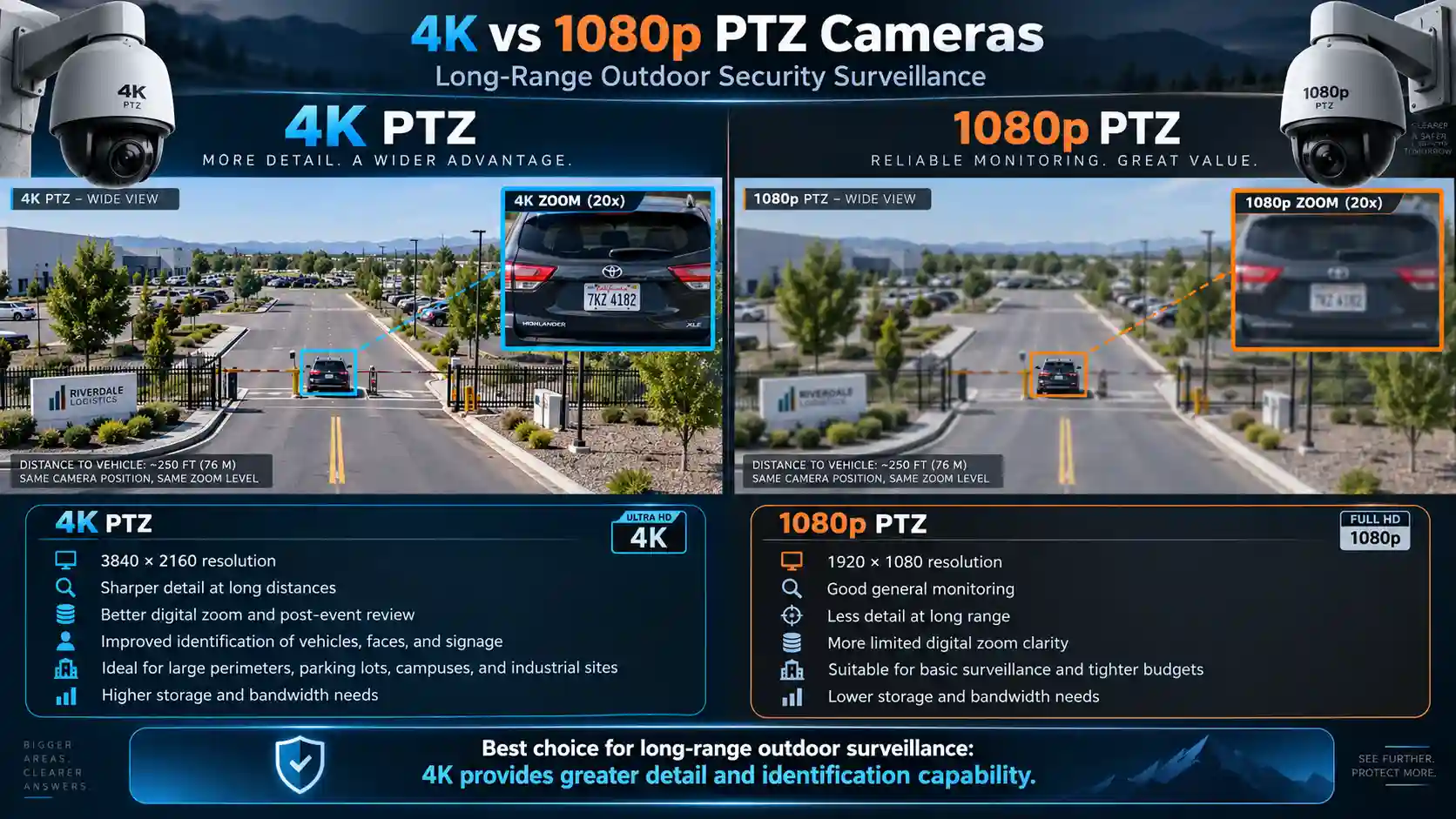
What Do 4K and 1080p Mean in a PTZ Camera?
Resolution describes the number of pixels in a video frame. 4K uses a larger pixel grid than 1080p. Resulting detail depends on the sensor, lens, focus, atmosphere, image processing, display, and recording settings.
4K and 1080p in a Security Video System
Record the required view, target size, lens focal length, optical zoom, frame rate, codec, bitrate, retention, and monitor capability. A 4K stream needs a recording chain and display that preserve its format.
Why Resolution Alone Does Not Define Long-Range Detail
At 150 m-plus, the lens and sightline determine how much of the target occupies the frame. Optical zoom changes target geometry before encoding; digital zoom enlarges recorded pixels after capture. Weather, haze, rain, heat shimmer, and focus stability also affect the operator’s view. Define the action that follows observation, then select the pixel and optical requirements that support that action.
| Decision factor | 4K project condition | 1080p project condition |
|---|---|---|
| Outdoor view | Broad scene or several review areas | Defined target and optical view |
| System capacity | 4K stream, recording, decoding, and display are specified | 1920 x 1080 chain is specified |
| Acceptance focus | Detail across the required wide scene | Operator decision at the selected zoom |
| Shared checks | Lens, sightline, weather, PTZ coverage, codec, and retention | Lens, sightline, weather, PTZ coverage, codec, and retention |
When Should You Choose 4K for Camera Security?
4K fits a broad outdoor view across several review areas when the system can carry, store, decode, and display the stream. Roads, utility perimeters, border sectors, and remote terrain can create this requirement.
Wide Outdoor Scenes and Multiple Review Areas
Record sector width, target dimensions, mounting point, expected movement, and the operator decision. A wider pixel grid can support more cropping within a recorded scene, subject to lens selection and target size. Test representative lighting and weather at the intended distance.
Network, Codec, Storage, and Display Requirements
Ask the integrator to calculate bitrate and retention for the selected frame rate and codec. Shuoxin’s reference model lists H.265, H.264, and MJPEG, giving a compatibility starting point for a video management review. Confirm the camera stream, network uplink, recorder, decoding workstation, and monitor as one chain. A 4K decision belongs in that capacity review.
When Does 1080p Fit a Long-Range PTZ Camera Project?
1080p fits when the selected optics place enough target detail in the frame for the agreed live and recorded decisions. It also fits systems specified around 1920 x 1080 output.
Optical Zoom, Lens, and Target Geometry
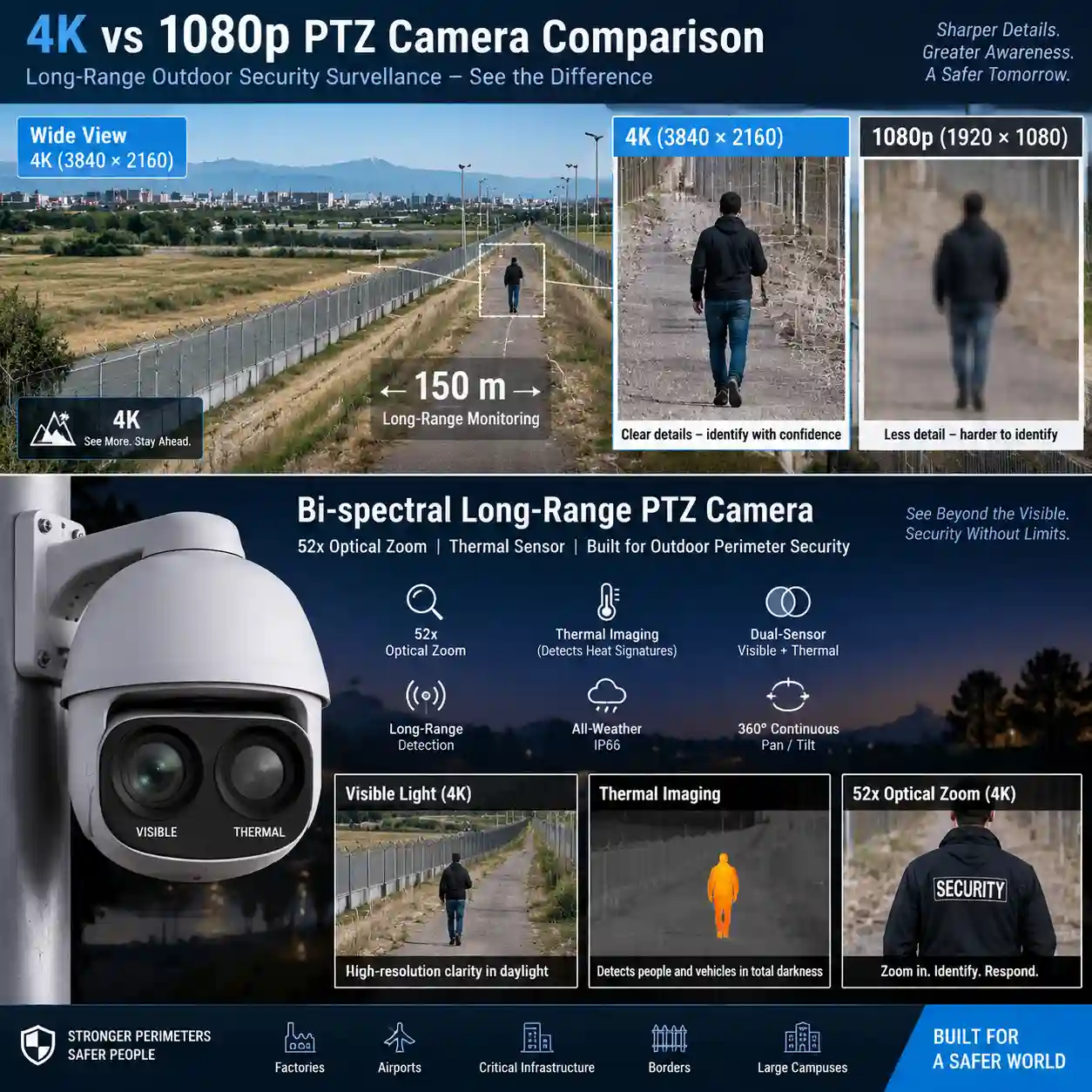
The Shuoxin WL-TX30-HD-RCX provides a verified 1920 x 1080 visible channel, a 1/2.8-inch CMOS sensor, a 6.1-317 mm lens, 52x optical zoom, and 16x digital zoom. These figures describe one bi-spectral configuration. Review the биспектральная тепловизионная PTZ-камера дальнего действия page, then compare the lens range with your target size, sightline, and mounting plan.
Control-Room Workflow and Acceptance Views
Specify the live view, recording, display size, motion, and lighting for acceptance. Ask operators to perform the service task, such as following a vehicle on a road sector. Record the scene, zoom position, focus behavior, and time.
How Do PTZ Functions Affect the 4K vs. 1080p Decision?
Pan, tilt, presets, and tracking paths determine which sector reaches the operator and how quickly it can be revisited. Resolution supports the defined coverage and movement.
Pan, Tilt, Presets, and Tracking Paths
The WL-TX30-HD-RCX lists 360-degree endless pan, +90 to -90 degree tilt, 256 presets, and eight tracking paths. Map those functions to road directions, substation boundaries, border sectors, or recurring forest observation points. A preset map also helps the acceptance team test repeatable views at the project distance.
Thermal Search and Visible Verification
The reference model combines a thermal channel with a visible channel. Its thermal specification lists a 640 x 512 uncooled vanadium oxide detector, an 8-14 um response band, a 12 um pixel size, and a 30-150 mm lens. Use the thermal image for search and the visible channel for the agreed verification task. For terminology and acceptance language, review the Руководство по диапазону DRI тепловизионных камер; keep project distances tied to your own test conditions.
Which Outdoor Conditions Should You Compare?
Outdoor resolution decisions operate within physical and communications constraints. Document exposure, access, power, network availability, and maintenance before selecting the stream format.
Weather, Enclosure, and Optical Window
The WL-TX30-HD-RCX lists IP66 protection, an operating range of -35 to +55 degrees C, a wiper, heated glass, and defrosting/defogging. Treat these as model-specific checks against the installation climate and optical-window maintenance plan. Acceptance should include the weather conditions that matter at the site.
Power, Network, and Remote-Site Communications
For vehicle projects, the model lists wide-range DC12V input and optional vehicle shock absorbers. It also lists ONVIF Profiles S/G and RS485 for platform and control review. Confirm connector, power budget, uplink capacity, recorder compatibility, and remote communications coverage. The selected resolution must fit the complete path.
How Does the Choice Change by Outdoor Application?
Энергетические объекты, подстанции и нефтяные месторождения
Start with the equipment perimeter, sightline, mounting height, and recurring sectors. Compare resolution alongside the lens, PTZ presets, environmental hardware, and control-room display. Utility operators should record the exact view required for each inspection decision.
Roads, Police Vehicles, Borders, and Remote Areas
Mobile and perimeter projects add vibration, changing viewpoints, terrain, and communications gaps. Confirm vehicle power and shock-absorber options where applicable, then test presets and tracking paths along the route or boundary. Resolution follows the documented target and operator action.
Предотвращение лесных пожаров
Forest terrain creates changing backgrounds, long sightlines, and weather exposure. Define sectors, mounting position, handoff rules, and the recorded evidence required by the control room. See the related guidance on thermal PTZ cameras for forest-fire prevention when building the application checklist.
Use This 4K vs. 1080p PTZ Camera Selection Checklist
- Define the 150 m-plus target, sector, and operator decision.
- Record sightline, target size, mounting height, terrain, and weather.
- Compare detector, lens, optical zoom, PTZ movement, and thermal/visible roles.
- Calculate codec, network, recording, retention, and display requirements.
- Confirm power, enclosure, platform compatibility, and remote communications.
- Run a documented acceptance view at the intended observation distance.
Conclusion: Match Resolution to the Outdoor PTZ Camera Task
Choose 4K when the defined outdoor view needs a larger pixel grid and the network, storage, display, and acceptance plan support it. Choose 1080p when the specified optical system and workflow provide the required view at the project distance. Both decisions require the same site record.
Changzhou Shuoxin Electronic Technology Co., Ltd. can discuss the WL-TX30-HD-RCX reference configuration with its 640 x 512 thermal detector, 1920 x 1080 visible channel, 52x optical zoom, PTZ presets, outdoor enclosure features, vehicle input, and ONVIF/RS485 interfaces. Send the observation sector, target geometry, mounting plan, climate exposure, power, network, and acceptance view through submit outdoor PTZ camera requirements so the configuration discussion uses project evidence.
ЧАСТО ЗАДАВАЕМЫЕ ВОПРОСЫ
Q1: Is 4K always better than 1080p for an outdoor PTZ camera?
A: 4K supplies more pixels in each frame. The useful result still depends on lens, target geometry, sightline, weather, network, storage, display, and the operator’s acceptance task.
Q2: Which resolution is better for long-range camera security?
A: The suitable resolution is the one that supports the documented decision at 150 m or more after the optical and system checks. Compare both formats using the same target, lens plan, lighting, recording, and acceptance conditions.
Q3: Does 4K require more bandwidth and storage?
A: A 4K stream carries a larger pixel grid, so the project team should calculate bitrate, recorder capacity, retention, decoding, and display requirements for the selected codec and frame rate.
Q4: What resolution does the Shuoxin WL-TX30-HD-RCX provide?
A: Its visible channel is specified at 1920 x 1080. The same model lists a 640 x 512 thermal detector and separate thermal optics; the product page does not establish a 4K output for this configuration.
В5: What details should be confirmed before choosing a PTZ camera?
A: Confirm target size, observation distance, sightline, mounting, weather, PTZ sectors, detector and lens, power, communications, codec, recording, display, platform compatibility, and the acceptance view. These inputs let a supplier discuss a configuration against the actual outdoor task.