ブログ

目次

    分類

    関連するブログ

    Robot Surveillance PTZ Camera Guide Long-Range UGV Selection
    PTZ vs. Fixed Cameras for Construction Site Security
    How to Protect Outdoor Security Cameras from Weather & Lightning
    サーマルカメラはどこまで見えるのか?DRIとレンジの説明
    ボートの夜間監視におけるサーマルカメラと低照度カメラの比較

    Ambulance Camera System Guide Driving, MDVR & Remote Monitoring

    Ambulance Camera System Guide Driving, MDVR & Remote Monitoring


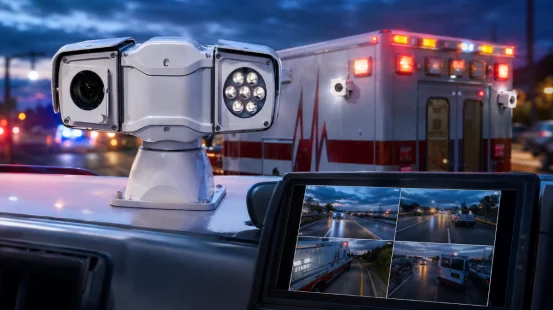
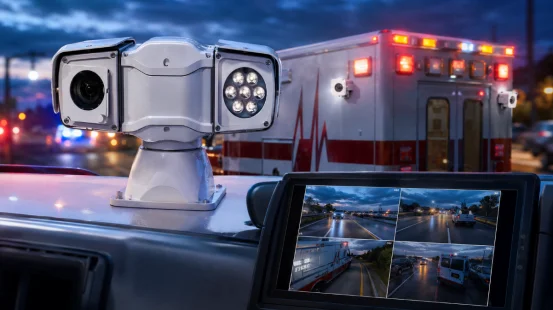
    Vehicle PTZ camera and multi-channel screen in an ambulance

    An ambulance camera system must do more than record the road ahead. Your vehicle may cross an intersection at speed, reach a dark roadside scene, reverse near pedestrians, or face a complaint weeks later. A complete ambulance surveillance system combines exterior cameras, a patient compartment camera, local recording, remote access, and clear data rules.

    An exterior vehicle PTZ camera watches outside. An ambulance interior camera records the patient area. A mobile DVR for ambulance use stores several channels and connects them to an ambulance fleet monitoring system.

    What Does an Ambulance Camera System Include?

    Start with coverage, not a long equipment list. Map the front, rear, sides, cabin, and any long-range observation point before choosing hardware.

    Fixed Exterior Cameras and Blind Spots

    An ambulance blind spot camera provides a continuous view beside or behind the vehicle. Front, rear, and side cameras help during lane changes, reversing, and tight hospital entrances. Unlike an ambulance PTZ camera, a fixed camera cannot turn away from its assigned zone.

    Exterior PTZ Monitoring

    An exterior vehicle PTZ camera adds controlled rotation and optical zoom. It can inspect an accident scene or help a command center view activity from another angle. シュオシン’s 150m night vision vehicle PTZ camera combines 1080p imaging, 33x optical zoom, 360-degree rotation, and infrared illumination.

    Patient Compartment and MDVR Equipment

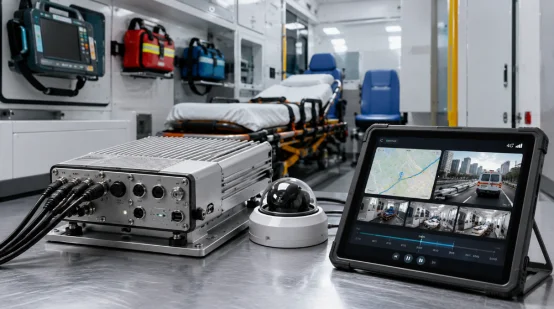
    A patient compartment camera covers the cabin, not the road. It supports patient compartment video recording and event checks. The ambulance MDVR camera system receives several channels, records them locally, and sends selected streams to a remote platform. The MDVR is the recorder, not the camera.

    Why Is a Standard Dash Camera Not Enough?

    A dash camera sees one direction. An ambulance moves through complicated traffic and often stops where ordinary drivers do not. One forward view rarely explains the full event.

    High-Speed Driving Needs Wider Coverage

    A camera system for emergency driving should show areas that mirrors cannot cover well. Side cameras can reveal a motorcycle beside the vehicle. A rear camera shows traffic during a sudden stop. An ambulance reversing camera helps near loading bays and busy emergency entrances.

    Multiple Views Create Better Records

    Ambulance video evidence is more useful when front, rear, side, and interior channels share one timeline. An ambulance accident video recording system can show what happened before impact, where the vehicle stopped, and who approached afterward. That matters during an investigation or ambulance liability dispute video request.

    How Does Night Vision Support Emergency Calls?

    Night performance depends on more than a distance printed on a specification sheet. Headlights, rain, reflective signs, target size, and lens position all change the result.

    Low-Light Roads and Distant Scenes

    1 ambulance camera system with night vision can help you spot people, obstacles, and vehicles during late calls. A night vision ambulance camera with infrared lighting may produce black-and-white images in darkness, while noise reduction helps preserve detail.

    The listed PTZ uses a 5.5 to 180 mm lens, 33x optical zoom, and a stated 150 m infrared range. Its field of view changes from 60.5 degrees at wide angle to 2.3 degrees at telephoto. The wider vehicle PTZ camera range includes other imaging configurations.

    Weather and Vehicle Movement

    A rugged camera for ambulance vehicles should tolerate vibration, rain, dust, and sudden temperature changes. Useful features include shock absorbers, heated glass, defogging, a wiper, and secure mounting. The referenced PTZ lists IP66 protection, minus 35°C to plus 55°C operation, and impact resistance of at least 4G. A clear lens during cold rain is not a small issue.

    How Does an Ambulance MDVR Camera System Work?

    The signal path is simple: cameras capture video, the MDVR stores it, a mobile network carries selected streams, and the management platform controls access.

    Local Recording During Network Loss

    Ambulance camera recording during network loss is essential. Tunnels, underground hospital ramps, and rural roads can interrupt 4G service. Local ambulance video storage should continue when live viewing stops. You can keep the main stream locally while sending a lighter sub-stream for remote viewing.

    Ambulance MDVR storage capacity depends on camera count, resolution, frame rate, bitrate, codec, recording schedule, and retention days. H.265 ambulance video recording can reduce storage and transmission needs, but the calculation still needs realistic scene activity.

    Remote Access and Incident Retrieval

    Remote video monitoring for ambulances lets authorized staff check live channels, device status, and historical footage. An ambulance camera system with remote monitoring may support time-based search, playback, and controlled export. An ambulance camera system with 4G remote access should still record locally. A tunnel is a boring place to learn that remote recording was your only recording.

    How Should Patient Compartment Video Be Protected?

    Interior video can contain patients, medical staff, conversations, and sensitive events. Patient compartment video privacy needs its own policy rather than being treated like road footage.

    Access, Storage, and Audit Rules

    Ambulance video data security should cover encrypted storage, user roles, secure transmission, export permissions, and audit logs. Ambulance camera access control can separate exterior footage from patient-area footage. Retention periods should follow local law, contracts, and EMS policy.

    The in-cabin ambulance camera should capture the required area without creating unnecessary views. If audio is included, state why it is needed and who may access it.

    Ambulance MDVR system with dome camera and remote monitoring tablet

    How Do You Choose the Right Ambulance Camera System?

    When deciding how to choose an ambulance camera system, start with risks and workflows. Resolution alone will not tell you whether the system fits the vehicle.

    A Practical Buying Checklist

    Check fixed coverage for the front, rear, and sides. Decide whether you need a roof-mounted PTZ camera for ambulance observation. Confirm MDVR channels, local storage, remote playback, user permissions, and network-loss behavior. For ambulance camera system integration, verify codecs, ONVIF support, platform APIs, and remote PTZ control for ambulance operations.

    The best camera system for ambulances usually combines fixed cameras, an optional PTZ, a patient compartment camera, and a multi-channel recorder. Test power stability, vibration, time synchronization, and file recovery before delivery. A neat installation means little if footage disappears after a hard reboot.

    From Vehicle Requirements to a Practical PTZ Choice

    Once fixed blind spots, cabin recording, and MDVR storage are planned, you can judge whether long-range PTZ coverage adds real value.

    Shuoxin designs and produces intelligent security monitoring equipment, including vehicle-mounted PTZ, infrared, thermal, and network camera systems. Its 150 m vehicle model supports ONVIF, web or RS485 control, H.265/H.264/MJPEG compression, 256 presets, and several mounting arrangements. Those details suit contractors who need an exterior PTZ camera within a wider emergency vehicle camera system. It complements an EMS fleet camera system rather than replacing the MDVR or interior cameras.

    よくあるご質問

    Q1: What Is Included in an Ambulance Camera System?
    A: Fixed exterior cameras, an optional PTZ camera, a patient compartment camera, an MDVR, local storage, displays, and remote management software.

    Q2: Can a PTZ Camera Remove Every Ambulance Blind Spot?
    A: No. A PTZ can rotate away from a driving zone. Fixed cameras are better for continuous blind-spot coverage.

    Q3: Can Ambulance Video Be Viewed Remotely?
    A: Yes, when the recorder, mobile network, and platform support live view or playback. Local recording should continue during network loss.

    Q4: What Is the Difference Between a Patient Compartment Camera and an MDVR?
    A: The camera captures cabin video. The MDVR records, stores, and transmits video from one or more cameras.

    Q5: How Long Should Ambulance Video Be Stored?
    A: Set the period from local law, EMS policy, contract terms, storage capacity, and the type of footage collected.

    共有:

    Facebook
    Twitter
    LinkedIn
    前の
    Robot Surveillance PTZ Camera Guide Long-Range UGV Selection
    PTZ vs. Fixed Cameras for Construction Site Security

    相談して問題を見つけます

    便利なコミュニケーションの旅を始めてください。