
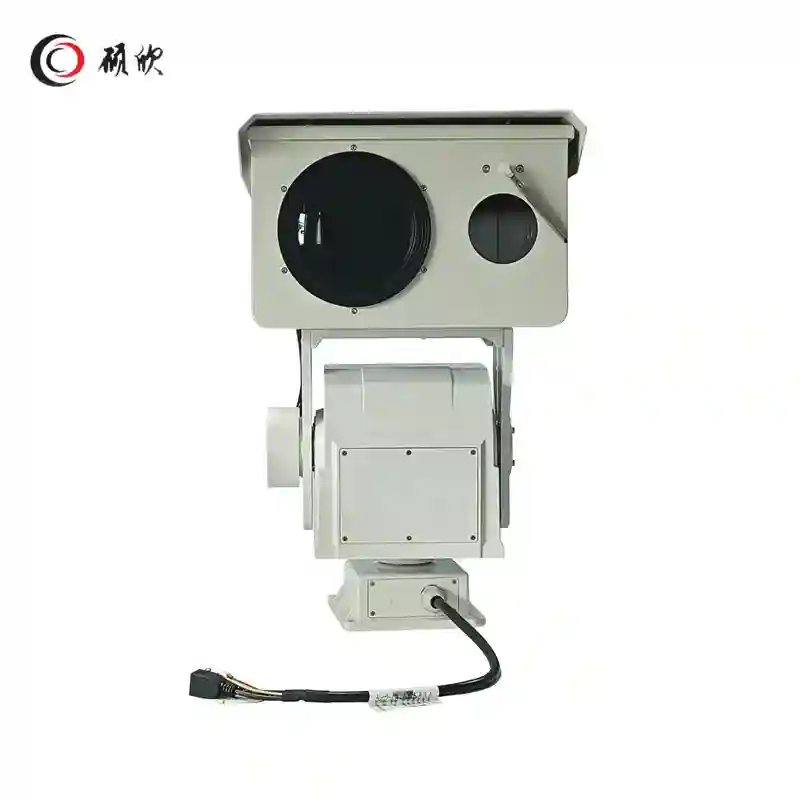
The use of PTZ camera equipment becomes clear when the outdoor task changes across sectors. A PTZ camera can pan, tilt, and zoom between documented viewpoints. A fixed-view camera keeps one framing aimed at one defined sector. At 150 m or more, the choice depends on target geometry, coverage, optics, control, network, power, and the acceptance view.
This comparison supports substations, roads, police vehicles, border sectors, forest-fire points, oilfields, and remote sites. Define the operator’s decision before selecting the architecture.
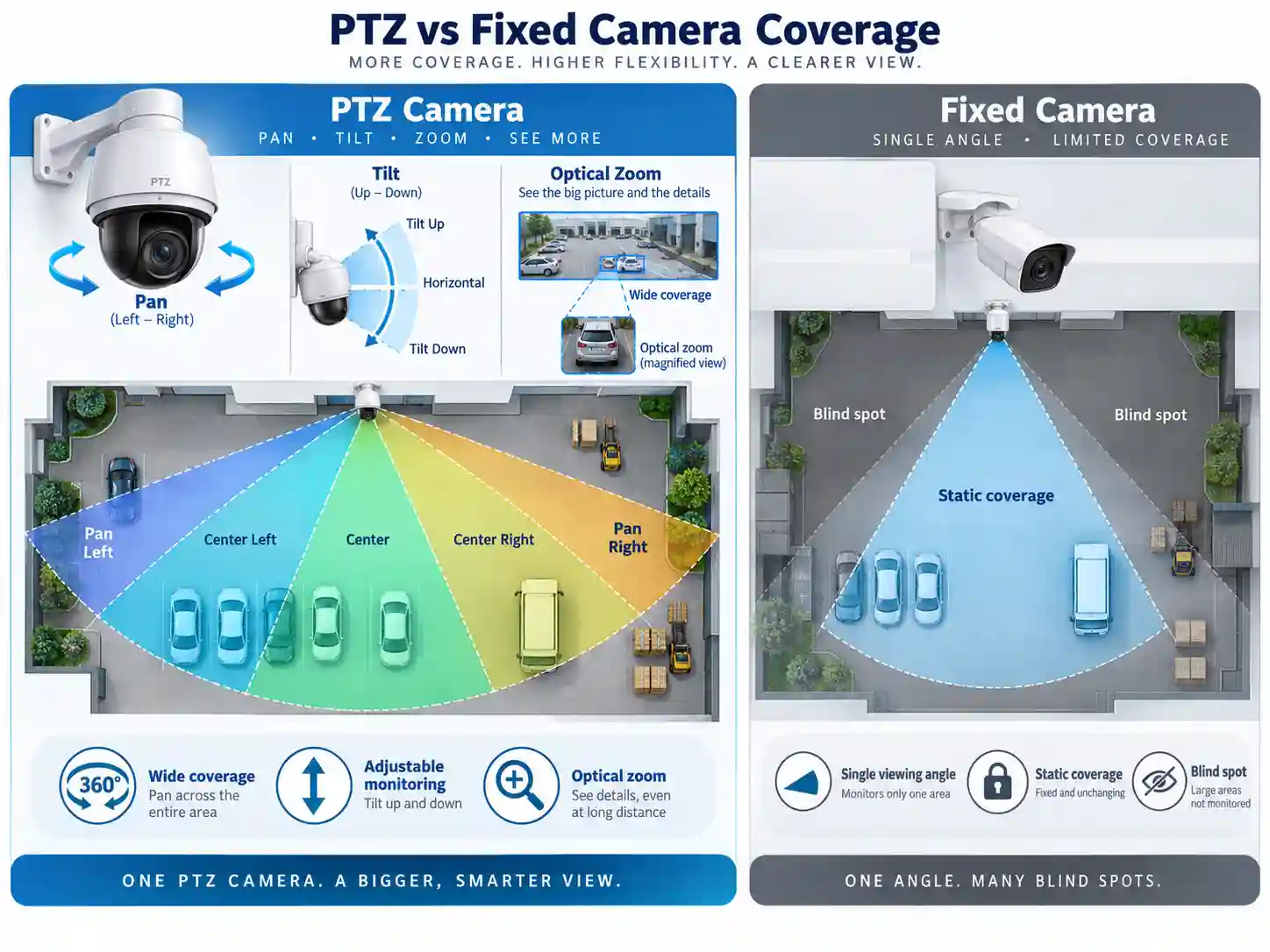
What Is the Difference Between PTZ and Fixed Camera?
PTZ means pan, tilt, and zoom. The camera changes direction or magnification through commands, presets, or tracking paths. A fixed-view camera keeps its optical axis aimed at one scene and records continuously. Both architectures serve outdoor security; their coverage tasks differ.
PTZ Camera Movement and Coverage
PTZ movement lets an operator assign views to several sectors from one mounting point. Pan sets the horizontal direction, tilt sets the vertical angle, and optical zoom changes the target’s size in the image before recording. Presets store repeatable positions, while tracking paths support recurring movement sequences. The project must define which sectors need control and how quickly an operator must revisit them.
Fixed-View Coverage and Observation Task
A fixed view keeps a continuous frame on one documented sector. This arrangement suits a target area with stable geometry, a known sightline, and a recording requirement that does not depend on steering the camera. The lens, mounting angle, weather exposure, and blind areas still need a site review. Multiple fixed views may be required when a project has several critical sectors.
| Decision factor | كاميرا PTZ | Fixed-view camera |
|---|---|---|
| Coverage | Multiple controlled sectors from one mount | One continuous documented sector |
| Detail adjustment | Pan, tilt, and optical zoom | Lens and mounting set the view |
| Operator task | Patrol, preset recall, tracking, and verification | Continuous observation and event review |
| Main project check | Movement map, command path, and handoff | Sightline, blind areas, and frame retention |
What Is the Use of PTZ Camera in Long-Range Outdoor Monitoring?
The use of PTZ camera equipment fits outdoor tasks that require changing sectors, moving-target follow-up, or a thermal-to-visible verification step. A single mount can serve a planned patrol route when the camera, link, and control platform support the required views. The decision remains tied to target size and sightline at 150 m or more.
Multi-Sector Observation and Preset Routes
Road corridors, utility boundaries, border sectors, and remote terrain can contain several observation points. Map each sector, priority, and operator action. Assign presets to recurring views and define handoff between sectors. Acceptance should show each preset returning to its agreed view.
Optical Zoom and Target Verification
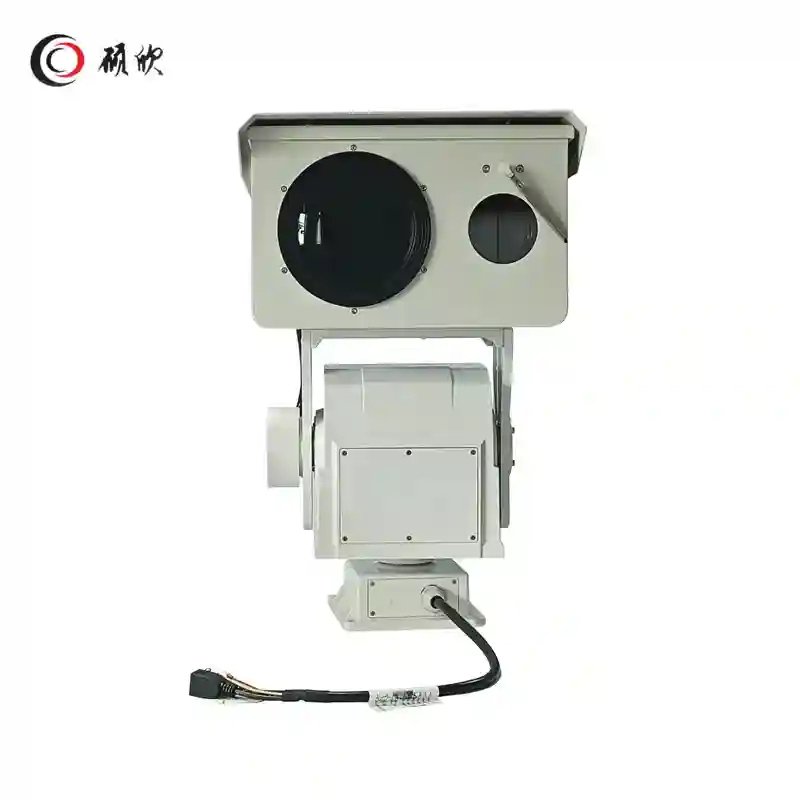
The Shuoxin WL-TX30-HD-RCX lists a 1/2.8-inch CMOS visible sensor, 1920 x 1080 output, a 6.1-317 mm lens, 52x optical zoom, and 16x digital zoom. Its thermal channel lists a 640 x 512 uncooled vanadium oxide detector and a 30-150 mm thermal lens. Review the كاميرا PTZ للتصوير الحراري ثنائي الطيف بعيد المدى configuration against the target, mounting position, and required verification view.
When Can a Fixed-View Camera Fit an Outdoor Security Task?
A fixed-view camera fits an outdoor task when one sector remains critical and the project needs continuous framing. Examples include an equipment boundary, a road approach, or a perimeter segment with stable geometry. The project should show that the lens and mount keep the target in view at the intended distance.
Defined Sector and Stable Mounting
Record target dimensions, sightline, elevation, mounting height, lens, focus, weather, obstructions, and maintenance access. The site plan must identify blind areas and additional observation points.
Recording, Handoff, and Coverage Gaps
Set recording, retention, display layout, and event handoff. If a moving target leaves the fixed frame, define the next camera or PTZ station. Test the handoff with representative motion and lighting.
How Do PTZ Functions Affect the Comparison?
PTZ functions add controllable coverage to camera security. The control path, presets, tracking, and recorded views must operate together. Name each function required at the project distance.
Pan, Tilt, Presets, and Tracking Paths
The WL-TX30-HD-RCX lists 360-degree endless pan, +90 to -90 degree tilt, 256 presets, and eight tracking paths. Map these functions to road directions, substation sectors, border lines, or forest observation points. Run preset recall, manual movement, zoom, and tracking during acceptance. Record the selected view and operator action for each test.
Thermal Search and Visible Verification
The model lists an 8-14 um thermal response band and a 12 um pixel size alongside its thermal detector. Use the thermal channel for the defined search task and the visible channel for the agreed verification task. The دليل نطاق كاميرا التصوير الحراري DRI explains DRI terms for project discussions. Keep every distance and acceptance conclusion tied to the site’s test conditions.
Which Outdoor Conditions Should You Compare?
The camera architecture operates within the enclosure, optical window, power, communications, and maintenance plan. Compare those conditions before selecting PTZ or fixed view.
Weather, Enclosure, and Optical Window
The WL-TX30-HD-RCX lists IP66 protection and an operating range of -35 to +55 degrees C. It also lists a wiper, heated glass, and defrosting/defogging. Compare these model-specific specifications with local temperature, precipitation, dust, and access conditions. Include optical-window cleaning and weather checks in acceptance.
Power, Network, and Control Integration
The model lists wide-range DC12V input for vehicle configurations and optional vehicle shock absorbers. It also lists ONVIF Profiles S/G, RS485, and H.265/H.264/MJPEG. Confirm the power source, control protocol, recorder, platform, stream settings, and communications path. Test PTZ commands and recorded playback through the installed system.
How Does the Choice Change by Outdoor Application?
محطات توليد الطاقة، والمحطات الفرعية، وحقول النفط
Compare fixed sectors requiring continuous framing with sectors needing patrol or zoom control. Record access, power, mounting, exposure, and control-room handoff. Acceptance should show the required equipment view.
Roads, Police Vehicles, Borders, and Remote Areas
Moving targets and changing viewpoints require controllable coverage. Roads and borders need route or sector maps. Police vehicles add mobile power, vibration, and changing communications. Confirm vehicle configuration, presets, link behavior, and recording across the route.
الوقاية من حرائق الغابات
Forest observation points can cover broad sectors with changing terrain and weather. Define the observation handoff, mounting position, backhaul, power, and maintenance access. The guide to thermal PTZ cameras for forest-fire prevention provides related application context.
Use This PTZ Camera Selection Checklist
- Define the 150 m-plus target, sector, and operator decision.
- Decide whether one continuous view or multiple controlled sectors are required.
- Compare lens, optical zoom, detector, PTZ movement, and recording.
- Confirm mounting, enclosure, power, network, control protocols, and maintenance access.
- Map blind sectors, presets, handoff rules, and acceptance views.
- Test the selected architecture at the intended observation distance.
Conclusion: Match the Camera Architecture to the Outdoor Task
A PTZ camera serves changing sectors, moving targets, and controlled zoom when the project defines those actions. A fixed-view camera serves one continuous sector when its lens, mounting, and recording view meet the acceptance requirement. The use of PTZ camera equipment should follow the site map and operator workflow.
Changzhou Shuoxin Electronic Technology Co., Ltd. supplies the WL-TX30-HD-RCX reference configuration with documented thermal and visible channels, PTZ presets, outdoor hardware, vehicle options, codecs, ONVIF Profiles S/G, and RS485. The verified specification does not identify a fixed-view counterpart or a built-in wireless technology. Send the target, mounting plan, power, network, critical sectors, and acceptance views through submit outdoor PTZ camera requirements for a configuration discussion.
الأسئلة الشائعة
Q1: What is the difference between PTZ and fixed camera?
A: A PTZ camera changes pan, tilt, and zoom to serve controlled views. A fixed-view camera keeps one optical framing on a defined sector. The project choice depends on coverage and operator tasks at the intended distance.
Q2: What is the main use of PTZ camera for outdoor security?
A: The use of PTZ camera equipment supports changing sectors, moving-target follow-up, preset patrols, and thermal-to-visible verification. Define the sectors, target geometry, and operator action before selecting the model.
Q3: When can a fixed-view camera fit a 150 m-plus observation task?
A: A fixed-view camera fits when one sector needs continuous framing and the selected lens and mount keep the target in view. Record sightline, blind areas, weather, lighting, and the required recorded view for acceptance.
الربع الرابع: Which PTZ specifications should an outdoor project compare?
A: Compare pan, tilt, optical zoom, presets, tracking paths, detector, visible channel, enclosure, power, interfaces, codecs, recording, and platform compatibility. Test each required function through the installed system.
س5: What information should be submitted for a PTZ camera configuration?
A: Submit the observation distance, target size, sectors, mounting point, terrain, weather, power, communications, platform, stream requirements, and acceptance tasks. These inputs let the supplier discuss a configuration against the outdoor project.