
A loading-yard camera can record a truck and still miss the plate, driver, or pallet involved in a dispute. Industrial CCTV systems work when each view has a defined job. Start with the incident you need to investigate, then select the lens, network, power, and storage around that task. Industrial surveillance systems should produce a result the installer can test before handover.
What Should an Industrial CCTV System Protect?
List the events that matter at entrances, production rooms, warehouses, loading bays, control rooms, and the perimeter. The industrial security camera system should record evidence for intrusion, accidents, equipment damage, and disputes.
Map Risks and Required Evidence
Give each camera one written purpose. A gate may need a plate and driver image. A warehouse overview tracks movement; a second view records the item crossing the door. Warehouse surveillance cameras often need both.
Separate Security Monitoring from Machine Inspection
IP surveillance cameras record changing areas for people to review. Machine-vision cameras may use a trigger to inspect a fixed product line and send raw images to processing software. Define the task before requesting quotations because the capture and software designs differ.
Which Camera Types Fit Each Industrial Zone?
Mounting position, target distance, weather, and movement determine the camera type. Each zone needs its own view.
Use Fixed Cameras for Defined Views
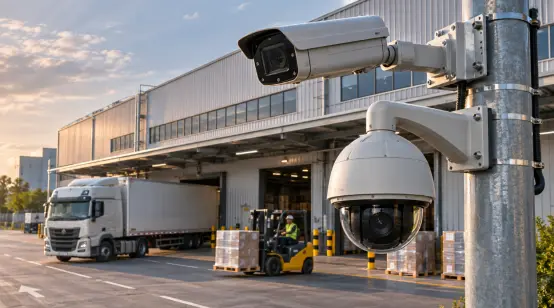
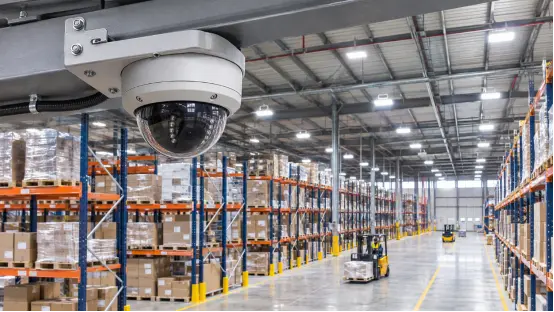
Dome or turret cameras fit ceilings and indoor circulation areas. Bullet cameras suit gates, fence lines, and loading doors. Factory security cameras near machinery need stable mounts away from vibration and obstructions.
Assign PTZ and Thermal Cameras Specific Jobs
An industrial PTZ camera can patrol a yard and inspect distant details through optical zoom. Fixed cameras keep continuous coverage while the PTZ faces elsewhere. Thermal imaging can detect people, vehicles, or unusual heat in darkness. Compare industrial camera and PTZ options with the required distance.
How Much Image Detail Does the Project Need?
The lens and target size determine the useful image detail. Specify industrial video surveillance by the required result, such as a readable plate or identifiable package.
Match the Lens to Distance and Target Size
A wide lens covers more area and makes distant targets smaller. A longer focal length narrows the field and reaches farther. Test varifocal or zoom options from the actual mounting position.
Test Lighting and Movement at the Site
Use wide dynamic range where a dark building faces a bright yard. Infrared supplies black-and-white night images; starlight or full-color modes preserve color. Moving vehicles may need a higher frame rate. Test headlights, welding light, dust, steam, and reflective metal.
What Environmental Protection Does the Site Require?
Temperature, water, dust, vibration, corrosion, and electrical interference affect industrial camera installation. Record them for each zone.
Specify Outdoor and Harsh-Environment Protection
Outdoor barrel cameras commonly use IP66 or IP67 housings. Check the unit, cable entry, connector, bracket, and power supply. Coastal or chemical environments may require corrosion-resistant materials. Compare the operating range with site temperatures.
Treat Hazardous Areas as a Separate Design Task
Refineries, mines, and areas with combustible dust or gas require equipment selected for the classified zone. The project safety team should define certification and installation requirements. Weather protection alone does not provide explosion protection.
How Should You Design Network and Power?
Industrial surveillance systems may place cameras far from the control room. Draw cable routes, switches, uplinks, and power sources first.
Calculate Traffic before Selecting Switches
Add every camera bit rate on each uplink, plus live viewing traffic. Check switch uplinks, backplane performance, packet rate, and NVR bandwidth. Fiber can serve long routes between buildings. A lighter substream suits remote viewing.
Check PoE Power under Night Load
A PoE security camera system carries data and power through one cable. Include cold starts, infrared lamps, heaters, and PTZ movement in the power budget. A camera may restart when infrared turns on. Small detail, expensive service call.
How Much Recording and Storage Should You Plan?
Set retention from incident discovery time, policy, and legal requirements. An NVR for industrial surveillance must support camera count, bit rate, drive capacity, and expansion.
Size the Recorder from Channels and Bit Rate
Storage equals bit rate multiplied by time and channel count, divided by eight. Sixteen channels at 2 Mbps for 30 days require about 3.3 TB before working allowance. Motion recording saves space in quiet zones; active production areas may record continuously.
Add Edge Storage and Recovery
Camera-side storage can record during a network outage and transfer the missing segment after reconnection. Large industrial CCTV systems can use local recording with central management to reduce network pressure.
Which Analytics Deserve a Place in the System?
Each analytic rule needs a named recipient and response. Test it with workers, vehicles, weather, and normal production activity.
Connect Every Alert to a Response
Human and vehicle classification, line crossing, and intrusion zones can support a perimeter surveillance system. Set schedules and target sizes. Test leaves, rain, shadows, and steam because these conditions can trigger weak rules.
Use Thermal Data for Defined Industrial Risks
A thermal imaging camera for industrial use can monitor equipment, warehouses, and dark boundaries. Multispectral systems pair visible detail with temperature distribution. Define alarm temperature, distance, response, and visible-light confirmation.
What Should You Test before Handover?
The final test should reproduce real events. A noon image says little about a wet gate at night or a dusty forklift aisle.
Test Real Events by Day and Night
Drive through the gate, move a pallet through the warehouse door, and walk the perimeter. Confirm faces, plates, packages, and vehicles in playback. Check focus after PTZ movement.
Verify Recording, Access, and Recovery
Confirm retention, export, timestamps, alerts, permissions, and outage recovery. Lock recorders and switches in controlled rooms. Document camera names, cable routes, spare ports, and maintenance ownership before the industrial security camera system enters service.
How Can the Camera Package Fit the Project?
Large yards, long gates, and dark perimeters need different imaging ranges. Шуосинь offers 2MP and 4MP IP zoom modules with 23x to 40x optical zoom, plus PTZ and thermal camera categories. A designer can match distance, movement, and low-light conditions to each zone. Request a sample image from the proposed mounting point before ordering an industrial PTZ camera or fixed unit.
ЧАСТО ЗАДАВАЕМЫЕ ВОПРОСЫ
Q1: How many cameras does an industrial site need?
A: Count the views required for each risk. Entrances, production areas, warehouses, loading bays, and perimeter sections may need separate overview and identification views.
Q2: Is 4K required for factory security cameras?
A: Use 4K where a wide scene needs fine detail. A suitable lens may meet the evidence target at a lower resolution.
Q3: When should an industrial project use thermal imaging?
A: Thermal imaging suits dark perimeters and heat monitoring around defined equipment or storage risks. Visible-light video supplies color and identity detail.
Q4: How do you calculate storage for industrial CCTV?
A: Multiply bit rate by time and channels, then divide by eight. Add working allowance and confirm the selected recording schedule.
Q5: Is PoE suitable for industrial surveillance systems?
A: Yes, when cable distance, switch power, environmental conditions, and surge protection fit the site. Test the full night load before acceptance