
For industrial surveillance cameras, picking between infrared vs. thermal imaging depends on what you need to see at night. An active infrared night vision camera works by catching bounced near-IR light from a built-in lamp.
A thermal imaging camera spots the heat given off by objects. Both types use infrared light waves. Still, CCTV buyers often say “infrared camera” when they really mean active near-IR night vision.
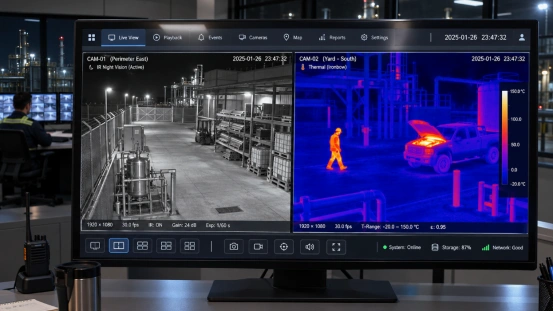
| Camera type | Image source | Useful for | Main check |
| Active IR night vision | Reflected near-infrared light | Visual detail in a defined area | Illuminator reach and beam angle |
| サーマルイメージング | Emitted thermal radiation | Finding warm targets in darkness | Thermal contrast, detector and lens |
| Bi-spectral PTZ | Thermal and visible-light channels | Detection followed by visual inspection | Channel performance and PTZ coverage |
What Is the Difference Between Infrared and Thermal Imaging?
When you buy CCTV gear, active IR and thermal imaging do very different jobs. Active IR shoots out near-infrared light for the camera lens to catch. This mostly gives you a black-and-white picture. Thermal imaging feels the heat from a target and its background. Then, it shows their heat patterns on the screen. It can build a clear picture in total pitch black without any extra lights.
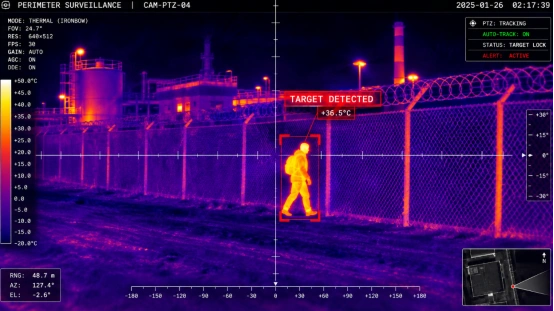
Active IR can show sharp edges and surface details as long as its light hits them. Thermal imaging can help you spot a person or a car by showing their body heat against a cold background. But, the thermal view alone usually cannot show clear faces, clothing details, or license plates.
When Should You Choose an Infrared Night Vision Camera?
You should pick an infrared night vision camera when you need normal video of a door, a loading dock, a walking path, or a road at night. It works best in fixed spaces. You aim the camera right at the action. Then, you make sure the built-in light can cover that whole spot. The normal camera lens will record the bounced near-IR light in black and white.
Match the Illuminator to the View
Security cameras mostly use 850 nm or 940 nm near-infrared lights. The 850 nm light is more common. It can shine much farther. The 940 nm light gives off less of that faint red glow. But, many camera sensors do not see as well in that 940 nm range. So, you must check the camera and its light together as a team.
One model says its IR light can reach a 150 m distance. Seeing a clear face depends on the lens, the size of the target, the camera angle, the weather, and how light bounces off the scene. A long, narrow space needs a tight beam of light. A 10 m warehouse needs a wide beam. Strong IR lights use a lot more power. Check your PoE power limits when the night lights turn on.
When Does a Thermal Imaging Camera Suit Industrial Surveillance?
A thermal imaging camera is great for outdoor factory security. Use it when you need to spot a warm body far away across a dark yard, a fence, or a work zone. It does not need visible light. It does not need an IR lamp either. Some setups use an uncooled 640 × 512 detector. They use an 8 to 14 μm response band and have sensitivity below 35 mK. Always check the exact data sheet for the model you pick.
Check Thermal Contrast and Measurement Needs
Thermal cameras work well when the target is much warmer or colder than the background. A person walking in a cold yard is very easy to see. But hot pipes, running motors, ovens, or walls baked by the sun can hide the target. Test the scene, the lens, and the detector at the real distance. Test them during the exact hours when you need the alarms to work.
Thermal detection can warn you about a warm object. But it might not tell you who or what it is. Pair it with a normal video camera if your guards need to see clothing, faces, or plates. A radiometric thermal camera needs exact measurement rules. It also needs a proper alarm setup to give correct heat numbers.
Which Specifications Determine Useful Performance?
Start by looking at the distance and details you need at every camera spot. A thermal camera’s spotting range depends on a few things. These include detector resolution, lens size, target size, heat contrast, and the weather. Check if a camera’s range claim means just spotting an object, knowing what kind of object it is, or clearly identifying who it is.
Read Range Claims in Context
For a normal visible camera, compare how wide it can see and its optical zoom at your set distance. Some bi-spectral PTZ cameras offer 33× and 52× zoom choices. A tight, narrow view gives great detail at a far-away gate. But it covers a much smaller part of the yard.
Check the thermal resolution and sensitivity next to the lens. One choice lists a sensitivity below 35 mK. Make sure you check the power draw when the IR is running. Check your network speed, recorder matching, safe operating temperatures, and ingress rating. IP ratings tell you about dust and water safety. If you are in a risky, explosive zone, you need extra special safety papers.
When Is a Bi-Spectral PTZ Camera the Better Fit?
A bi-spectral PTZ camera puts a thermal camera and a visible-light camera into one body. A guard can find moving things using the heat view. Next, they can use the optical zoom to look at it up close. The PTZ movement lets the camera turn toward a fence, a loading spot, or a machine area. Good options include full 360-degree turning, saved positions, ONVIF support, and H.264/H.265 video saving, depending on your model.
The PTZ can only point one way at a time. Map out your blind spots. Put fixed cameras on the most important paths. Make sure your video box can show both camera views and handle the right alarms.
How Should You Test Cameras Before Buying?
Ask the seller for a free site test or real test videos. Look at the view after dark with the IR turned on. Watch out for bad glare bouncing off shiny walls or close objects. For thermal units, test a warm person against the real background. Make sure to include any nearby hot factory machines.
Walk to each camera spot and write down your exact goal. Do you need to spot motion, know if it is a car, see a clear face, or check exact heat numbers? Look at the lens, alarms, saving space, power, mounts, rain safety, and hazardous-area rules to match that goal.
Match Detection and Visual Evidence to the Same Site
シュオシン sells active-IR PTZ cameras with a listed 150 m light option. They also sell bi-spectral PTZ setups that give you thermal spotting and optical zoom together. These cameras are very good for watching long roads and checking big open yards. Look at the whole security camera product line. Check the detector, lens, heat reading, power, and weather rules for your exact site. The Shuoxin website gives you more details about the company and its items.
よくあるご質問
Q1: Is thermal imaging infrared?
A: Yes. Thermal cameras catch infrared heat waves given off by objects. But when buying CCTV, the term “infrared camera” usually means a different tool. That tool uses an active near-IR light to bounce light back to the lens.
Q2: Can a thermal camera identify faces or license plates?
A: Thermal video helps you spot a person or a car using heat. But the thermal picture almost never has enough clear detail to read a face or a plate. Use a normal visible-light camera to get that exact proof.
Q3: Can an infrared or thermal camera see through glass?
A: Normal window glass blocks most of the long-wave infrared that thermal cameras need. Active IR lights can also bounce right off the glass and blind the lens with glare. Put the camera outside the glass if you need a clean, clear view.
Q4: Does every thermal camera measure temperature?
A: No. Standard thermal imaging just shows heat shapes. For true heat numbers and alarms, you need a special model. It depends on the unit’s build, exact setup, and proven accuracy. Check those exact rules when your factory needs real number readings.
Q5: Can active IR and thermal imaging work together?
A: Yes. A bi-spectral camera joins thermal and visible-light parts inside one system. The thermal side helps you find movement in the dark. At the same time, the visible side gives the guard clear details to look at.