
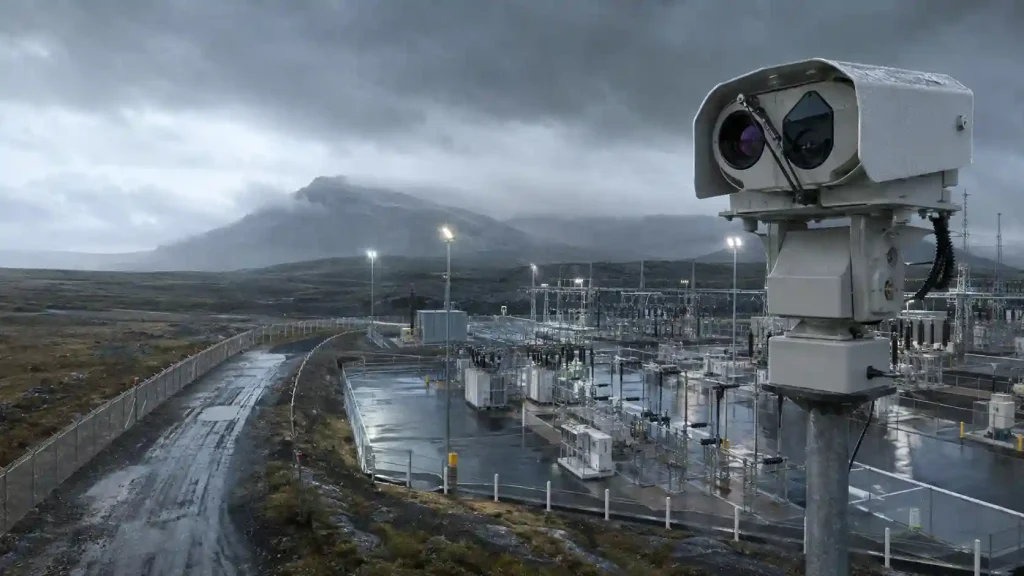
Choose a ptz thermal camera from the outdoor observation task. For a project beginning at 150 m, document the target sector, sightline, mounting point, environmental exposure, operator action, and control-room connection. That record guides the review of thermal optics, visible verification, PTZ coverage, enclosure, power, communications, and site acceptance.
This guide addresses power facilities, substations, roads, patrol vehicles, border sectors, forest-fire prevention areas, oilfields, and remote infrastructure. The 150 m boundary defines the editorial scope. It does not state a camera performance distance.
What Is a PTZ Thermal Camera?
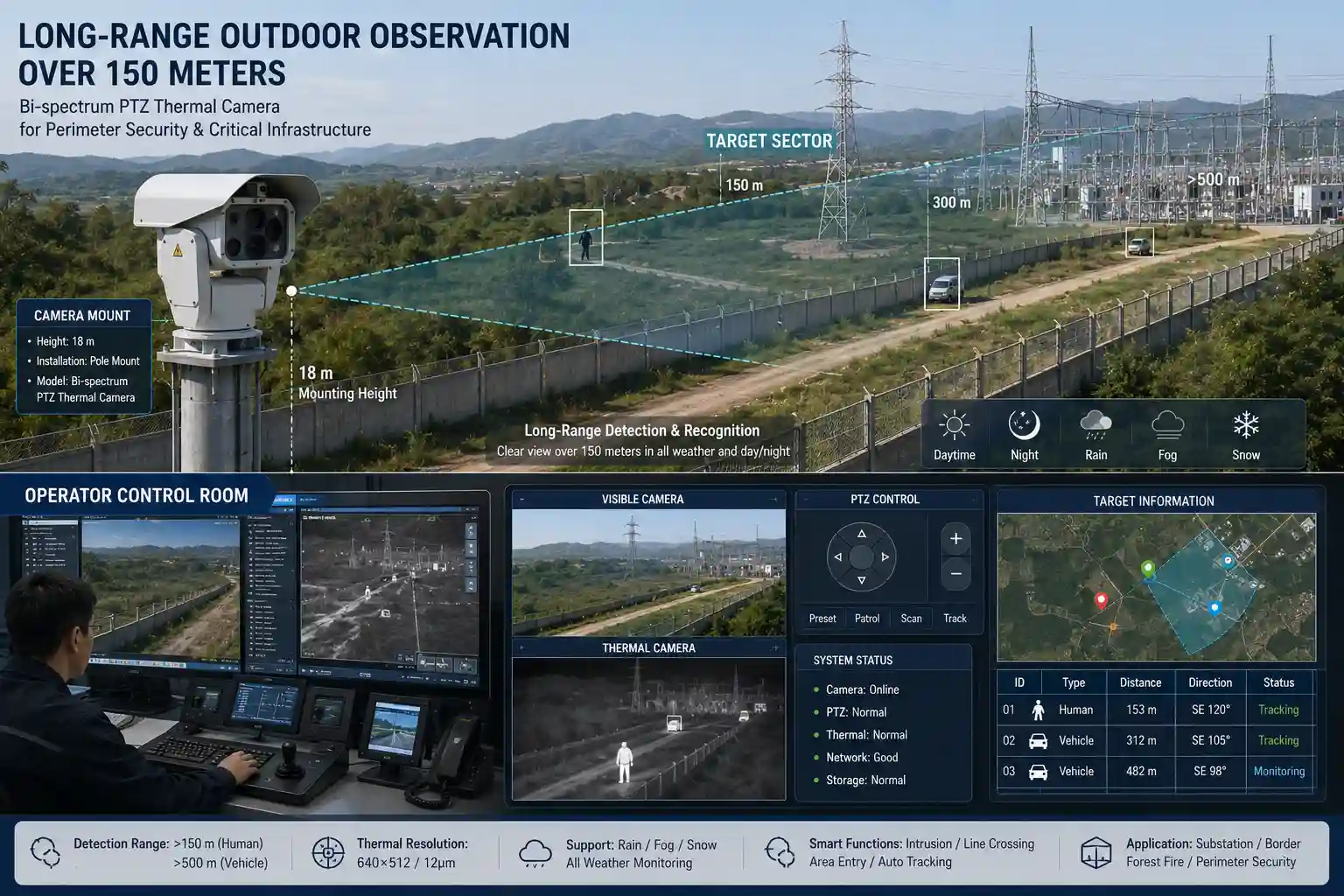
A PTZ thermal camera combines a thermal imaging channel with pan, tilt, and zoom movement. A bi-spectral configuration can include a visible-light channel. The thermal channel forms an image from heat patterns. The visible channel provides a second operator view when site light and atmosphere support it. PTZ control moves the camera between defined sectors and repeat observation points.
For a long-range security camera project, the channels, lens, presets, network path, and operator procedure form one operating plan.
How Do You Define a 150 m-Plus Outdoor Observation Task?
Start with the decision an operator must make. A road control point may need recurring views along defined directions. A substation may need coverage of outdoor equipment zones and access routes. A border or forest sector may use a structured scan route from a high mounting point. Record the target area, approximate target size, planned operating period, and action that follows an observation.
Set the Observation Objective and Target Area
Map the sector before choosing focal length or zoom. Record the starting distance, longest sightline, terrain changes, obstructions, and repeat-view areas. This map gives the supplier and project team a basis for discussing field of view and presets.
Define the thermal and visible-channel roles in the operating procedure. State the channel used for a sector scan, the view used for the next operator decision, and the preset that resumes the route. Keep this sequence in the project specification.
Map Sightlines, Mounting, and Environmental Exposure
Document mounting height, cable route, service access, wind, rainfall, dust, temperature, power, sun angle, vegetation, and terrain. These conditions affect camera location and PTZ patrol routes.
The site survey also defines acceptance evidence. Agree on the sectors, preset views, channel switching, recording, and control commands to test after installation.
Which PTZ Thermal Camera Specifications Matter for Security Selection?
Read the detector, optics, visible channel, PTZ mechanics, and system interfaces as one configuration.
| Selection input | What to define | Prove da richiedere |
|---|---|---|
| Observation sector | Target area, sightline, mounting point, operator action | Site map and acceptance views |
| Thermal channel | Detector format, response band, pixel size, thermal lens | Model specification and lens configuration |
| Visible channel | Sensor, resolution, lens, zoom | Model specification and planned-position views |
| PTZ coverage | Pan, tilt, presets, tracking paths, sector sequence | Preset plan and control test |
| System connection | Power, network, codec, recording, platform interface | Wiring and integration review |
Review the Thermal Detector and Lens Together
Review detector format, pixel size, response band, lens focal length, target size, site geometry, and atmospheric conditions together.
The Shuoxin WL-TX30-HD-RCX provides a 640 x 512 uncooled vanadium oxide detector, an 8-14 um response band, 12 um pixel size, and a 30-150 mm thermal lens. These figures describe a reference configuration for comparison with the defined sector. The telecamera PTZ a infrarossi bispettrale a lungo raggio page lists the documented configuration.
Temperature range, calibration, and measurement accuracy require thermometry documentation for the selected model. An outdoor security camera review can focus on the channel, lens, target, environment, control process, and site test.
Plan Thermal Observation and Visible-Channel Verification
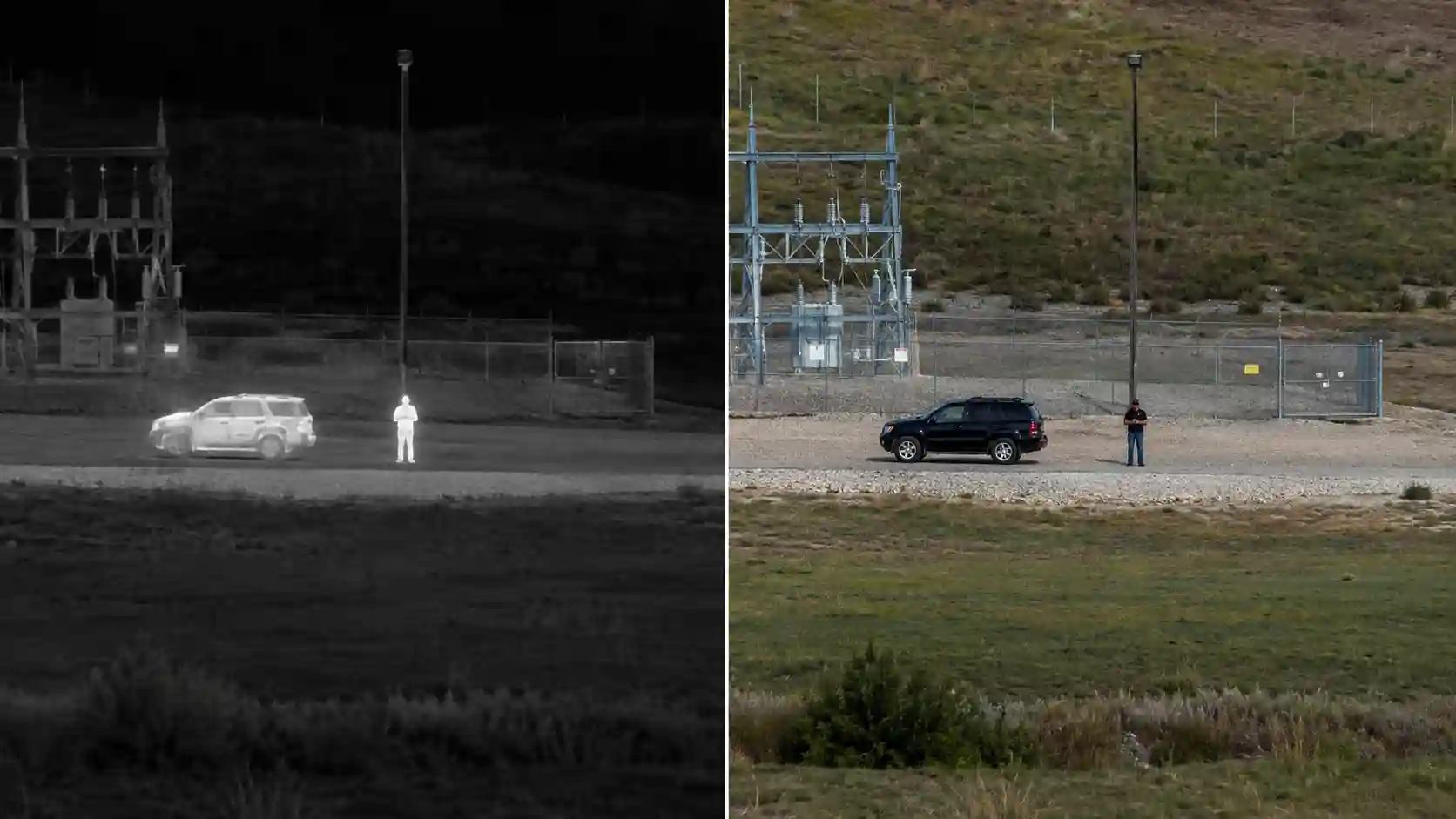
Write the channel sequence into the operating procedure. The thermal view supports a sector search; the visible channel provides a second view when conditions allow it. State the event record, PTZ preset, channel selection, and response handoff.
For the WL-TX30-HD-RCX, the visible channel uses a 1/2.8-inch CMOS sensor with 1920 x 1080 resolution, a 6.1-317 mm lens, 52x optical zoom, and 16x digital zoom. Optical zoom changes the lens view; digital zoom enlarges the recorded image. Review this channel at the intended mounting position and operating conditions.
Match PTZ Coverage to Patrol Routes and Presets
Specify sector order, dwell time, overrides, return position, and events that call another preset. The WL-TX30-HD-RCX lists 360-degree endless pan, +90 to -90 degree tilt, 256 presets, and eight tracking paths. The Guida alla portata della termocamera DRI provides DRI terminology for acceptance records; results require the selected model and site conditions.
Which Outdoor PTZ Security Camera Conditions Must You Confirm?
An outdoor PTZ security camera needs a review of the enclosure, optical window, power source, communications path, recording system, and control interface.
| Site condition | WL-TX30-HD-RCX documented item | Project review |
|---|---|---|
| Weather and dust | IP66; -35 to +55 degrees C | Local temperature, rain, dust, wind, drainage, cable protection |
| Optical window | Wiper, heated glass, defrosting, defogging | Window condition, maintenance access, service procedure |
| Integrazione | ONVIF Profiles S/G, RS485, H.265/H.264/MJPEG | Platform version, topology, bandwidth, recording, commands |
| Vehicle platform | Wide-range DC12V input; optional shock absorbers | Electrical connection, mounting, vibration, cable protection |
Check the Enclosure and Environmental Hardware
The listed IP66 protection, -35 to +55 degrees C operating range, wiper, heated glass, defrosting, and defogging form a site-check list for this model. Compare them with local rain, dust, temperature, wind, salt exposure, cable protection, and maintenance access.
Confirm Power, Network, Control, and Recording Requirements
The WL-TX30-HD-RCX lists ONVIF Profiles S/G, RS485, H.265, H.264, and MJPEG. Confirm platform version, network topology, bandwidth, recording, permissions, and control commands. For a patrol vehicle, confirm the DC connection, mounting, vibration provisions, cable protection, and communications handoff.
How Does Selection Change by Outdoor Application?
The selection method remains based on sector, mounting point, response procedure, and environmental exposure. The project record changes by application.
Impianti di produzione di energia, sottostazioni e giacimenti petroliferi
Define outdoor equipment areas, access routes, weather exposure, and control-room handoff. Connect each sector to a preset plan, network path, power source, and acceptance view.
Roads, Patrol Vehicles, Borders, and Remote Areas
Map directions, terrain, preset routes, communications paths, and operator actions. Vehicle projects add power and vibration data. Include the vehicle platform, mounting location, DC input, and communication arrangement in the configuration request.
Forest-Fire Prevention Areas
Record terrain, observation points, sector boundaries, weather exposure, and response path. The thermal PTZ cameras for forest-fire prevention article offers related context. The selected model and acceptance criteria remain project-specific.
Use This Six-Step Thermal Camera Selection Workflow
1. Define the 150 m-plus observation objective, target area, and operator action. 2. Survey sightlines, terrain, mounting position, environmental exposure, power, and service access. 3. Set thermal and visible-channel requirements with selected-model documentation. 4. Map PTZ sectors, presets, tracking paths, and manual-control actions. 5. Confirm enclosure, electrical connection, network, codecs, recording, control, and platform compatibility. 6. Agree on acceptance views, commands, records, and environmental checks before delivery.
The site owner records conditions, the integrator maps the camera to the system, and the commissioning team tests the documented requirements.
Conclusion: Turn the Site Record Into a PTZ Thermal Camera Configuration
Thermal camera selection starts with the outdoor sector and ends with a documented site test. A PTZ thermal camera needs an aligned thermal lens, visible channel, PTZ route, environmental configuration, power arrangement, and control-room connection for the task at 150 m or more.
Shuoxin offers the WL-TX30-HD-RCX with a 640 x 512 thermal detector, 30-150 mm thermal lens, 1080p visible channel, 256 presets, IP66 protection, and DC12V vehicle input. Submit sector, mounting, climate, power, network, and platform details through Shuoxin’s project contact channel for configuration discussion.
FAQ
Q1: What is a PTZ thermal camera?
A: A PTZ thermal camera combines thermal imaging with pan, tilt, and zoom movement. A bi-spectral model can add a visible-light channel. The project team matches the channels and PTZ plan to an outdoor observation task.
Q2: How do I choose a PTZ thermal camera for a 150 m-plus outdoor site?
A: Start with the target area, sightline, mounting position, weather exposure, operator action, and control-room connection. Then review the thermal detector and lens, visible channel, PTZ presets, enclosure, power, network, and acceptance procedure. The 150 m-plus scope needs a site-specific review.
Q3: Which thermal camera specifications should an outdoor security project compare?
A: Compare detector format, response band, pixel size, thermal lens, visible sensor and lens, PTZ range, preset capacity, environmental features, power input, codecs, control interfaces, and recording compatibility.
Q4: What should I confirm for a vehicle-mounted outdoor PTZ security camera?
A: Confirm the mounting location, DC power connection, vibration provisions, cable protection, network arrangement, control method, and preset plan. The WL-TX30-HD-RCX lists wide-range DC12V input and optional shock absorbers; final compatibility needs installation review.
Q5: What information should I provide when requesting a thermal camera configuration?
A: Provide the observation sector, target area, distance, terrain, mounting position, environmental conditions, power source, network, video platform, control protocol, recording requirement, vehicle details, and acceptance views. These inputs let a supplier assess the selected configuration against the site.