
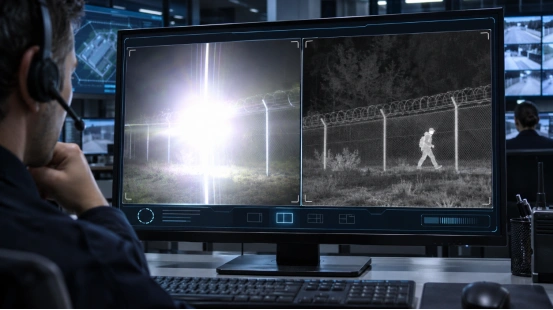
A perimeter feed can turn into a white disk and streaked frame while the recorder, network, and PTZ controls stay online. That pattern points to light entering the lens. An IR blinding attack can saturate a visible or near-infrared sensor long enough to hide a person or vehicle. A true anti-laser PTZ camera needs measurable optical protection and a second observation path. A rugged housing alone does not address the beam.
What Happens During an IR Blinding Attack?
Silicon CCD and CMOS sensors respond strongly to visible and near-infrared energy. A focused source entering the lens concentrates light on the image sensor, so the affected area can grow far beyond the small spot seen from outside.
Saturation, Blooming, and Sensor Damage
At lower incident energy, camera sensor saturation creates a bright area with lost detail. Charge may spread into nearby pixels and produce blooming or streaks. The picture can recover when the source moves away. Higher energy may create dead pixels, damaged lines, or full sensor failure. Wavelength, power at the lens, exposure time, focal length, aperture, filter transmission, and sensor response all affect the result.
This is why laser camera blinding cannot be judged from laser color or an advertised range. Near-infrared light may be faint or invisible to an operator while the camera receives a strong signal.
Why Are IR-CUT and WDR Functions Limited?
IR-CUT, automatic exposure, and wide dynamic range help cameras handle normal changes in scene lighting. Their published purpose and test conditions differ from deliberate high-intensity exposure.
Day and Night Imaging Has a Different Job
During the day, an IR-CUT assembly blocks part of the near-infrared spectrum to improve color. At night, the mechanism moves the cutoff filter away so the sensor can use infrared illumination. That night setting can leave the silicon sensor more responsive to incoming near-infrared energy.
WDR and strong-light suppression can reduce glare from headlights or entrances. They do not establish PTZ camera laser protection. A buyer needs a separate optical test report that states the wavelength and incident level. Ordinary day and night features may still help the image recover after brief glare, but they carry no anti-laser rating by themselves.
What Should an Anti-Laser PTZ Camera Include?
An anti-laser camera system starts at the optical path. Software can shorten exposure or flag a saturated region, yet the lens may continue focusing energy onto the sensor.
Wavelength-Specific Optical Protection
أن optical filter for laser protection should state its blocked wavelength range, optical density, angle limits, clear aperture, and transmission across the camera’s useful band. A narrow filter can reject a known wavelength with less effect on the rest of the picture. Wider protection usually removes more useful light, which can reduce night sensitivity or alter color.
Ask how the filter behaves across the full zoom range. A long focal length narrows the field and can concentrate incoming energy. Protective glass also needs an environmental specification for temperature, moisture, vibration, and coating durability.
Exposure Control and Attack Detection
Fast exposure reduction, gain control, saturation alarms, and automatic PTZ movement can limit the time spent looking directly at a source. These functions need defined trigger thresholds and logs. The operator should receive an alarm that identifies the affected channel, time, preset, and recovery status.
Why Does Multi-Spectral Redundancy Matter?
A single visible or near-infrared sensor creates one optical failure point. Surveillance camera redundancy uses another camera, another viewing angle, or another spectral channel to preserve useful information.
Separate Visible and Thermal Observation Paths
A multi-spectral PTZ camera may combine visible, infrared illumination, laser illumination, and thermal imaging. A separate long-wave thermal channel commonly works around 7 to 14 micrometers and forms an image from target radiation. Visible and near-infrared attacks occupy a different spectral region, so a tested thermal path can maintain target detection when the visible channel saturates.
A thermal imaging PTZ camera still needs its own protection review. Thermal optics, detector limits, switching time, alignment, and image detail should appear in the acceptance plan. Thermal video may show a warm target while providing less visible detail for clothing, color, or plate reading.
How Can Site Design Reduce Direct Laser Access?
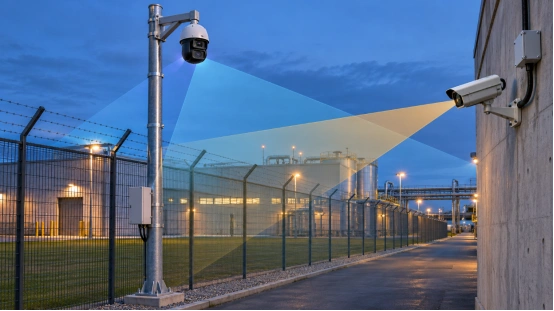
Camera placement changes how easily a beam can enter the lens. Site design adds useful protection before the optical hardware has to react.
Change Geometry and Overlap Critical Views
Mount the PTZ above easy line of sight and use a hood that stays outside every zoom position. Avoid long straight approaches aimed at the lens. Place a fixed camera at an offset angle to cover the PTZ and the route below it. Two separated cameras make one beam direction less likely to block both views.
For a long-range PTZ security camera, keep the wide scene on a fixed unit while the PTZ examines detail. Presets should include a safe overview position and a route that moves away from a detected glare source.
What Must a Supplier Prove?
The phrase laser-resistant security camera has little purchasing value until the supplier attaches numbers and a test method.
Turn Anti-Laser Claims into Test Values
Request protected wavelengths, optical density, incident power or irradiance at the entrance aperture, exposure duration, beam angle, zoom position, and pass criteria. The report should state the largest obscured image area, recovery time, dead-pixel result, and transmission loss during normal day and night imaging.
Also request the filter part number and its position in the optical stack. A generic IR-cut specification describes color control. It does not document resistance to a directed source.
How Should You Test the System before Acceptance?
Acceptance testing should protect people, equipment, and the site. Improvised field tests can injure eyes and permanently damage the camera.
Use a Controlled Optical Test
Use a qualified optical laboratory or a documented supplier test setup. Test the agreed wavelengths and exposure limits with the camera at wide and telephoto positions. Record visible and thermal output, alarms, PTZ response, recovery time, and post-test pixel condition. Repeat normal low-light tests afterward because a protective filter can change night performance.
How Can a Multi-Sensor Configuration Support the Project?
شوكسين offers PTZ configurations that combine visible, thermal, laser, infrared, and white-light channels for defined projects. Available platform features include continuous pan, optical zoom, ONVIF control, defrost and defog equipment, weatherproof housings, and wipers. These capabilities provide a practical base for channel redundancy and long-range observation. The public product information does not assign an anti-laser rating.
A project inquiry should therefore specify threat wavelengths, filter requirements, protected channels, switching logic, mounting geometry, and the required laboratory test. Written confirmation keeps the anti-laser requirement tied to the delivered configuration.
الأسئلة الشائعة
Q1: Does an IR-CUT Filter Stop an IR Blinding Attack?
A: A standard IR-CUT mechanism manages day and night color response. Laser protection requires wavelength-specific attenuation data and testing.
Q2: Can WDR Prevent Infrared Camera Blinding?
A: WDR manages ordinary bright and dark areas. A directed high-intensity source can still saturate or damage the sensor.
Q3: Does Thermal Imaging Provide a Backup View?
A: A separate thermal channel can provide another spectral path. Test its band, alignment, switching, and target detail for the project.
Q4: Which Laser Wavelengths Should the Filter Block?
A: Base the filter on the site’s documented threat assessment. Request attenuation and image-transmission data for every specified band.
Q5: Can You Test Anti-Laser Protection on Site?
A: Use a qualified laboratory or a controlled supplier procedure. Casual laser testing creates eye hazards and may destroy the sensor.