ブログ

目次

    分類

    関連するブログ

    How Far Can a Thermal Camera See? DRI & Range Explained
    Best Thermal PTZ Camera for Forest Fire Prevention: Early Detection Before Flames Spread
    IP66 Outdoor PTZ Camera for Harsh Weather Road Surveillance
    Marine Thermal PTZ Cameras for Maritime Search and Rescue: Finding People and Vessels in Darkness and Fog
    Oil Field and Pipeline Surveillance: Why Long-Range Night Vision Cameras Are Critical for Leak, Theft, and Intrusion Prevention

    Thermal vs Low-Light Cameras for Boat Night Surveillance

    Thermal vs Low-Light Cameras for Boat Night Surveillance
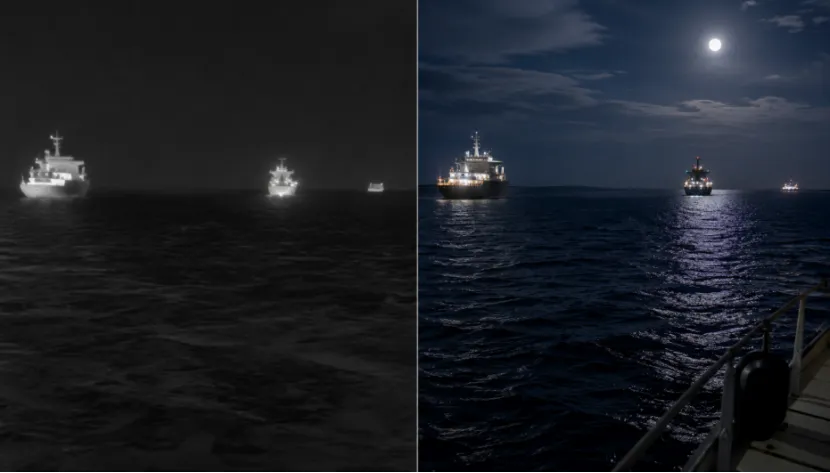
    Thermal vs. low-light camera view of ships at night

    Night surveillance at sea is not simply “seeing in the dark.” You may need to spot a person in black water, check whether an unlit shape is a small craft, or read a hull number near a dim harbor. Waves and engine vibration add another problem. A thermal camera for boats reveals heat without visible light. A low-light camera for boats uses moonlight, starlight, or weak deck lighting. Your choice depends on whether you need fast detection or clear identification.

    Which Camera Gives the Better Night View?

    In complete darkness, a thermal camera for boats is usually the stronger standalone choice. It detects infrared energy rather than reflected light, so a warm person, running engine, or recently used machinery may stand out. A marine thermal camera also avoids the glare created by deck lights.

    A low-light camera for boats has a different job. It uses a sensitive sensor, suitable lens aperture, gain control, and image processing to capture tiny amounts of available light. The security camera knowledge base notes that starlight cameras can still produce color video in very slight light. Low-light sensitivity is measured in lux, and a lower value indicates operation in a darker scene.

    This makes a starlight marine camera useful when you need natural colors, clothing details, buoy markings, or recognizable evidence. A thermal image may reveal a target but not show whether it is a person, an animal, or warm floating equipment.

    How Do Thermal and Low-Light Cameras Compare?

    When comparing thermal vs night vision for boats, name the task first. A boat night vision camera near a harbor has different priorities from a night surveillance camera for ships watching an open sea lane.

    Factor Thermal Camera Low-Light Camera Better Fit
    Complete darkness Works without visible light Needs ambient light or an illuminator Thermal
    Moonlight Shows heat, not natural color Can show detailed Full HD images Low-light
    Light fog Often keeps useful heat contrast Visible contrast may fall Thermal for detection
    Target detection Strong with temperature contrast Depends on available light Thermal
    識別 Weak for color and text Better for markings and faces Low-light
    Initial cost Usually higher Usually lower Low-light

    A thermal imaging camera for boats is strong for finding a target. A high-sensitivity visible camera is stronger for confirming what it is. At 02:00, finding a person overboard comes first. Later, clothing color and body movement may help a rescue crew judge the situation.

    Which Camera Works Better in Fog and Rough Water?

    No marine night vision camera can see perfectly through dense fog, heavy rain, spray, or a wet window. Thermal imaging may perform better in light fog or haze, but moisture still reduces range. Temperature contrast matters too. A cold object close to the water temperature may blend into the background.

    A thermal camera for man overboard detection can help locate body heat when enough contrast exists. A visible long-range marine camera can then show a life jacket, arm movement, nearby ropes, or a rescue craft.

    Motion matters as much as darkness. At high optical zoom, a small roll can push the target across the frame. A gyro-stabilized marine camera uses attitude sensing and mechanical compensation to reduce this movement. For a marine camera for rough seas, stabilization is not a luxury. Without it, you may detect a target but fail to hold it long enough to inspect.

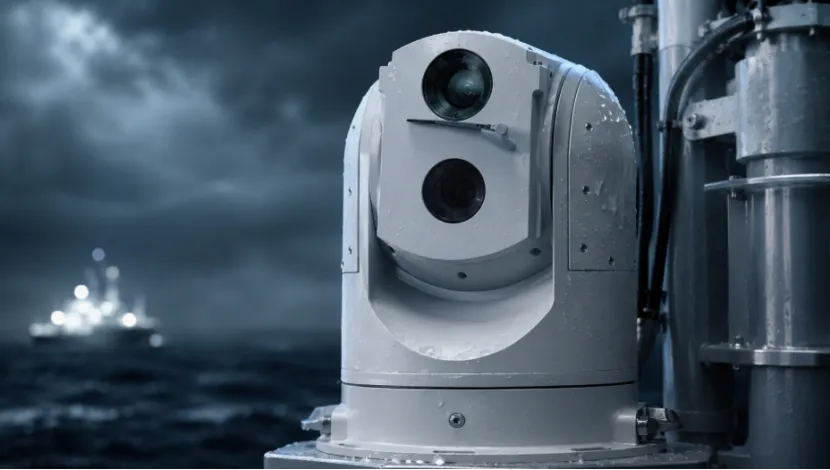
    Marine PTZ camera mounted on a ship in stormy weather

    Is One Camera Enough for Professional Marine Surveillance?

    Near a lit marina, one good low-light camera for boats may be enough. For patrol vessels, commercial ships, offshore structures, or search work, a dual-spectrum marine camera gives you a clearer decision path. The thermal channel finds heat. The visible channel supplies Full HD detail. A marine PTZ camera then pans, tilts, and zooms toward the area that needs attention.

    The knowledge base defines PTZ as pan, tilt, and zoom, and notes that PTZ systems support 360-degree, long-distance observation. It also states that resolution, focal length, sensor performance, signal-to-noise ratio, and lens aperture affect usable image quality. Ocean and ship environments need corrosion-resistant materials and proper sealing.

    A marine surveillance camera can support situational awareness, but a thermal camera for night navigation should not replace radar, AIS, charts, or a proper watch. Cameras answer visual questions. They do not remove normal navigation duties.

    Where Does Shuoxin Fit into This Choice?

    シュオシン designs and produces intelligent security monitoring equipment for maritime, transportation, border defense, and environmental applications. Its gyro-stabilized dual-spectrum PTZ camera combines a 640 × 480 thermal channel with a 1920 × 1080 visible channel and 52× optical zoom. Listed sensitivity reaches 0.0005 lux in color and 0.00001 lux in black and white. The unit also provides biaxial gyroscopic stabilization, continuous 360-degree pan, optical fog penetration, a wiper, IP67 protection, and a corrosion-resistant metal structure. It is specified for ships and high-altitude observation, where attitude sensors adjust camera posture as the platform moves.

    This configuration joins a thermal camera for boats with visible detail in one system. The dual-spectrum marine camera can move from discovery to confirmation without forcing you to change devices during a fast event.

    よくあるご質問

    Q1: Is a thermal camera for boats useful in total darkness?
    A: Yes. It detects infrared energy and needs no visible ambient light. Results still depend on resolution, lens, distance, weather, and temperature contrast.

    Q2: Can a marine thermal camera see through fog?
    A: It may keep better target contrast than a visible camera in light fog or haze. Dense fog, rain, spray, and wet optics still reduce range.

    Q3: What is the best boat night vision camera for identification?
    A: A high-sensitivity visible camera is usually better for natural color, hull markings, clothing details, and recognizable Full HD evidence.

    Q4: Do you need a marine PTZ camera on a moving ship?
    A: PTZ lets you search broad zones. It helps check faraway objects. Gyroscopic stabilization is vital. It keeps views steady if waves or vibrations cause image drift.

    Q5: Should you choose thermal or low-light imaging?
    A: Choose thermal for detection in complete darkness. Choose low-light visible imaging for identification where some light exists. For demanding 24-hour work, combining both is usually the practical choice.

    共有:

    Facebook
    Twitter
    LinkedIn
    前の
    How Far Can a Thermal Camera See? DRI & Range Explained
    Best Thermal PTZ Camera for Forest Fire Prevention: Early Detection Before Flames Spread

    相談して問題を見つけます

    便利なコミュニケーションの旅を始めてください。