
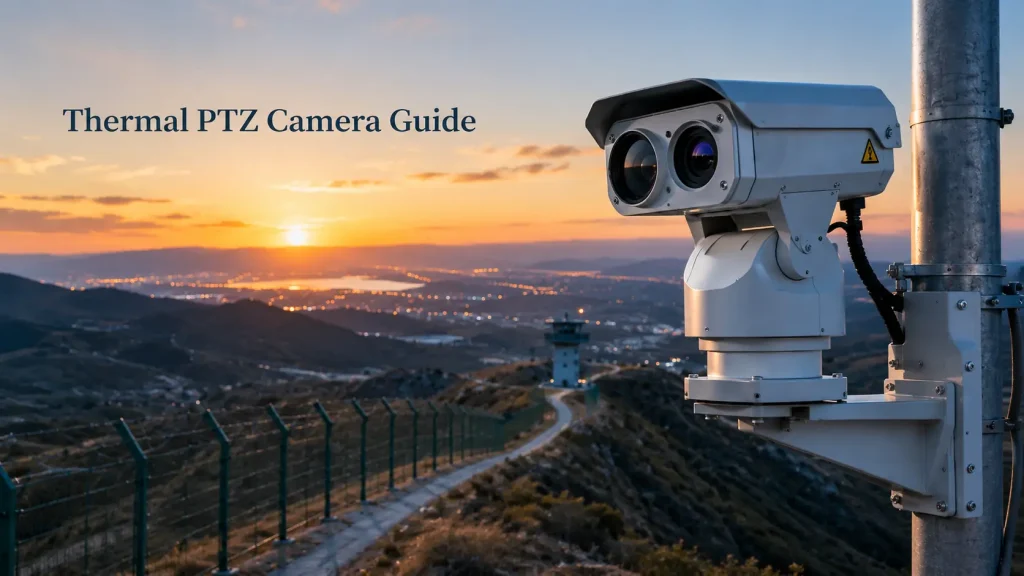
Une caméra PTZ thermique combine l'imagerie thermique avec des fonctions de panoramique, d'inclinaison et de zoom télécommandées. Pour un projet de surveillance extérieure au-delà de 150 m, la caméra PTZ thermique optimale est celle dont la configuration est adaptée à la cible, au champ de vision, au terrain, aux conditions météorologiques, au mode de contrôle et à la tâche de vérification en lumière visible.
La décision d'achat commence par la nature du travail. Les sites frontaliers, les sous-stations électriques, les patrouilles routières et les sites forestiers nécessitent chacun un plan de surveillance et un processus d'intervention différents.
Qu'est-ce qu'une caméra PTZ thermique ?
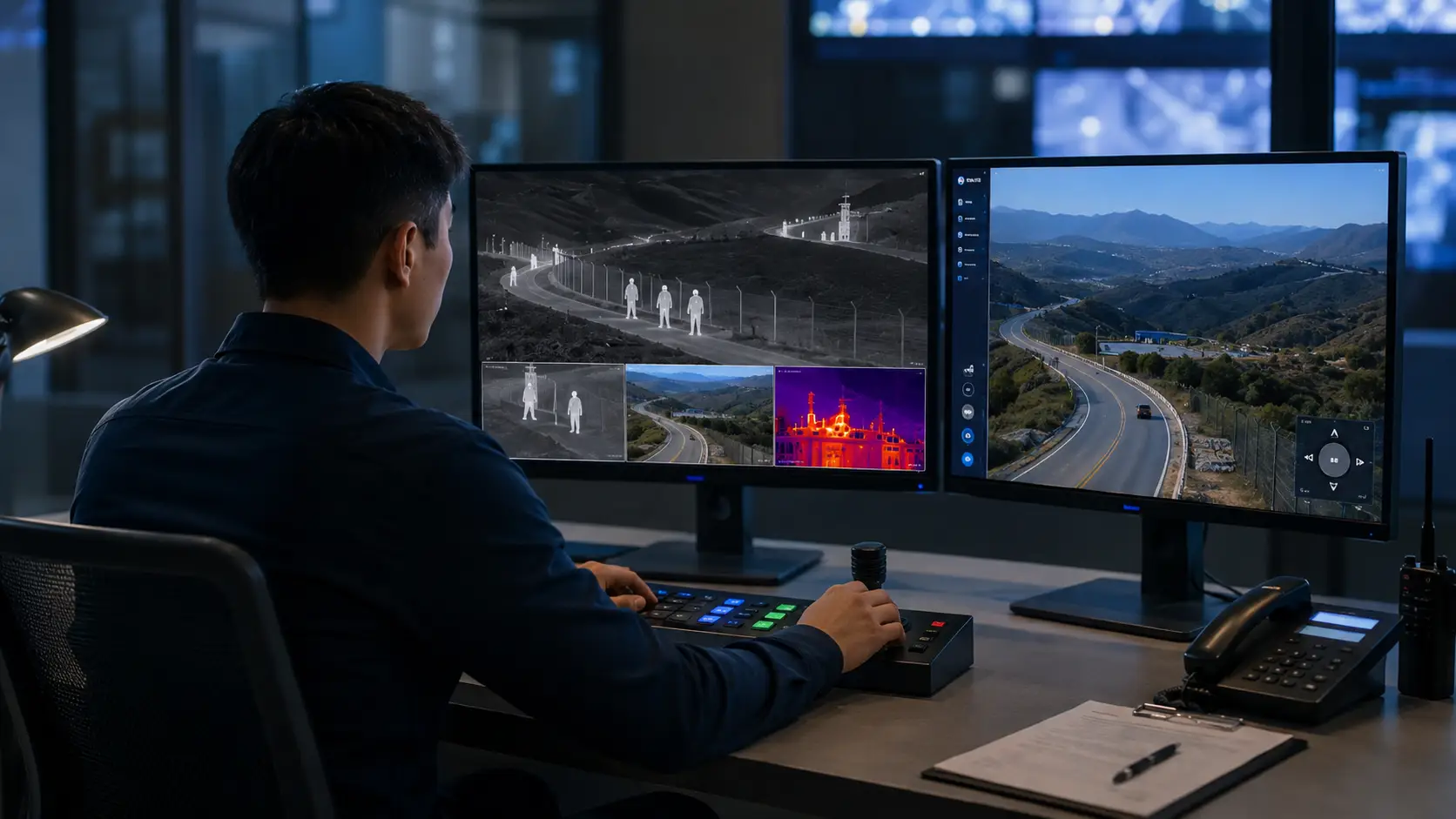
Une caméra thermique PTZ forme une image à partir de l'énergie infrarouge émise par les objets. Son mécanisme PTZ permet de déplacer la caméra horizontalement et verticalement, puis d'orienter l'objectif vers une zone d'intérêt. Les opérateurs peuvent ainsi scanner une zone extérieure, sélectionner une position prédéfinie et diriger la caméra vers le lieu d'une alarme depuis un poste de contrôle.
L'imagerie thermique permet la détection même en cas de faible luminosité. La détection, la reconnaissance et l'identification utilisent différents seuils de détail d'image. La taille de la cible, l'objectif, l'atmosphère, la hauteur de montage et les conditions de test influent sur chaque résultat.
Comment l'imagerie thermique détecte les cibles extérieures
L'imagerie thermique révèle les contrastes de température d'une scène. Les personnes, les véhicules, les équipements et le terrain peuvent générer des variations de chaleur, offrant ainsi à l'opérateur une méthode supplémentaire pour explorer une zone extérieure de nuit ou par luminosité changeante. La qualité de l'image reste toutefois tributaire de l'objectif, du détecteur, du contraste de température de la cible, des conditions atmosphériques et d'une visibilité directe.
À titre d'exemple au niveau du modèle, voir Shuoxin caméra PTZ d'imagerie thermique bispectrale à longue portée Ce détecteur à oxyde de vanadium non refroidi offre une résolution de 640 x 512 pixels, une taille de pixel de 12 µm, une bande passante de 8 à 14 µm et une lentille thermique de 30 à 150 mm. Ces caractéristiques correspondent au modèle WL-TX30-HD-RCX. Elles ne garantissent pas une portée de détection, de reconnaissance ou d'identification pour tous les projets.
Qu’apporte le mouvement PTZ à la surveillance thermique ?
La surveillance extérieure à longue portée repose sur la couverture des caméras et un contrôle précis et reproductible. Les fonctions de panoramique, d'inclinaison, les préréglages et les trajectoires de suivi permettent une observation planifiée d'un périmètre, d'une voie d'accès, d'un corridor de transmission ou d'une crête.
Le modèle WL-TX30-HD-RCX offre une rotation panoramique continue à 360°, une inclinaison de +90° à -90°, 256 positions prédéfinies et huit trajectoires de suivi. La conception du système doit définir les vues visualisées, les déclencheurs de réponse et l'enregistrement des événements.
Quand une caméra PTZ thermique est-elle adaptée à un projet à longue portée ?
Cet article considère une distance d'application minimale de 150 m. Avant de choisir une caméra, il est conseillé de cartographier les voies d'accès, les zones sans visibilité, la taille de la cible, la position de montage, l'alimentation, les communications et la visibilité.
Sécurité des frontières et des grands périmètres
Les projets de surveillance des frontières et des périmètres ouverts utilisent un point d'observation pour scanner une vaste zone extérieure. Il convient d'enregistrer les reliefs, la végétation, les structures, les conditions météorologiques saisonnières, les itinéraires des cibles et la ligne de visée complète. Une fiche de mesure de portée requiert le type de cible, la configuration de l'objectif, les conditions atmosphériques et le résultat d'image souhaité.
Centrales électriques, sous-stations et champs pétrolifères
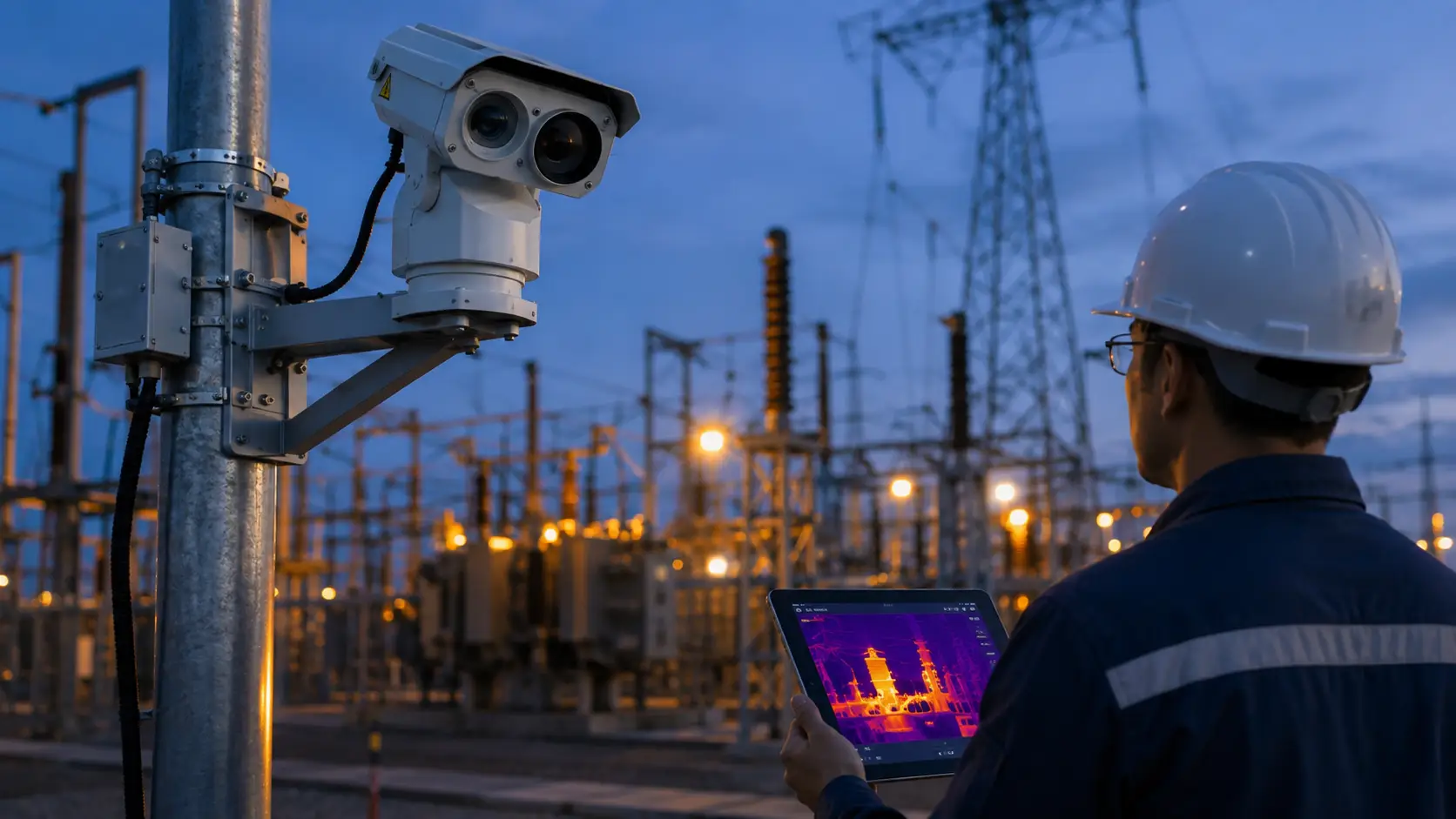
Les sous-stations, les lignes électriques, les champs pétroliers et les longs pipelines présentent des voies d'accès exposées et des équipements dispersés. L'analyse de sélection doit prendre en compte les vibrations, la charge du vent, la température, la protection du boîtier, l'accessibilité pour le nettoyage, l'alimentation électrique, le tracé du réseau et la maintenance. Le modèle WL-TX30-HD-RCX est conforme à la norme IP66, fonctionne de -35 °C à +55 °C et est équipé d'un essuie-glace, d'un vitrage chauffant, du dégivrage et du désembuage. Ces caractéristiques doivent être validées en fonction des conditions locales et des exigences d'installation.
Routes, véhicules de police, forêts et zones reculées
La surveillance des routes et autoroutes nécessite une planification prenant en compte les virages, les pentes, l'éblouissement, le sens de circulation et les points de montage. Les véhicules de police ajoutent la gestion de l'alimentation électrique et des vibrations. Les sites forestiers et isolés ajoutent la gestion du terrain, de l'alimentation électrique, de la couverture de communication et de l'accès pour la maintenance. Définissez la procédure à suivre par l'opérateur suite à un événement thermique, puis sélectionnez la configuration correspondante.
Imagerie thermique et zoom en lumière visible : que faut-il spécifier ?
L'imagerie thermique facilite la recherche par la chaleur. Un canal de lumière visible fournit des détails sur la scène lorsque les conditions d'éclairage et atmosphériques le permettent. Une conception bispectrale intègre ces deux fonctions dans un seul système PTZ.
| Question de sélection | Pourquoi c'est important | Que vérifier sur la page officielle du modèle |
|---|---|---|
| Quelle cible l'opérateur doit-il trouver ? | Le type de cible et la tâche définissent les exigences en matière de détails de l'image. | Détecteur thermique, lentille thermique et critères de test du projet. |
| Quels détails de la scène sont nécessaires après la détection ? | La vérification visuelle dépend du canal visible, de l'optique, de la lumière et de l'atmosphère. | Capteur visible, distance focale, zoom optique et champ de vision. |
| Quels secteurs nécessitent une observation répétée ? | Le positionnement PTZ répétable prend en charge les analyses de routine et la réponse aux alarmes. | Plage de panoramique et d'inclinaison, préréglages, trajectoires de suivi et fonctions de positionnement. |
| Comment la caméra se connectera-t-elle au système ? | Les interfaces de contrôle et vidéo ont une incidence sur le travail d'intégration. | Protocoles, compression, interfaces de contrôle et exigences réseau. |
Rôles de détection et de vérification visuelle
Utilisez le canal thermique pour la recherche et le canal visible pour obtenir les détails de la scène souhaités. Les tests d'acceptation doivent préciser la cible, la distance, l'arrière-plan, les conditions météorologiques, la tâche d'imagerie et l'action de l'opérateur. La WL-TX30-HD-RCX est équipée d'un capteur CMOS à balayage progressif de 1/2,8 pouce, d'une résolution de 1920 x 1080 pixels effectifs, d'une plage focale de 6,1 à 317 mm, d'un zoom optique 52x et d'un zoom numérique 16x.
Choix de l'objectif, du capteur et du champ de vision
Un champ de vision large couvre une plus grande surface. Un champ de vision étroit concentre les détails sur un secteur plus restreint. Cartographiez la limite extérieure, l'altitude, les itinéraires cibles et les secteurs de vérification visuelle avant de spécifier les préréglages de l'objectif thermique, de l'optique visible et du PTZ.
Quelles sont les caractéristiques extérieures les plus importantes ?
Les performances en extérieur dépendent de la caméra et de la configuration du site. Le tableau distingue les champs de modélisation des champs liés à l'ingénierie du site.
| Domaine d'exigence | Exemple de modèle officiel | Confirmation du projet |
|---|---|---|
| Imagerie thermique | Détecteur non refroidi 640 x 512 et objectif thermique 30-150 mm | Tâche cible, conditions de test et résultat DRI requis |
| Fonctionnement PTZ | Rotation panoramique continue à 360 degrés, inclinaison de +90 à -90 degrés, préréglages et trajectoires de suivi | Séquence de balayage, zones d'alarme et commandes de l'opérateur |
| Protection de l'environnement | IP66, -35 à +55 °C, essuie-glace, pare-brise chauffant, dégivrage, désembuage | Météo locale, charge de montage, drainage et accès aux services |
| Intégration | H.265, H.264, MJPEG, ONVIF Profile S et G, contrôle Web ou RS485 | politique de compatibilité, de bande passante, de conservation et de cybersécurité du VMS |
Portée, préréglages et contrôle PTZ
Les itinéraires fixes conviennent aux analyses répétées ; les préréglages aux points de contrôle définis ; la commande manuelle permet un suivi par l’opérateur. La page produit officielle mentionne les profils ONVIF S et G, la commande web et la commande RS485. Veuillez vérifier la plateforme, le réseau, les autorisations et la procédure de la salle de contrôle.
Boîtier, température, alimentation et maintenance
Les spécifications pour une utilisation extérieure doivent préciser la position de montage, la source d'alimentation, la mise à la terre, le cheminement des câbles, l'accès pour le nettoyage et la fréquence d'inspection. Le modèle WL-TX30-HD-RCX est compatible avec une alimentation 12 V CC pour véhicules et propose des amortisseurs de suspension en option. Les projets concernant les véhicules doivent prendre en compte l'architecture électrique, le support, l'environnement vibratoire, la protection des câbles et l'affichage opérateur.
Planification vidéo, réseau et stockage
La page officielle du modèle répertorie les codecs H.265, H.264 et MJPEG. Le choix du codec dépend de la plateforme, de la liaison de transmission, de la résolution, de la fréquence d'images, de la politique d'événements et de la durée de stockage. Définissez l'enregistrement, les clips d'événements, les exportations, les autorisations, la surveillance de l'état et la conservation avant de calculer la capacité. Guide de portée des caméras thermiques DRI préconise un examen distinct des conditions d'essai.
Comment choisir la meilleure caméra thermique PTZ ?
Commencez par un énoncé de tâche précisant la zone extérieure, la distance minimale, la cible, la tâche d'imagerie, l'action de réponse, le point de montage et le calendrier de fonctionnement. Évaluez la visibilité et l'exposition depuis la position de la caméra. Spécifiez ensuite les rôles thermique et lumière visible, l'optique, la couverture PTZ, le contrôle, le boîtier, l'alimentation, le réseau et l'enregistrement. Demandez par écrit le modèle sélectionné, ses options, ses interfaces et les conditions de test.
Conclusion : Élaborer le cahier des charges en fonction de la tâche extérieure
La meilleure caméra thermique PTZ est conçue pour des applications extérieures longue portée. Elle combine détection thermique, détails en lumière visible, contrôle PTZ, protection de l'environnement et intégration système. Pour une surveillance au-delà de 150 m, les documents du projet doivent préciser la zone d'observation et les tests de réception avant le choix d'un modèle.
Shuoxin présente la WL-TX30-HD-RCX comme une caméra PTZ thermique bispectrale longue portée avec canaux thermique et visible, mouvement PTZ, protection IP66 et compatibilité ONVIF. Veuillez soumettre la configuration du site, la distance cible, les conditions de montage, la disponibilité de l'alimentation et des communications, les intégrations requises et les critères d'acceptation via exigences relatives aux projets PTZ à longue portée demander une analyse du modèle et de la configuration.
FAQ
Q1 : Qu'est-ce qu'une caméra PTZ thermique ?
A : Une caméra thermique PTZ forme des images à partir de l'énergie infrarouge et utilise des commandes motorisées de panoramique, d'inclinaison et de zoom. Elle permet la numérisation à distance et l'observation ciblée d'une zone extérieure.
Q2 : Quelle est la portée de surveillance d'une caméra thermique PTZ ?
A : Un projet peut utiliser une caméra thermique PTZ au-delà de 150 m si le site et sa configuration le permettent. La distance réelle de détection, de reconnaissance et d'identification nécessite des conditions de test définissant la cible, l'objectif, l'atmosphère, l'arrière-plan et le résultat d'image souhaité.
Q3 : Une caméra PTZ thermique a-t-elle besoin d'un zoom en lumière visible ?
A : Un canal de zoom en lumière visible facilite l'interprétation de la scène lorsque le projet nécessite des détails visuels après la détection thermique. Le capteur et le zoom optique requis dépendent de la cible, de la distance, de la luminosité et des critères d'acceptation.
Q4 : Quelles sont les spécifications importantes des caméras thermiques PTZ pour la surveillance des sous-stations ou des frontières ?
A : Commencez par examiner le détecteur thermique et la lentille, le canal visible, la couverture PTZ, l'indice de protection du boîtier, la plage de températures, l'alimentation, les interfaces de commande et l'intégration réseau. Ensuite, vérifiez l'emplacement de montage, la ligne de visée, l'exposition aux intempéries, le processus d'intervention et les normes du site.
Q5 : Une caméra thermique PTZ peut-elle contribuer à la prévention des incendies de forêt et à l'observation de zones distantes ?
A : Une caméra thermique PTZ peut faciliter la surveillance extérieure des forêts et des zones isolées, à condition que le projet définisse son objectif, son champ de vision, sa source d'alimentation, sa liaison de communication et sa procédure d'intervention. La portée de mesure des incendies, les seuils d'alarme et la distance de détection nécessitent des données de modélisation validées et des essais sur site.