
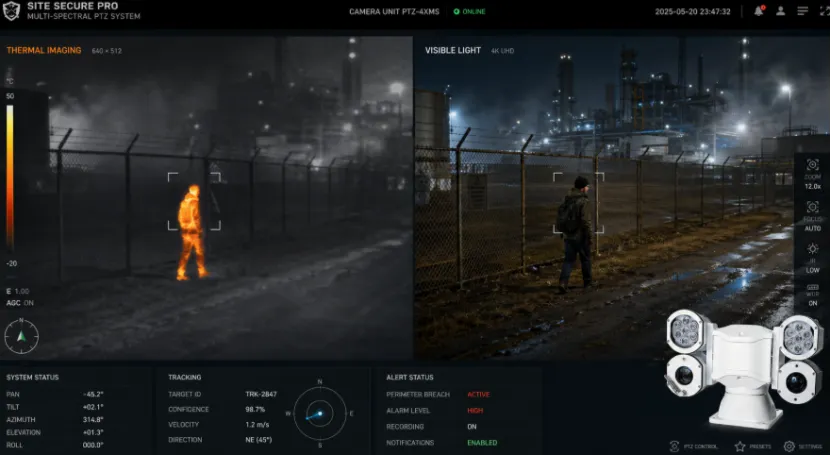
En regardant un Caméra PTZ multispectrale vs caméra PTZ thermique Tout se résume à une question essentielle : souhaitez-vous simplement repérer une cible ? Ou devez-vous absolument savoir qui elle est, la suivre et obtenir des preuves irréfutables ?
Une caméra thermique PTZ est très performante dans les endroits sombres, le brouillard, la fumée ou les grands espaces ouverts. Elle détecte la chaleur plutôt que la lumière, ce qui la rend idéale pour repérer rapidement les problèmes. Cependant, les agents de sécurité ont parfois besoin de plus d'informations. Est-ce un ouvrier près de la clôture ? Un camion ? Ou peut-être un simple cerf ? L'imagerie thermique seule ne permet pas toujours d'obtenir ces détails.
Une caméra PTZ multispectrale résout ce problème. Elle agit comme une paire d'yeux supplémentaires concentrée sur un point précis. Elle combine l'imagerie thermique à l'imagerie en lumière visible classique. Elle intègre également un éclairage infrarouge, une vision nocturne laser et une lumière blanche puissante. Ajoutez à cela un zoom optique et un contrôle panoramique/inclinaison, et vous obtenez un outil performant. Cette combinaison permet de gagner un temps précieux dans les zones à risque. Dans le domaine de la sécurité, chaque seconde compte.
Qu'est-ce qu'une caméra PTZ thermique ?
Il s'agit d'une caméra de surveillance mobile qui détecte la chaleur. Les personnes, les voitures, les animaux et les machines émettent tous une signature thermique. Elle les capte. Elle n'a besoin ni des lampadaires ni même de la lune pour fonctionner.
Comment l'imagerie thermique vous aide à voir dans l'obscurité totale
L'imagerie thermique détecte les infimes variations de température et les convertit en vidéo. C'est pourquoi une caméra PTZ thermique fonctionne parfaitement dans l'obscurité totale. Elle est également performante même en cas de fumée épaisse, de brouillard ou de violentes tempêtes. Pour la sécurité périmétrique, c'est un atout considérable. Une caméra classique ne montrerait probablement que du noir à 2 heures du matin, tandis qu'une caméra thermique identifiera clairement une personne s'approchant de votre mur. Elle est particulièrement adaptée aux champs pétrolifères, aux grands entrepôts et aux longues routes. Elle permet même de repérer les incendies et les cibles dissimulées par mauvais temps.
Points faibles des caméras thermiques PTZ
Ces caméras sont excellentes pour la détection de cibles. Cependant, elles peinent à les identifier précisément. Elles signalent la présence d'une personne en mouvement, mais ne permettent pas de distinguer la couleur des vêtements ni les traits du visage. Elles ne peuvent pas non plus lire les plaques d'immatriculation. Ainsi, si vos agents souhaitent simplement savoir si quelqu'un a franchi une ligne, la détection thermique est suffisante. Mais si vous devez identifier précisément l'auteur du franchissement, la chaleur seule ne suffit pas.
Qu'est-ce qu'une caméra PTZ multispectrale ?
Une caméra PTZ multispectrale utilise simultanément plusieurs objectifs ou canaux différents. Elle vous offre littéralement plusieurs façons d'observer la même scène.
Pourquoi les modes d'imagerie multiples sont importants
Une caméra de sécurité multispectrale utilise d'abord l'imagerie thermique pour repérer une cible. Ensuite, elle passe à la lumière visible, à l'infrarouge, au laser ou à la lumière blanche pour examiner les détails. C'est le principal atout d'une caméra PTZ dotée de l'imagerie thermique et de la lumière visible.
Imaginons que la caméra thermique détecte une forme chaude près d'un portail verrouillé. La caméra visible effectue alors un zoom avant. En cas de très faible luminosité, la vision nocturne infrarouge ou laser permet d'obtenir une image plus nette. Besoin de couleur ? Un voyant blanc s'allume. De plus, la fonction PTZ permet à l'utilisateur de suivre la personne au lieu de fixer un mur vide.
La caméra PTZ thermique multispectrale longue portée Shuoxin répond parfaitement à ces exigences. Elle combine imagerie visible IP HD et imagerie thermique. Elle est dotée d'un éclairage laser, d'une vision nocturne infrarouge ou à lumière blanche et est compatible ONVIF. Elle dispose également de fonctions de désembuage et de dégivrage, ainsi que d'amortisseurs de chocs pour véhicules (en option). Les forces de l'ordre l'utilisent pour leurs patrouilles mobiles. Les pompiers l'installent pour la gestion des interventions d'urgence en cas d'incendie. Elle est également idéale pour les patrouilles routières mobiles et l'inspection de véhicules spéciaux.
Caméra PTZ multispectrale vs caméra PTZ thermique : quelles sont les principales différences ?
Les deux systèmes protègent efficacement votre propriété, mais ils fonctionnent différemment. L'un se contente de détecter la chaleur, tandis que l'autre combine chaleur, lumière, zoom et suivi pour une double vérification.
Détection vs Identification
A caméra thermique pour la détection de périmètre On se demande : « Y a-t-il quelque chose là-bas ? » Une caméra multispectrale pose les questions plus difficiles : « Qu'est-ce que c'est ? Où cela se dirige-t-il ? Devons-nous envoyer des gardes immédiatement ? »
Cette deuxième étape évite bien des tracas aux acheteurs. Les fausses alertes mobilisent inutilement votre personnel. Les vidéos floues compliquent la rédaction des rapports. L'association d'une caméra visible et d'une caméra thermique permet de constituer un dossier de preuves beaucoup plus solide.
Performances de vision nocturne
Une caméra de sécurité conçue pour l'obscurité totale peut se contenter de la vision thermique. Mais une caméra PTZ à vision nocturne longue portée, utilisant la vision thermique, infrarouge et laser, offre des options plus complètes.
Consultez les spécifications du produit Shuoxin. Il est équipé d'un laser 808 nm importé avec zoom synchrone. L'angle est réglable, avec une portée laser optionnelle de 500 m ou 800 m. Il offre une vision nocturne infrarouge d'une portée de 120 à 150 mètres, ainsi qu'une vision nocturne à lumière blanche d'une portée de 50 à 80 mètres.
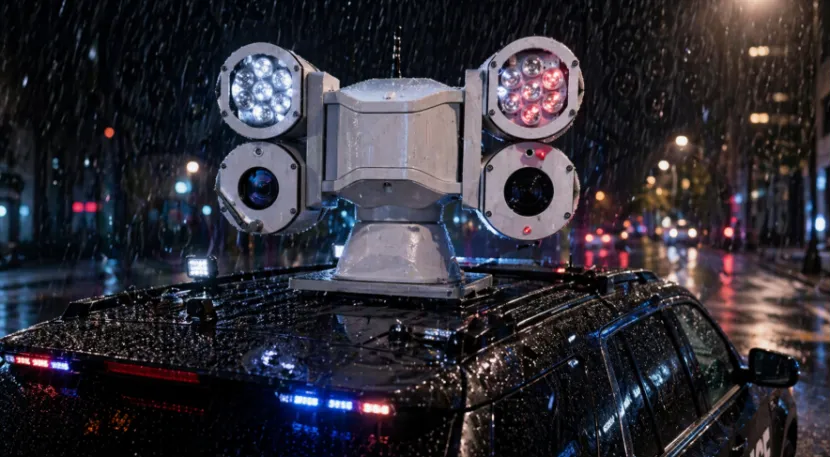
Avoir toutes ces options est extrêmement pratique. Imaginez une voiture de patrouille routière stationnée dans une rue sombre. La caméra thermique repère une personne au loin. La caméra infrarouge l'observe discrètement. Puis, le projecteur s'allume pour révéler son visage en couleur. C'est tout simplement efficace.
Surveillance à longue portée
Une caméra thermique PTZ pour la surveillance à longue portée détecte les menaces précocement. Cependant, une caméra PTZ longue portée un bon zoom optique permet de reconnaître la menace.
Shuoxin intègre une caméra IP HD avec zoom optique 33x et objectif de 5,3 à 175 mm. Une autre version propose un zoom optique 52x et un zoom numérique 16x. Celle-ci dispose d'une focale de 6,1 à 317 mm et d'un champ de vision téléobjectif très court. Pour les vastes zones, ce zoom n'est pas un simple atout : c'est indispensable pour obtenir une image nette à partir d'un point flou.
Suivi et couverture PTZ
PTZ signifie panoramique, inclinaison et zoom. Cela signifie que la caméra pivote, s'oriente vers le haut et vers le bas et effectue un zoom précis. C'est particulièrement important dans les grands espaces. Ces caméras gèrent facilement la surveillance à 360 degrés et le suivi automatique. ShuoxinL'équipement offre une rotation panoramique continue à 360 degrés et une inclinaison de +90° à -90°. Il mémorise 256 positions prédéfinies et gère 8 itinéraires de suivi. Cette flexibilité surpasse largement celle des caméras fixes.
Quand faut-il choisir une caméra PTZ thermique ?
Choisissez une caméra thermique PTZ si votre objectif principal est de repérer rapidement le danger dans des espaces vastes et sombres.
Principaux cas d'utilisation des caméras PTZ thermiques
Ces systèmes conviennent aux champs pétrolifères, aux usines chimiques et aux ports à fort trafic. Ils sont également indispensables dans les entrepôts, les forêts et les zones frontalières. Ces sites sont souvent exposés à une faible luminosité et à de longues clôtures. La pluie et le brouillard y sont fréquents, et la présence de gardiens est limitée. Les systèmes de surveillance thermique périmétrique repèrent facilement les franchissements de lignes. Ils se connectent à des caméras PTZ pour suivre les menaces. De plus, ils éliminent les fausses alertes en distinguant les véhicules, les personnes et les animaux sauvages. Si vous souhaitez éviter les angles morts, optez pour la technologie thermique.
Quand faut-il choisir une caméra PTZ multispectrale ?
Optez pour une caméra PTZ multispectrale si la simple observation ne vous suffit pas. Choisissez-la lorsque vous avez besoin de preuves irréfutables, d'un suivi fluide et d'une vidéo d'une netteté exceptionnelle.
Cas d'utilisation optimaux pour les caméras PTZ multispectrales
Une caméra PTZ multispectrale pour la surveillance mobile est extrêmement performante sur les véhicules de police. Les camions de commandement des pompiers et les patrouilles routières l'apprécient également beaucoup. Le travail sur véhicule est exigeant : le matériel est soumis à des chocs importants, des virages serrés, la poussière et la pluie. Les températures varient rapidement.
Ici, les amortisseurs de véhicule optionnels et la protection IP66 font toute la différence. Un essuie-glace, un système antibuée et un système de dégivrage intégrés maintiennent l'objectif propre. Shuoxin ajoute également la compatibilité ONVIF, ce qui simplifie grandement la connexion aux anciennes plateformes vidéo. Si vous comparez un caméra PTZ montée sur véhicule et une caméra thermique PTZ embarquée, multispectrale, pour plus de performance. Le tout dans un seul coffret.
Pourquoi Shuoxin correspond-il à ce type de projet de sécurité ?
Shuoxin conçoit des systèmes de vidéosurveillance robustes pour les environnements extérieurs difficiles. Leurs équipements sont conçus pour résister aux situations les plus extrêmes, et pas seulement aux tests en intérieur. Leur caméra PTZ multispectrale combine imagerie thermique et zoom visible. Elle intègre la vision nocturne laser, l'infrarouge et un éclairage blanc puissant. Grâce à ses composants robustes, sa compatibilité ONVIF et sa protection contre les intempéries, elle est tout simplement exceptionnelle. Les entreprises à la recherche d'équipements fiables pour les patrouilles de police, les interventions d'urgence ou la sécurité périmétrique trouveront leur bonheur. Détectez plus tôt, vérifiez plus rapidement et obtenez des preuves plus solides.
Lequel est le meilleur pour la sécurité ?
Pour le repérage de base, l'imagerie thermique est imbattable. C'est une caméra thermique longue portée fantastique pour les environnements sombres et difficiles.
Pour les missions de sécurité les plus exigeantes, une caméra PTZ multispectrale est la solution idéale. Elle repère, identifie et suit les intrus. La météo change rapidement. Le brouillard arrive en un clin d'œil. Un individu se cache dans les buissons. La réalité est imprévisible. Ainsi, dans le duel entre caméra PTZ multispectrale et caméra PTZ thermique, privilégiez la caméra thermique pour obtenir des alertes précoces. Optez pour la multispectrale pour une surveillance complète.
FAQ
Q1 : Une caméra PTZ multispectrale est-elle meilleure qu'une caméra PTZ thermique ?
R : Cela dépend de vos besoins. Une caméra PTZ thermique est idéale pour la détection de cibles dans l'obscurité ou par mauvais temps. Mais une caméra PTZ multispectrale est préférable si vous avez également besoin d'identifier la cible, de la suivre et d'obtenir une preuve visuelle claire.
Q2 : Quelle est la différence entre l’imagerie thermique et la vision nocturne infrarouge ? R : L’imagerie thermique détecte la chaleur émise par les personnes et les véhicules. Elle fonctionne dans l’obscurité totale. La vision nocturne infrarouge, quant à elle, agit comme une lampe torche invisible permettant à la caméra de voir dans le noir. Elle nécessite un éclairage supplémentaire pour fonctionner.
Q3 : Quelle est la meilleure caméra PTZ pour la sécurité périmétrique ?
A : La meilleure caméra PTZ pour la sécurité périmétrique doit être équipée d'une détection thermique et d'un zoom optique. Elle doit également offrir un suivi PTZ précis, la détection d'intrusion, la réduction des fausses alarmes et une vérification vidéo nette.
Q4 : Une caméra PTZ multispectrale peut-elle être utilisée pour les véhicules de police ?
R : Oui ! Une caméra PTZ multispectrale pour véhicules de police est idéale. Elle combine imagerie thermique, zoom visible, vision nocturne laser, éclairage infrarouge et un système de contrôle PTZ robuste monté sur véhicule pour une surveillance mobile en conditions difficiles.
Q5 : Pourquoi choisir une caméra PTZ avec imagerie thermique et lumière visible ?
A: Une caméra PTZ avec imagerie thermique et lumière visible offre le meilleur des deux mondes. La partie thermique repère la cible. La partie visible capture les détails et enregistre des preuves plus nettes.